- City Fajr Shuruq Duhr Asr Magrib Isha
- Dubai 04:20 05:42 12:28 15:53 19:08 20:30

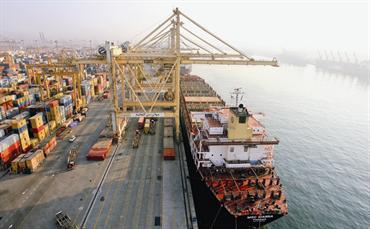
A file picture of Jebel Ali port. Shipping industry saw a marginal revival in July and August. (EB FILE)
Shipping companies in Dubai expect the pre-Ramadan momentum in the shipping industry to continue well into the last quarter of 2009 and early 2010 on the back of increased demand in Asia and a possible revival of the local real estate sector.
Shipping, which remained in the doldrums for most of 2009, saw a marginal revival in July and August propelled by pre-Ramadan shopping across the world.
"We expect freight volumes to remain strong in the next three months because of an increasing demand in Asia," said Robbert van Trooijen, Chief Executive for West and Central Asia at shipping company Maersk.
An executive at Stalco Dubai said the shippers in Dubai are waiting for a revival in the real estate sector. "We expect the demand for construction materials to improve next year as the real estate sector garners strength," he said.
Volume of freight being shipped into and outside the GCC in container ships has dropped by more than 10 per cent as compared to the same period the last year, Jorn Hinge, President and CEO of United Arab Shipping Company (UASC), a regional shipping firm, recently told Emirates Business.
The figures replicate the worldwide industry trend, said Hinge.
Not only has the global recession impacted the freight volumes, the sector has been facing additional trouble because a significant number of new ships have come online this year. These ships were ordered two to three years when demand for consumer goods was at its peak.
An astonishing number of ships – "about half of the current container ship fleet" are currently on the order books, said Hinge.
This has put a downward pressure on freight rates and van Trooijen said raising freight rates remained the biggest challenge for shipping companies today.
According to a recent report by Howe Robinson Shipbrokers (HRS), the year-on-year demand growth is expected to run at a negative 7.5 per cent in 2009. It predicted a growth of five per cent in 2010 and a long-term average of nine per cent growth thereafter.
However, 2009 so far has been extremely challenging. "The difficulties besetting the containership market are well documented. Chronic oversupply has coincided with the worst demand side performance ever recorded.
"Freight rates, charter rates, asset prices and profitability have been devastated. The short-term outlook is one of widespread pessimism," said the HRS report.
At the same time it is likely that demand may rebound more quickly than previously expected as the downward multipliers reverse direction and stimulate market activity, noted HRS.
HRS analysts said they expect a V-shaped recovery of freight volumes in the coming days. "Previous downturns have been followed by a standard V-shaped recovery. This resulted from restocking. The recent devastation in cargo flows has, in large part, been due to savage destocking which is now complete and inventory levels are at minimal levels. If demand only stabilises, stock levels will need to increase and once demand starts to grow there should be a push to re-stock. This could well signal another V."
About "half of the current containership fleet" is currently on the order books of shipping yards, said Hinge.
Van Trooijen said the shipping industry that has suffered volatility like most business sectors is now awaiting stability and it requires "frequent orders in small quantities" to create a stable demand picture, expecting that most companies are careful to avoid running large inventories again, after their experience with the disappointing retail sales at the end of 2008.
Still, he pinned hopes for revival of the sector on positive growth signals from the Asia-Europe shipping route, and on the emerging orders for Christmas.
Low freight rates key challenge for shipping
Identifying the abysmally low freight rates as the primary challenge that the shipping sector is facing today, Dubai-based shipping company executives said these rates must rise by about $2,000 (Dh7,346) per container for the firms to sustain themselves. Freight volumes, on the other hand, have improved recently, they pointed out.
Freight rates dropped by close to 50 per cent from a peak in July 2008 (when rates were propelled by the high fuel prices) to January 2009. Top shipping company officials said that as of now, this rate must rise by at least 15 per cent from the prevailing levels to ensure a sound economic performance of firms in the third and the fourth quarter of 2009.
"Low freight rates remain our industry's main challenge," said Robbert van Trooijen, Chief Executive of Maersk West and Central Asia Limited. Van Trooijen argued that the shipping industry reacted "irrationally" to the economic downturn and that it is "too fragmented" to make a sustained effort to ensure a rise in freight rates.
"The industry reacted far too soon to the economic depression," he said. "That was irrational," he added.
Another Dubai-based shipping company official supported van Trooijen's comments and added that the large number of players in the shipping industry has contributed to the worsening of the situation. "It's relatively easy to open a shipping company," he said.
Unlike the logistics services sector where the three largest companies command more than 60 per cent of the global trade, the shipping industry is deeply fragmented and the three largest companies account for just 40 per cent of the global market share.
Citing that present freight rates need to improve for the industry to return to healthy returns on capital, van Trooijen said some shipping companies in India have been charging as low as $300 a container for shipping to Europe. Shipping companies do not publicly disclose their freight rates as a business strategy.
Even though the freight volumes have been rising particularly in the Asia to Europe route, van Trooijen said that idle shipping capacity coming back online could again distort the supply-demand balance.
"Shipyards are still building ships. Orders were not cancelled because of the penalties involved, despite the fact that the economic returns on these new vessels would be very unsatisfactory," he said.
Keep up with the latest business news from the region with the daily Emirates Business 24|7 newsletter. To subscribe to the newsletter, please click here.
 Follow Emirates 24|7 on Google News.