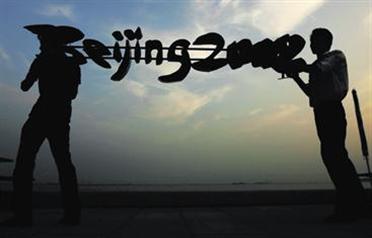
The Olympic Games will open in Beijing today following years of preparation to build venues and infrastructure befitting the greatest sporting event on the planet.
With the eyes of billions of people around the world focusing on the Chinese capital over the next two weeks, the country – following a no-expenses-spared policy – has invested an estimated $42 billion (Dh154.26bn) on sports arenas and transport, triple the amount spent on the 2004 Games in Athens.
Terms such as the Bird's Nest, which describes the distinctive shape of the $500 million National Stadium, and the Water Cube, used for the $100m Aquatics Centre, will become synonymous with the 2008 Games.
The event will be the most high-profile public gathering yet in communist China and has been termed by some as a coming out exercise for the country. However, as major sporting events go, Beijing did host the Asian Games in 1990, and the Olympic Sports Centre Stadium, built for that event, has been renovated, along with 10 other venues, for these Olympics.
Last week, Beijing Organising Committee (BOCOG) President Liu Qi told the International Olympic Committee that Beijing "will write a new page in the development of the Olympic movement".
A total of 12 new venues will be used in the city, along with a further 20 existing or temporary venues, and eight in other parts of the country – Qingdao, Hong Kong, Tianjin, Shanghai, Shenyang and Qinhuangdao. China is keen to keep the venues in use after the games and not repeat mistakes made by Montreal, Canada, whose 1976 games were a financial disaster that it only recently finished paying for.
"The majority of the money spent accounts for permanent infrastructure, stuff that we think will actually be productive for the Chinese economy in the long term," said Andy Rothman, an economist with brokerage CLSA in Shanghai. "The Chinese government is in very good financial shape. It can clearly afford to spend all this money on the Olympics and on other infrastructure."
Stadiums such as the Capital Indoor Stadium – the official volleyball venue – built in 1968, have been renovated to add 30 years to its life, with a skating ground underneath movable planks to ensure future use.
After the Olympics, Peking University Gymnasium, the official table tennis venue, will be converted into a comprehensive facility for table tennis, handball, basketball, badminton, volleyball, indoor football and gymnastics competitions, as well as special sports training.
The National Stadium will also continue as Beijing Guoan Football Club's ground with the capacity reduced after the Games from 91,000 to 80,000.
Organisers have tried to incorporate environmentally friendly architecture in the venues and have dubbed the games the "Green Olympics".
The Bird's Nest may not be built out of twigs – in fact it uses 35 kilometres of steel – but is equipped with more than 1,100 solar panels that will help defer energy costs and coal usage, eventually projected to save in excess of 900 tonnes of coal over their 25-year lifespan.
After the Olympics, the power produced by the solar panels will be merged into the city's power grid and provided to families when there are no sport events on going.
The stadium's steel roof, a single 330m by 220m structure, weighing 45,000 tonnes, is clad with a series of ETFE (ethylene tetrafluoroethylene) panels.
ETFE, a transparent plastic related to Teflon, is taking the place of glass and other plastics in today's buildings. It is 99 per cent lighter than most glass, transmits more light, is a better insulator, and costs far less to install. It is also recyclable, self-cleaning and far tougher, with an estimated lifespan of 50 years.
This has also been used in the 17,000-seat Water Cube, which will have 100,000 m sq of blue ETFE panels.
The Bird's Nest also claims that 70 per cent of its waste water supply is recycled.
"The recycled water will be used to wash the racetrack and water the plants around the venue," said Li Jiulin, chief engineer of the stadium's construction.
In the Science and Technology University Gymnasium, which will host judo and taekwondo matches, 148 light conductors, each eight metres long, help transmit 80 per cent of the sunlight into the gym, enough for the athletes' training or physical education classes.
The pollution in Beijing has been widely reported to be stifling and an attempt has been made to eradicate it with factories' output curtailed. "The Olympics is a world event and world-class architecture has been delivered for it," said Rory McGowan, director of the Beijing office of global design engineers Arup.
(With input from Beijing Olympic website and Xinhua News Agency)
 Follow Emirates 24|7 on Google News.