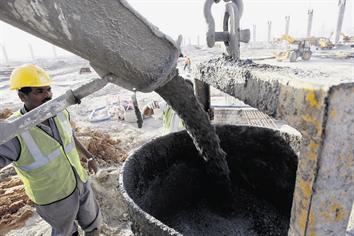
The GCC's annual cement capacity will cross the 120 million tonnes mark by 2011, glutting the market with the product, according to a recent report from Global Investment House (GIH). The GCC project market, which rose from $300 billion (Dh1.1 trillion) in 2004 to $2.67trn in Q1 of 2009, declined to $2.1trn as of Q3. "Within the planned projects, 25 per cent have been put on hold. As per our calculations, even if 75 per cent projects continue as per plan and of these even if 40 per cent are construction related, then it would result in an annual average cement demand of 90.6 million tonnes till 2017," said the report. "Whereas with less projects continuing because of the economic uncertainty, the demand for cement has declined because of which the utilisation rate of cementers has gone down to an average of 75 per cent as of 9M-2009. With the continuing capacity buildup and less demand we expect the utilisation rates to fall in the range of 65-70 per cent until the project market picks up." Meanwhile, the net profit of the GCC cement sector witnessed a decline of 18.7 per cent to $1.1bn in 9M-2009 as compared to $1.37bn in the corresponding period last year. "As per our previous expectations, outlook for the sector is still dicey as in Q2-2009 its net profit rose 46 per cent quarter-on-quarter while Q3 profit is down 50.6 per cent on a q-o-q basis," said the report. Average realisation prices as of 9M-2009 have declined on an average six per cent in GCC when compared with those of 2008 (see table). Countries with relatively stable prices are Saudi Arabia and Oman while the rest have witnessed a major fall. With capacity buildup continuing, further pressure on cementers is expected. "The only favourable thing is the focus of many cementers in the region to curtail their costs through multi fuel burners and by opening facilities near to raw material quarries. Most of the UAE cement companies are focusing more on these measures and we expect if the prices and utilisation rates continue to decline, more and more cementers would be focusing on cost control measures," said the report. Contract value declining Construction contracts are positively correlated with the projects activity in the region. GCC projects recorded a 3.1 per cent and 16.2 per cent decline on a year-on-year basis and during the period January-September 2009. Total value of projects awarded in the GCC reached $2.1trn in Q3-09 compared to $2.2trn during the same period a year ago. Construction contracts awarded in the GCC have reached $80.9bn in Q3-09 compared to $109.46bn in Q3-08, a 26.1 per cent decline. YTD from January-September 2009, contracts awarded declined 36.7 per cent from a total value of $127.86bn. The average contract awarded was $8.99bn from the beginning of the year to September 2009 as compared to $12.1bn during the same period a year ago. The months of January and July 2009 witnessed the largest construction contracts awarded in a single month, reaching $17.1bn in January and $24bn in July. Nine-month results Majority of the cement players announced their nine-month results for 2009. Out of the 24 listed cement companies, only three – Kuwait Portland Cement Company, Hilal Cement Company and National Cement Company did not announce their results. Net profit of the sector witnessed a decline of 18.7 per cent to $1.1bn in 9M-2009 as compared to $1.37bn in corresponding period last year. Debt levels of the sector have risen while equity eroded because majority of the companies suffered losses or because of losses on their investment portfolio. Debt levels also rose because majority of the companies are undergoing expansion for which they require leverage for funding. Prices under pressure GCC cement prices witnessed a decline of seven per cent during 9M-2009 as compared to those in 2008. Average cement prices dropped to $77.4 per tonne by Q3-09 compared to $83.2 per tonne in 2008. Prices in Kuwait and Qatar witnessed the highest decline at 16 per cent and 11.6 per cent, respectively. On a CAGR basis, Kuwait cement prices increased 14.8 per cent during the period 2003-2008, reaching an all time high of $100.4 per tonne in 2008. During the period 2003-2008, cement prices in Kuwait were highest in the GCC due to the fact that Kuwait was an importer of clinker and it transferred all its cost to the consumers. On the other hand, Saudi Arabia and Oman enjoyed a 3.1 per cent and 1.4 per cent increase in prices during the period January-September 2009. Saudi Arabia is gifted with a large land size and abundance of natural resources including oil, natural gas and limestone. Easy and cheap access helps Saudi companies produce at low prices and save on cost. Saudi cement prices reached $63.5 per tonne as of Q3-09. Due to the strong demand in Oman, companies shifted to importing cement in addition to the local production, thus cement prices are 6.9 per cent above the GCC average as of Q3-09. Average price in Oman reached $82.7 per tonne as