- City Fajr Shuruq Duhr Asr Magrib Isha
- Dubai 04:20 05:42 12:28 15:53 19:08 20:30

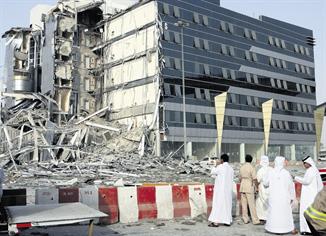
A team has been formed to investigate the building collapse. (EB FILE)
Concrete structures show warning signs of construction issues faster than steel structures, according to an industry expert.
Imad Al Jamal, Vice-Chairman of the Higher Technical Consultative Committee of the UAE Contractors' Association, was talking about the greater necessity of safety and security on construction sites after a building collapsed in Dubai on Sunday.
"Bolted joints in steel structures will not show any immediate warning signs and the expertise in steel structures here is not as vast as concrete," he said. However, he was clear that it is too early to pinpoint any blame.
"The UAE Contractors' Association has always encouraged best practices regarding safety and security issues on construction sites. In this instance, we need to wait for a full investigation on whether there was a fault in the design, the supervision or execution because a project involves consultant, contractors, sub-contractors and suppliers. We also need to implement regulation in a tough manner," said Jamal.
"We also need greater involvement of not just the government bodies but also the UAE Society of Engineers, the UAE Contractors' Society and even academics in the UAE universities and testing laboratories. Together, we can give professional opinion and learn from such incidents. We have had accidents before and collapses in Sharjah, Dubai and Abu Dhabi. There should be greater transparency within the construction sector and information must be made public. We do not need more paperwork, but actual implementation of regulations."
Meanwhile, in a press statement, Engineer Essa Al Maidoor, Assistant Director-General of Engineering and Planning Section, said Dubai Municipality imposes strict compliance to safety on all consulting offices and general contracting companies throughout various phases of construction in accordance with the best international criteria and conditions.
He said the officials concerned moved to the site of the incident immediately after the municipality's call centre received a report. A specialised technical team, led by Marwan Abdullah, head of the Engineering Supervision Section, has been immediately formed because of the nature of the building, which consists of three underground levels, a ground floor and four storeys.
In the meantime, the team is reviewing designs to examine all possible reasons of the accident. Many technical issues might have affected the building and its safety, such as condition of soil and effect of underground water.
Also, the team is reviewing accounts and construction details that entail necessary laboratory tests, which might require the help of other bodies to establish the accident's real reasons.
Criminal sanctions
According to Erin Rankin, Associate at Fulbright & Jaworski, the construction and collapse of buildings, either during or after construction, can attract both civil and criminal sanctions. Additionally, a number of different parties may be involved in investigating a building collapse such as police, public prosecution, the relevant municipality and the Department of Civil Defence.
"In our experience, with decennial liability-based claims, an owner may pursue remedies against sub-contractors to the project in addition to the engineers and contractors with whom the owner has contractual privity," said Rankin. "A party cannot contract out of decennial liability due to Article 882 of the Civil Code, which provides that conditions tending to exempt the contractor or the engineer from his liability for damages in the case of a building collapse or to minimise such liability are void."
The UAE is a decennial liability jurisdiction, she said. Article 880 of the UAE Federal Law No5 of 1985 regarding the Civil Transactions Law provides that contractors and architects/engineers (if responsible for the design or supervision) are jointly liable to the owner for any total or partial collapse of the construction works that occur, or any defect that threatens the strength and safety of the structure for at least 10 years (unless the structure has a shorter design life), unless a longer period is agreed by contract.
Article 880(2) provides that decennial liability remains even if the problem arises from a defect in the land itself, or if the owner agreed to the construction of the defective building or installations, she added.
Article 880(3) states that the 10-year period starts from the time of delivery of the work. In the context of construction contract, "delivery of the work" means "taken over by the employer": ie following the issue of a completion certificate. Depending on the terms of the contract, the 10-year liability provision might be construed to commence at the conclusion of the contractual defects liability period, therefore possibly extending the period of exposure.
Article 883 of the Civil Code provides that the owner has a three-year time limit from the date a defect is discovered to commence legal or arbitration proceedings. For example, if the owner discovers a defect only two years into the decennial liability period, he must commence proceedings within three years from the date of discovery.
Additionally, this three-year time limit could cause the decennial liability period to exceed 10 years if the owner discovers the defect less than three years before the expiry of the original decennial liability period.
Article 881 of the Civil Code limits the potential decennial liability of engineers that are only responsible for the layout of a building, as opposed to supervision of performance of construction, to defects in such layout. Therefore, if the design is correct and the defect is due to the construction, the engineer will not be liable if he did not supervise the construction. However, "supervision" might be interpreted to apply to approving a contractor's drawings or even a method statement where the construction is complex.
Decennial liability claims normally arise out of contractual relationships; however, there is no requirement for direct privity by written contract for liability to arise under the decennial liability provisions of the Civil Code.
Lessons learnt
This building accident could have been prevented if the proper standards of practice were implemented, according to a Build Safe UAE (BSU) spokesperson.
"We invite the entire supply chain directly involved in this accident to join BSU to improve their current performance and prevent similar accidents like this from being repeated. Works should be stopped, a full investigation conducted to understand the root cause of this accident and the lessons shared with the wider construction industry," said Elias McGrath, Group Administrator, BSU, and Assistant Project Manager at Bovis Lend Lease International.
"Lessons learnt from this accident should be communicated through safety alerts and discussed with the workforce through toolbox talks.
"It is important that organisations breaking the law are penalised – this sets a good public example and prevents offences or repeat offenders. Details of offenders should be held publicly to assist the tender qualification process for future projects. Maybe stiffer penalties will engage higher and more serious levels of commitment. The last thing organisations want in the current market scenario is a penalty for non-compliance," he added.
One of the suppliers on the project, on condition on anonymity, said the project had already faced a two-year delay and there was a continuous problem of delayed payments. "It was the owner of the building who came to our rescue when it came to payments. We also noted safety issues and construction issues on the site."
The building was already scheduled for handover next month.
Keep up with the latest business news from the region with the Emirates Business 24|7 daily newsletter. To subscribe to the newsletter, please click here.
 Follow Emirates 24|7 on Google News.