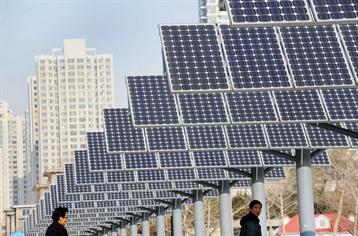
Massive renewable energy projects undertaken by the UAE and other Middle Eastern countries could turn them into solar energy exporters along with their large hydrocarbon exports, according to a veteran Arab energy analyst. "After oil, Arab countries could start exporting solar energy," said Nicolas Sarkis, Director of the Paris-based Arab Petroleum Research Centre (APRC), which acts as an adviser to the 10-nation Organisation of Arab Petroleum Exporting Countries. "The development of solar energy is rapidly becoming a priority of energy policies pursued by most countries in the Middle East and North Africa, whether oil and natural gas producers or not," Sarkis wrote in the APRC's monthly magazine, Arab Petroleum and Gas. He said that in non-oil Arab countries, the growing interest being shown in solar power and other renewable energy sources is dictated not only by the deterioration in their energy deficits and the insufficiency of their indigenous fossil fuel resources but also by environmental imperatives and the technological progress that characterises the development of renewable energies. As for the large hydrocarbon exporting countries in the Arab World, the exploitation of their huge potential in the area of solar energy reflects a dual concern to protect the environment and prepare the post-oil era, he said. UAE Highlighting solar projects and other renewable energy developments in the region, Sarkis said the UAE has emerged as a pioneer in this sector. "Abu Dhabi has emerged as a pioneer with its famous Masdar initiative, the largest clean energy development programme going ahead anywhere in the world, with investments of more than $22 billion (Dh80.7bn)," he said. He noted that several agreements have been concluded for the construction of Masdar City, including with BASF and Fraunhofer Gesellschaft of Germany. Masdar, which is an offshoot of Abu Dhabi Future Energy Company, part of the state-owned Mubadala group, has launched numerous projects both in the UAE and at the regional and international level. Its first photovoltaic solar power plant, which has a capacity of 10 MW and is the largest built so far in the Middle East, was connected to the UAE's national power grid last May. Since 2008, Masdar has also concluded several agreements with international companies for the implementation of a wide range of renewable energy ventures, including one with German company Coenergy for a plant to produce solar panels as part of a $2bn programme, and an association agreement worth $1.2bn with the Spanish company Sener for the development of a photovoltaic power station, according to Sarkis. Over the past few months, Masdar has also launched a number of other schemes. In particular, it has signed an agreement with Bahrain's National Oil and Gas Authority (Noga) for reducing greenhouse gas emissions in that country, concluded an agreement worth €2.2bn (Dh11bn) with E.ON and Dong Energy for the implementation of the first phase of a wind farm in the Thames estuary east of London, in the United Kingdom, and embarked on the study of a wind power project on the island of Mahé in the Seychelles. Saudi Arabia "Another very significant example is Saudi Arabia. The fact that it is the world's leading oil-exporting country has not prevented it from deciding to invest in the development of solar energy," Sarkis said. Under the terms of an agreement signed last June, Saudi Aramco and the Japanese refining company Showa Shell are to develop a pilot solar power plant that will have a capacity of 10 MW and is due to come on stream in 2011. Another 20 MW solar power plant is due to be built at King Abdullah University of Science and Technology, along with a center devoted to photovoltaic technology. For its part, Algeria announced in September 2009 that it was to develop a 150 MW solar power station at Hassi R'Mel. Other Arab states Other oil-exporting countries, such as Kuwait and Iraq, recently announced their determination to go down the same road. Egypt is also planning to develop power stations running on renewable energies that will account for 20 per cent of its total power generation capacity by 2020. "With limited hydrocarbon resources and rapidly growing domestic energy demand, all other Middle Eastern and North African countries are turning to renewable energies, especially solar power," Sarkis said. "The most ambitious is Morocco, which in November 2009 announced a $9bn programme for installing renewable energy power plants with a total capacity of 2 GW by 2020, representing 14 per cent of the country's total power generation capacity at that point." Tunisia, too, has drawn up a national programme, the Tunisian Solar Plan, which encompasses some 40 projects to be implemented over the 2010-2016 period under public-private partnership arrangements. Twenty-nine of the projects are due to be carried out by private sector companies and the rest by the public sector, including five by the Société Tunisienne d'Ele