- City Fajr Shuruq Duhr Asr Magrib Isha
- Dubai 04:20 05:42 12:28 15:53 19:08 20:30

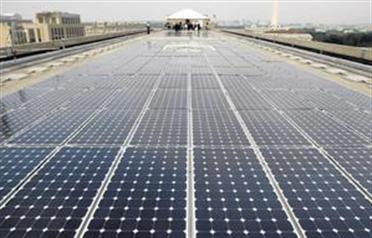
Clean technology relies much more on credit for development than the other sectors. (GETTY IMAGES)
The outlook does not look too bright for the green energy sector in 2009. The credit crisis may not have washed away plans by countries to gradually shift to renewable sources for their energy requirements, but it potentially threatens their essential but costly research projects, industry insiders said.
The sector has enjoyed easy credit flow for the past couple of years backed by factors such as high oil prices and rising global warming concerns.
"After years of boom during which creditors – much like in the mortgage market – bombarded small companies in clean energy sector with credit, the outlook has now turned bleak," energy research firm Platts said in its recent report. "The most bearish market signal for the clean energy sector is literally the credit crunch."
Market insiders affirmed the outlook looks bleak for 2009.
"We do foresee a decline in demand for renewable energy products in 2009. The worst affected will be research projects that were planned to coincide with the plans mooted by governments and large corporates to shift to renewable sources to meet energy requirements," said Rajendra Kharul, the centre head for wind energy at the World Institute for Sustainable Energy in Pune, India.
Kharul said about four to five independent power producers in India have delayed their expansion plans due to the credit crisis.
"We were expecting an addition of 1,500 megawatts of renewables to the country's generation capacity in 2009. That may not happen and the figure may come down to 800MW to 900MW," he said.
India ranked fourth in the world in wind energy production with a total a capacity of 8,000MW in 2007.
The scenario apparently is similar across the world. "Huge investments went into the solar and wind sector in 2007. It may not be the same in 2009," said Robin Mills, Petroleum Economics Manager with Emirates National Oil Company Limited (Enoc).
China, which has fast emerged as the hub of renewable energy production, may play a key role in slowing down the sector, analysts said. "The country was fast emerging as a hub for renewable energy production and consumption. It added 20,000MW of renewable energy to its production capacity on an annualised basis. But that is expected to wane," Kharul said.
Platts said while the big renewable energy players may survive and slowly prosper, it is the smaller players that will face the heat.
"This is because the clean technology sector relies much more on credit for its developments and investments than others, mainly because most clean developers or researchers are small businesses with small amount of ready cash or equity," it said.
That the smaller players are the ones involved in research is why the sector would slow down in 2009, Platts said.
"For the development of the next generation of ultra thin solar panels or developing the biggest, newest wind turbine for an offshore wind park to connect to the grid in 2014 requires most companies to take up large sums of long-term project finance credits from banks, funds and other investors," Platts said. "With such project financers now going bust or being short on cash, however the last thing they want to do in times like these is to hand out long-term credits to small companies with little equity and cash."
Globally, two factors are expected to stimulate the sector. Firstly, effective pro-renewable energy policies implemented by the administration that assumes office in Washington early next year. And secondly, continuance of funding of renewable energy projects by the relatively well-off GCC economies.
"A lot depends on the course that the US adopts. President-elect Barack Obama has laid considerable importance on shifting to green energy resources and the sector is waiting for the course that it adopts," said Kharul.
The US Senate has just passed what could end up being one of the most important legislation for the renewable energy sector. The package of more than $17 billion (Dh62.44bn) to be spent in 10 years is designed to stimulate growth in a number of clean technology sectors. "Production Tax Credits introduced by the US government can do a lot to stimulate the sector. It's essential that they continue with it," said Kharul.
Secondly, the GCC investors that have been attracted to the sector can keep the wheels of renewable energy moving.
"Investors from the UAE have supported projects across the world. A lot of work on foreign projects will depend on how they act," said Kharul.
Abu Dhabi, which holds close to 10 per cent of the global oil reserves in its belly, announced funds worth $15bn to support clean energy in January. In a decade from now, Masdar City, a community of 50,000 residents that plans to have a zero-carbon footprint, will be complete.
The Emirates Green Building Council has been formed by the government to promote the concept of renewable energy in buildings. The World Future Energy Summit organised by Abu Dhabi every year attracts experts and companies working in the field from all over the world. Market insiders say there are steps that the government can still take to promote green energy concepts within UAE. "The markets in the UAE have been growing slowly. There is still a hesitation among developers and individual customers in shifting to renewable sources to meet energy requirements. Government steps to curb the use of traditional fuels for meeting personal energy requirements can certainly help," said Barrie Harmsworth. a managing partner at Green Energy Solutions, Dubai.
Germany and other European economies that have specific targets to switch over to renewable energy resources are expected to keep up the demand for renewable energy sources. "Clean energy technology will remain in high demand as long as politicians set strict carbon targets, as long as the public resents new nuclear and coal power plants, and as long as companies active in the sector see export potential for the technology," the Platts report said.
A total of 44 countries have time-bound plans to switch over to renewable sources.
A latest development pertains to clean energy production. Royal Dutch Shell Plc and Anglo American Plc have delayed plans to develop a A$5bn (Dh11.68bn) project in Australia to convert coal into clean fuels, citing higher costs, it was reported yesterday.
The partners will extend studies into the proposed plant rather than move forward toward development, Roger Bounds, Project Director at the Monash Energy Holdings Ltd, told Bloomberg in an e-mail. They still believe coal-to-liquids provides a "long-term" opportunity for the brown coal resources in Australia's Victoria state, he said.
 Follow Emirates 24|7 on Google News.