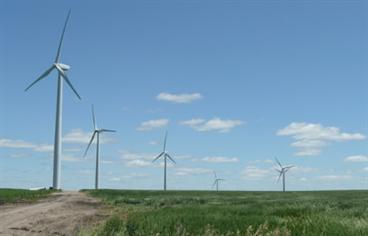
New energy resources must be developed to cope with a projected 50 per cent increase in the global population over the next 50 years, said energy analyst Dr Tore Undeland. Wind energy is already being exploited in Europe where countries such as Norway and Sweden are building offshore and onshore turbines, he said. Dr Undeland, a power electronics professor at the Norwegian University of Science and Technology's Department of Electric Power Engineering, stressed the importance of developing sustainable and renewable energy sources further. "We have to look into and be prepared for healthier and renewable energy sources such as wind, wave, bio from forests, tidal and osmotic salt," he told the International Conference on Electric Power and Energy Conversion Systems at the American University of Sharjah. "World oil demand grows each year in a healthy global economy and international oil production will reach a maximum and then decline. This means that the supply cannot meet demand and as a result prices increase and shortages develop." Quoting David Tilman from the University of Minnesota, Dr Undeland said the world's population was expected to increase from 6.6 billion to 9.5 billion in the next 50 years – and energy consumption was projected to increase by 240 per cent. "How might population and consumption drive agricultural and energy demand" he added. "Also the use of traditional electricity generators has lead to global warming and this is threatening life on our world. Are we going to continue using gas and coal, the two substances responsible for global warming as with the increase in demand our world would be subject to a greater threat?" He said that, based on atomic weight, each kilogram of gas produced 2.75kg of the greenhouse gas carbon dioxide and generated 13.9 kWh when burned, while a kilogram of coal produced 3.67kg of carbon dioxide and generated 10 kWh. "Although coal is the cheapest fuel it is most responsible for carbon dioxide emissions. Wind energy is three times more expensive than coal and offshore wind turbines are twice as expensive than onshore ones. "But adopting more expensive power generation methods is still economically viable according to wind turbine manufacturers. The cost of wind turbines is falling whereas the demand is increasing, and it is here that profits can be made. In Europe, there is a big move towards wind turbines to reduce dependence on Russian gas." Dr Undeland said China's reliance on fossil fuels to generate power for its booming industrial development was a key driver of its greenhouse gas emissions. "China is the world's second largest emitter of greenhouse gases after the United States and accounts for a seventh of global emissions. According to Economist Intelligence Unit data and forecasts from the International Energy Agency's World Energy Outlook 2006, China's current annual per capita CO2 emissions is 3.7 tonnes and this is expected to increase to 7.1 tonnes by 2030. "The US's current per capita CO2 emissions is 19.7 tonnes and this is projected to fall to 19.6 tonnes by 2030." He said we were in a transitional phase that would lead to the age of sustainable energy. "Opting for other energy sources such as solar, direct and indirect, hydro power, tidal and wave power, ocean and geothermal power, biomass and biogas has become inevitable considering the limitations to our oil and gas reserves." Newsweek International has ranked countries in terms of their preparedness to adapt to climate change. The UAE came 13th after Norway, which was first followed by Finland, Sweden, Switzerland, Canada, Japan, Austria, France, the US, Denmark, Belgium and Italy. Sudan, Nigeria, Madagascar, Uganda, Senegal, Kenya, Angola, Yemen, Bangladesh, and Sierra Leone were at the bottom of the list of 100 countries. Dr Undeland said a 20 per cent growth in the use of wind and solar power would provide around one per cent of total energy demand by 2020. "Norway has built the world's first full-scale floating wind turbine platform off the country's west coast. The HyWind turbine is part of a plan to move wind farms far offshore, minimising disruption to military radar operations and the shipping industry and keeping them well away from fisheries, birdlife and tourism centres. "The project is at the beginning of a two-year test period to see if it can stand up to the rigours of the North Sea. Technologies for floating offshore wind turbines and farms and a supergrid have been made. "The floating wind turbine is now a reality 120km off the northern coast. The HyWind could provide 20 per cent of the power currently produced from gas in the United Kingdom. The UK is studying a design for a ship that that would carry the HyWind instead of building it on the seabed." Dr Undeland said the electricity produced by HyWind was costly, but added: "We are studying ways of reducing the production and transfer costs and increasing HyWind's productivity and this could be achieved in the next 1