- City Fajr Shuruq Duhr Asr Magrib Isha
- Dubai 04:20 05:42 12:28 15:53 19:08 20:30

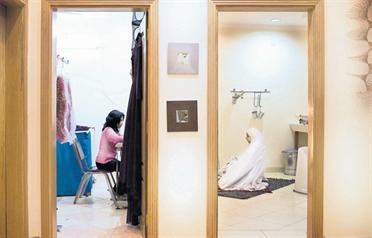
Hazel Thompson puts women's roles under the scanner in Measure of a Woman. (SUPPLIED)
As the Burj Al Arab, one of the most iconic buildings of our time, marks its tenth anniversary, a new photography project fittingly explores the role of buildings in creating a nation's character – while examining just how the past impacts the future.
Three UK-based photographers and five up-and-coming artists from the Middle East were commissioned to work on My Father's House, a project organised by the British Council and Sharjah Museums Department.
It uses architecture as a motif to explore the role and value of heritage in defining cultural identity, asking how we see the spaces we live in.
"The exhibition will engage diverse audiences and provide a positive learning experience on cultural identity, the importance of preserving cultural heritage and the rapid development of our urban landscape from an architectural point of view," says Manal Ataya, Director General of Sharjah Museums Department.
An exhibition of photographic art forms the centrepiece of the event and a series of lectures and seminars are open to the public.
These activities encourage us, the public, to take a fresh look at our surroundings, to consider the impact they have on environment and society and how cultural heritage is valued as a whole.
The year-long tour, which kicked off in Muscat, opens at the Sharjah Museum of Islamic Civilisation today and runs through to January 23.?It then goes to the Waqif Art Centre in Doha, and plans are also underway to take the exhibition to the UK.
"Cultural heritage and architecture are the symbols of our identity and the Middle East is a dynamic region with striking contrasts between the old and the new," says Hannah Henderson, Regional Manager Creativity, Middle East, British Council.
She says architecture plays an important role in shaping national identity. "Whilst modern developments and luxury hotels and housing complexes shape how we will live in the future, the incomparable richness of our architectural heritage harks back to an idyllic Arabian past where every form – wall, arch, parapet, door – had a meaning that chimed with people's everyday life."
The Gulf countries can be viewed through the prism of their petrol stations, water towers, mosques, shops, university campuses, street corners, homes, living rooms and temporary shelters, she says, and how these buildings are designed and used plays an important role in determining our identity and behaviour and reflect how we see where we live.
Accordingly, the exhibition puts on show eight individual artistic responses to these varied buildings, tracked over the period of a year. All were asked to respond to the theme, My Father's House, and the project was a journey of exploration and understanding for each of the artists involved, Henderson says.
The photographers are: Wed Abduljawad, Hafiz Ali, Boushra Almutawakil, Lamya Gargash, Camille Zakharia, Tim Hetherington, Tim Loveless and Hazel Thompson.
Inspiration for their works comes from subjects as varied as the oral tradition of storytelling, cinema, households, changing landscapes, archaeological and restoration projects and the role of women in shaping their societies.
But no attempt to interpret the nation's architectural and cultural heritage is complete without taking into account such landmark buildings as the Burj Dubai or the decade-old Burj Al Arab, which caught the world's attention when it was first built. Like London's Big Ben and the Eiffel Tower in Paris, these are recognisable symbols of Dubai and the UAE, not only making a statement about who we are as a nation, but also where we want to go.
But these buildings must be viewed in the context of what has gone before, as part of a panorama that necessarily features barjeels and enclosed courtyards.
"Both traditional and contemporary buildings in the UAE are integral to the country's Arabic and Islamic identity," says Dr Ulrike Al Khamis, Middle Eastern an Islamic Arts Collections Advisor, Sharjah Museum of Islamic Civilization.
"Mosques and public buildings often reflect proud references to Islamic architectural heritage through history, a phenomenon that can be observed particularly in Sharjah, and also throughout the Emirates. Other historical structures, including fortresses and the original residences of the ruling families stand as architectural markers of a proud local history characterised by continuous inter-cultural dialogue with East and West," she says.
Agrees Henderson, "The UAE has a stunning mix of old and new buildings that shape the identity of the Emirates. The speed with which the Gulf is developing is a remarkable phenomenon and the Gulf offers itself as a microcosm of the challenges, which face all societies as they balance the claims of the past with those of the future."
- My Father's House is now open at the Sharjah Museum of Islamic Civilization. Call 06 565 5455
Keep up with the latest business news from the region with the Emirates Business 24|7 daily newsletter. To subscribe to the newsletter, please click here.
 Follow Emirates 24|7 on Google News.