- City Fajr Shuruq Duhr Asr Magrib Isha
- Dubai 04:20 05:42 12:28 15:53 19:08 20:30

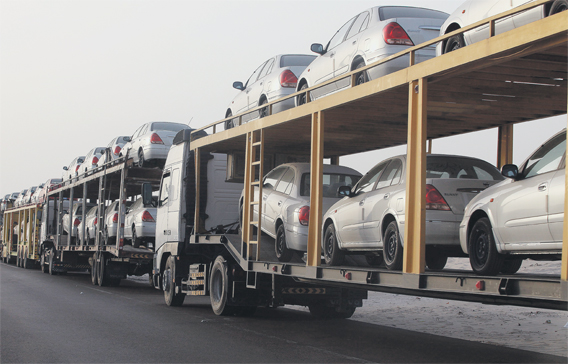
The UAE witnessed 1.3 million truck movements in 2009. (EB FILE)
The UAE ranks the highest in the region in terms of performance within the logistics and supply chain industry, marking 3.63 per cent growth during 2009, said an official yesterday.
Abdulla Rashid Al Otaiba, Chairman of the Department of Transport and Director of the Board, Abu Dhabi Ports Company, said the International Logistics Performance Index's cross-country comparison clearly indicates the growth potential within the sector.
He was addressing the opening session of the Global Logistics Forum, which was organised by AIM Events, in Abu Dhabi.
"Last year alone, the UAE witnessed 1.3 million truck movements, a 19 per cent decrease compared to the previous year. Over the last seven years, total imports rose by 170 per cent while total exports increased eight fold, an indication of the robust nature of our economy," said Otaiba.
Emphasising on Abu Dhabi's initiatives, he said that despite great achievements, the Abu Dhabi freight sector faces numerous challenges.
"There is a critical need to develop an integrated multi model freight transport system that can efficiently support and connect local, regional and global market. Secondly, there is an urgent need to develop a comprehensive regulatory system that can secure the optimum performance of the freight sector."
Earlier, delivering the keynote address, former German Chancellor Gerhard Schröder said the forum provides an excellent opportunity for global logistics experts to meet and exchange ideas.
"By delivering global logistics services and infrastructure, the UAE is in a strategic position and is on the right track, taking advantage of the increasing globalisation of the logistics market. The GCC as a whole is very well located to serve as a hub to regions located between the timezones of Europe and Asia – a market of four billion people within eight hours," said Schröder.
"The UAE is going on the right track in heavily investing in transport and logistics sector. During the next few years as the economy rebounds, the UAE will be on the right track to take advantage of the situation. Other countries like Germany have learned their lessons over years and know how important the logistics sector – the third largest sector after retail and automobiles – is for the economy."
Therefore, he said, the challenge for the UAE and the GCC, which are aiming to develop the logistics sector, is to make this sector a strategic need and develop it in balance to the demand.
"One key factor is the infrastructure. Policy makers must recognise the importance of trade facilitation and logistics and must undertake efforts to put in place the structural needs to boost performance in the country," he said and added that the partnership between the UAE and Germany would go a long a way in promoting economic growth.
A joint initiative by Abu Dhabi University and Berlin Institute of Technology (TU Berlin) Chair of Logistics, the event, according to Schröder, provided an international platform to exchange knowledge, experience and build academic and industrial relationships between locally renowned and leading logistics experts.
More logistics infrastructure is expected to be created in the GCC that would pave the way for competitive logistics services, as regional governments, municipalities and private investors have placed logistics development on their agenda, said another logistics expert in the region.
According to Roland Zibell, Director of ADI Services FZE, although Dubai remains to be the only outstanding hub for trading and logistics in the GCC, more locations have the potential to develop into platforms with good logistics infrastructure and service offerings.
"While this development has been focused on the UAE, there is now a clear trend that more locations and countries will follow," said Zibell. "We can expect more and better logistics infrastructure being created in the GCC and more competitive logistics services being offered."
Zibell said most companies, investors and governments in the GCC have re-focused on sustainable development of business and infrastructure.
According to the International Monetary Fund (IMF), the total GCC medium-term project investment stood at $2.19 trillion last year, wherein 44 per cent were real estate projects, while 19 per cent each accounted for infrastructure, oil and gas.
The UAE and Saudi Arabia were among the two leading countries in the GCC with 41.8 per cent and 28.8 per cent of investment respectively. Bahrain is also investing $2.9bn to upgrade its logistics infrastructure, including a new bridge to Qatar, an airport expansion, a state of the art logistics zone and a larger port.
A consultant to Dubai Logistics City (DLC), Zibell also said the two-day forum set to conclude today at the Fairmont Bab Al Bahar, Abu Dhabi, is an important milestone for the logistics development in the region.
"The Global Logistics Forum bringing together leading logistics experts in the UAE capital will trigger the understanding that logistics is not only to be associated with Dubai as a trading and logistics platform, but that logistics can be the pillar of sustainable business development throughout the region. The logistics sector usually is the first to feel a downturn, but also the first to feel the rebound," Zibell said.
He said the GCC is not only a nodal point in East-West trade, but also for the trade into Africa and for the own home market – both increasing in trading volumes due to strong growth which is spurred by the demographic development.
"There is enough volume to come for the logistics sector that would not only grow existing hubs but also boost further locations. Any competition in between the GCC's 'trading and logistics hubs' would help to keep the logistics sector on a path of sustainable development, continuous improvement, and growth."
Otaiba also said that the Department of Transport in Abu Dhabi developed a comprehensive service transport master plan (STMP) in order to streamline the sector.
"The principal goal of STMP is to streamline commercial freight transport and to create a safe and secure transport network. We have also established a special division within the department of transport, to carry responsibility for logistics and multi model freight transport. One of the first initiative is to develop a comprehensive freight masterplan, which will provide the roadmap for developing key regulations governing freight, distribution on land air and maritime transport, upgrading port and airport facilities, facilitating the developing of GCC wide railway system and making provision for efficient intermodal interchange."
 Follow Emirates 24|7 on Google News.