- City Fajr Shuruq Duhr Asr Magrib Isha
- Dubai 04:20 05:42 12:28 15:53 19:08 20:30

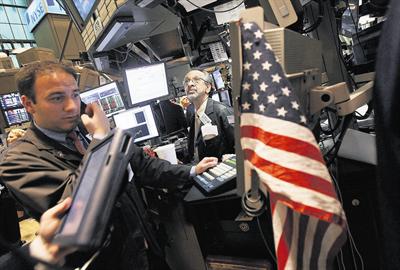
Wall Street's eyes and ears will be trained on the Fed and the torrent of quarterly earnings reports. (AFP)
This week is almost sure to be a rocky ride for the US stock market as investors fret about the stability of Fannie Mae and Freddie Mac, the government-sponsored home finance companies.
Barring any news or development, analysts and money managers said US stocks were set to fall further into the bear market's arms.
Wall Street's eyes and ears will be trained on Federal Reserve Chairman Ben Bernanke this week, when he will appear twice on Capitol Hill to give his semi-annual testimony on monetary policy. He will testify on Tuesday before the Senate Banking Committee, and on Wednesday, before the House Financial Services Committee.
Investors will zero in on anything Bernanke says about Fannie Mae and Freddie Mac, in addition to his take on the US economy, inflation and interest rates.
"The bottom line is that we're in the middle of a financial tsunami. This is a storm the likes of which this country hasn't seen," said Peter Kenny, managing director at Knight Equity Markets in Jersey City, New Jersey. "The market right now needs to see results. It no longer gives anyone the benefit of the doubt."
Fannie Mae and Freddie Mac, which own or guarantee about one in every two US mortgages and package them into bonds, are confronted by mounting losses from loan delinquencies and foreclosures. Investors fear that if they are hampered from doing business, the paralysis will only make the housing crisis get worse.
The coming week also will be filled with a torrent of numbers from quarterly earnings reports and economic indicators. It will be one of the busiest weeks for quarterly earnings, with reports due from Dow component Citigroup, the number one US bank, and technology bellwether Google, the leading web search company.
Making the terrain even more treacherous for stock investors are concerns about oil's jump on Friday to a record above $147 a barrel and worries that next week's data on consumer and producer prices may show rising inflationary pressures. As a result, there appears to be little that could comfort investors in the short run.
Economic reports to watch include the US Producer Price Index and the Consumer Price Index, industrial production and capacity utilisation, and housing starts.
"I have my helmet on and my body armor on today. We expect it to be another volatile week with the market reacting to a triple play of earnings, oil and the mortgage agencies," said Frederic Dickson, senior vice-president and market strategist at DA Davidson & Co in Lake Oswego, Oregon.
"The market is going to remain nervous, watching developments with oil and tensions in the Middle East, and the avalanche of earnings and outlooks that will really start to hit the tape with banks and tech companies next week."
US crude oil futures shot up more than two per cent on Friday as geopolitical concerns over Iran's nuclear work and supply worries combined to lift prices to an all-time high.
The government's report on the US Producer Price Index (PPI) for June is scheduled for Tuesday, followed by June CPI on Wednesday, when the Federal Reserve also is expected to release the minutes from its most recent policy-making meeting on June 24-25. At that meeting, the Fed held its benchmark fed funds rate for overnight bank lending at two per cent. Economists polled by Reuters forecast that overall PPI will increase 1.3 per cent in June, following May's gain of 1.4 per cent.
Core PPI, excluding volatile food and energy prices, is expected to gain 0.3 per cent in June, after rising 0.2 per cent in May.
The forecast for overall June CPI is up 0.7 per cent, compared with a 0.6 per cent gain in May, while core CPI is forecast to increase 0.2 per cent, matching May's gain, the Reuters poll showed.
Concerns about Fannie Mae and Freddie Mac's stability drove a sell-off on Friday, that marked the sixth straight weekly drop for both the Nasdaq and the Standard & Poor's 500 Index – their longest weekly losing streaks since 2004.
Earlier last week, the S&P 500 entered its first bear market since 2002, joining the Dow and the Nasdaq, which had already slid 20 per cent or more from their most recent closing highs, set last October.
During Friday's roller-coaster session, the Dow dropped below the psychologically important 11,000 level for the first time since July 2006. It trimmed that loss to close at 11,100.54.
For the week, the Dow Jones industrial average lost 1.4 per cent and booked its fourth straight weekly decline. The Nasdaq Composite Index slipped 0.3 per cent for the week, while the S&P 500 slid 1.9 per cent.
Fannie and Freddie are the twin pillars of the US housing market, so their troubles put the US economy and its banking system at risk, according to analysts.
"If the Fannie and Freddie crisis is not resolved, the markets are going to be in worse shape than they are right now," said John Praveen, chief investment strategist at Prudential International Investments Advisers in Newark, New Jersey.
"There's a lot of fear and uncertainty about what is going to be the outcome," Praveen said, adding such a resolution could occur over the weekend or next week, and it is "probably going to set the tone for the market. Oil is another big issue".
US Treasury Secretary Henry Paulson offered no hint of an imminent government bailout, saying his major aim was to back Fannie and Freddie "in their current form".
Paulson's statement followed a report in The New York Times saying the US Government was considering taking over the two if their funding problems get worse.
In addition to quarterly report cards from Citigroup and Google, next week's earnings to watch include chipmaker Intel Corp and Microsoft Corp.
This barrage of quarterly numbers and companies' comments on what they expect for the rest of the year are likely to make stock trading extremely choppy.
Friday's session, marked by a spike and a pullback in the Chicago Board Options Exchange Volatility Index (VIX), illustrated just how jumpy the stock market has become. The VIX, which is Wall Street's barometer of fear, shot up 15 per cent in trading to 29.44, its highest level since March 20. By the close, the VIX was higher, but more subdued. It ended at 27.49, up 7.42 per cent.
Besides Bernanke, next week's agenda includes appearances by two other Fed officials: Janet Yellen, the president of the Federal Reserve Bank of San Francisco, is scheduled to speak on the housing market on Tuesday in California. Thomas Hoenig, the president of the Federal Reserve Bank of Kansas City, is set to speak on monetary policy and the economic outlook on Wednesday in Colorado.
 Follow Emirates 24|7 on Google News.