- City Fajr Shuruq Duhr Asr Magrib Isha
- Dubai 04:20 05:42 12:28 15:53 19:08 20:30

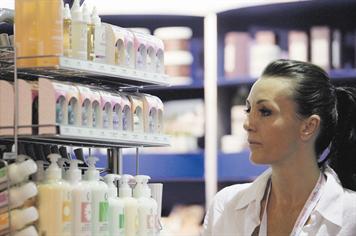
The luxury arm of the cosmetics and beauty industry has been hit by the global economic crisis. (XAVIER WILSON)
The economic crisis has changed buying habits of customers globally and now they are more inclined to set aside their favourite but expensive cosmetic brands and experiment with new products that offer good quality at more reasonable prices, say industry sources.
Dubai recently hosted Beautyworld Middle East, which ran alongside Wellness and Spas Middle East, from June 7 to 9 at Dubai International Convention and Exhibition Center.
A number of international and regional exhibitors participated in the shows and displayed a wide range of products and services targeted at consumers in the region.
Talking about the impact of the recession on the global cosmetic and beauty industry, Cecilia Furet, Export Manager, ABC Texture, a cosmetic manufacturing company from France, told Emirates Business: "Ever since the economic crisis hit the world, the price has become important. Consumers have become more conscious about their spending now and are less interested in buying expensive brands and are looking for quality products at a more reasonable price.
"The crisis has changed the buying habits of customers. They are now willing to try out other brands that are not very expensive. Earlier when the money was there, people used to spend a lot of money on expensive cosmetic brands without a second thought as they were in the habit of using them. Now they are willing to experiment and opt for less expensive brands. However, one thing has not changed and that is they still demand quality, perhaps now more than ever.
"We used to have good business in the US, which accounted for 50 per cent of our global turnover. But, since the end of 2007, when the crisis hit, our business has gone down in the US market and now only 10 per cent of our turnover comes from the US.
"When we call our clients in the US they say that they have no new projects to work on and the companies that had already launched the new products and had been using the products for some time as they liked them, did not place new orders.
"In other parts of the world, we felt the real impact of the crisis from the first quarter of 2009. Until the last quarter of 2008 – that is until November and December – it was fine, but finally it slowed down. No new products were launched, and all our clients adopted a wait-and-watch approach and new orders were not being placed."
Nicolas Gravet, Export Director, Bio Sure, a cosmetic manufacturer from France said: "The industry is suffering globally. As a group, our business is down in France, the US and Europe.
"Globally, distributors are having a tough time as their retail clients are not ordering much due to slowdown in business. So distributors have also been hit in the process and many of them are having difficulty fulfilling their financial obligations."
Talking about the impact of the crisis on the cosmetic and beauty industry in the Middle East, Sobhi Younes, Director, Sales and Marketing, Madi International, told Emirates Business: "The luxury arm of the cosmetic and beauty industry has definitely been hit. In the first quarter of 2009, it saw a dip of 10 to 15 per cent and in the past six months, it has gone down by 25 per cent to 30 per cent.
"However, the rest of the industry which deals with everyday cosmetic and beauty products has not been hit. That is because like food and other essentials of life, people need certain cosmetics so the industry has not been hit per se.
"New businesses are opening, saloons are still opening, people here are still interested in the new stuff and in developing their business.
"For example, we have already sold six of our newly-launched tanning machines, which cost anything between Dh100,000 to Dh220,000 in Kuwait. And here in Dubai, there has been a lot of interest in them. But the luxury arm of the cosmetics business has been hit as it is something that is not essential. It can be avoided. Also, now the competition is tough as all the people are thinking twice before buying the fancy stuff."
Gravet added: "The Middle East market has driven the growth of the cosmetic and beauty industry. In the Middle East market we are still seeing a growth of five per cent as a group. We had targeted 25 per cent, but for obvious reasons that did not happen, but we are still seeing growth. In terms of consumption, it has remained high here unlike the rest of the world and also the problems being faced by distributors elsewhere are not visible here."
About the Middle East market, Furet said: "Things were fine here until January, but then the recession hit the industry in February. There are new projects, clients want new products but they are delaying the launches of the products."
Asked about an expected upturn in the industry, the executives felt it will be sooner than later and that Asia and the Middle East will be one of the first to recover, followed by Europe and the US.
Younes said: "The market in the Middle East will bounce back much faster than the rest of the world as there is a lot of resilience and the Gulf always bounces back. This is because people Asia and the Arab World like to live well and spend."
Furet said: "Even though things are beginning to move now a bit and we are getting orders, but I still think that the industry and the market will need a year to recover from this crisis."
Gravet said: "There are already signs of recovery in Asia. However for the rest of the world, recovery will not begin before early 2010. Asia will be one of the first to recover, followed by Europe and the US."
Talking about the changes that the crisis has brought about, Furet said: "Even though the market will recover soon, the fact remains that the crisis has changed a lot of things. The market will be changed. Big brands have lost a lot and smaller brands have found a way of growing market share.
"People are looking for more innovative products as a way of differentiating themselves and standing out. And as people are more careful about their money now this is a good opportunity for small brands. They have to work on innovative products and invest time and money in research and development for new products."
Talking about the trends that are dominating the beauty and cosmetic industry, Furet said: "Globally the trends are more or less the same. Here also, as in the rest of the world shades are ever important, so are concealers and new textures in cosmetics are a rage. Also people like more personalised products that suit their skin type."
Gravet said: "People now look for more natural products that will not only make them look good but will not harm their skin. They also want products that will protect their skin for a longer period of time and protect them from pollution, allergens. So the organic cosmetics and products are popular. People want products with high quality ingredients and formulas."
The male grooming market has become a significant driving force in the global cosmetics and personal care industry.
According to Euromonitor International, global sales for men's grooming products are predicted to be worth Dh92 billion in 2011. Eastern Europe and Asia Pacific in particular are expected to boom as male consumers increasingly adapt to western lifestyles. In Asia Pacific sales are projected to reach Dh15bn in 2011, while in Eastern Europe they are predicted to grow to Dh9.2bn.
Elisabeth Brehl, Managing Director of Epoc Messe Frankfurt GmbH, organiser of the events said: "Male consumers are increasingly placing greater importance on looking good and the personal care aspects of improved health and wellness. Recent reports have revealed that the global sales of men's grooming products reached Dh71.6bn in 2008. The value of the market in 2009 is estimated to be Dh79.7bn, an increase of 11.3 per cent as compared to last year.
"The downturn has tempered optimism but the men's beauty market remains one of the best performing segments in the personal care sector."
Keep up with the latest business news from the region with the daily Emirates Business 24|7 newsletter. To subscribe to the newsletter, please click here.
 Follow Emirates 24|7 on Google News.