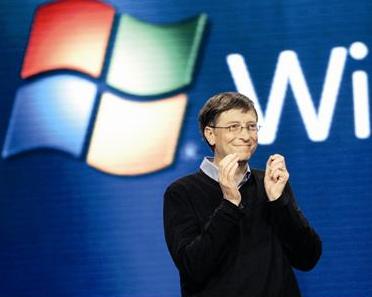
A Harvard dropout who ushered in the home computer age and made billions of dollars along the way will have his last official working day at Microsoft on Friday. Three people will fill the void left behind when Bill Gates, 52, retires from the company that he and friend Paul Allen co-founded in 1975. Gates was a 13-year-old student in the US state of Washington when he began programming computers. He fell in love with the machines and school officials tapped into his programming prowess, swapping computer time for his services. It is said that Gates tinkered with school records to put him in classes made up mostly of girls. Gates met Steve Ballmer, now Microsoft's CEO, while the two were students at Harvard. Gates, with the blessing of his lawyer father and teacher mother, left college after two years to launch "Micro-soft" with Allen. He later received honorary degrees from Harvard and other universities. Gates has said in interviews a new chip released by Intel convinced him the time was right to start a software company. The duo obtained the rights to computer software, modified it and rechristened it Microsoft Disk Operating System (MS-DOS). A key move by Gates was to focus on licencing software to computer makers in numerous "partnerships", that resulted in affordable machines being available to the masses. Since Gates began his transition from leading Microsoft to heading his personally-bankrolled charity, the Bill and Melinda Gates Foundation, his job as chief software architect has been handled by Ray Ozzie. Craig Mundie inherited Gate's chief research and strategy officer duties, while Ballmer became CEO of the Seattle-based software colossus. After retiring, Gates – the world's third richest man – will remain Chairman of Microsoft and the company's largest shareholder. "I don't think anything is going to drastically change the day he leaves," said Matt Rosoff of the private analyst firm Directions On Microsoft. "If he thinks something is important and tells Ballmer, Ballmer will listen to him." Still, Gates's bespectacled, nerdish look is an integral part of Microsoft's image and his departure is symbolic, according to observers. "The challenge Microsoft has when the founder departs is remembering its heart," said analyst Rob Enderle of the Enderle Group in Silicon Valley. "At some point the firm has to take the essence of what made Bill Gates successful and make sure that is preserved. Whether it is a company or a person, once you've lost your heart there isn't much left but a shell." Analysts say there are signs that Microsoft has been struggling since Gates stepped away from managing operations several years ago. Microsoft has "missed a number of opportunities" and the Windows and Office software on which its fortune is built have stumbled. Microsoft's Windows Vista operating system released in January 2007 has flopped with customers, many of whom are clinging to its predecessor Windows XP. "They are in trouble on the desktop [computer software]," Enderle said. "Microsoft started as a desktop vendor and suddenly it is its weakness." Meanwhile, Apple's Macintosh computers have been gaining popularity. While Windows is still used on 90 per cent of the world's computers, Macintosh computers using Apple operating systems has grown to more than five per cent of the market. The software giant also sees its bottom line threatened by Google, which offers free online programmes that compete with Office and other software sold by Microsoft. Microsoft failed in a recent bid to buy Yahoo for nearly $50 billion (Dh18.35bn) in order to combine online resources to battle Google more effectively in the internet search and advertising markets. Enderle says he does not see "Gates's fingers" in the attempted Yahoo takeover, and Gates was thought to be one of the board members who supported pulling the plug on acquisition talks. "Microsoft has to leverage its strengths, right now it is thrashing a bit," Enderle added. "The company is on its own. The training wheels are off. It needs a way to point itself in the right direction and pedal like hell." Microsoft's server and tools division is its most profitable unit. Its entertainment unit, which sells Xbox videogame consoles and gaming software, has yet to make a profit. "You could see Microsoft struggling after Gates steps out of day-to-day roles," said Enderle. "A founder takes such a larger-than-life role and directs a company in very subtle ways that are often forgotten when he leaves. That gap, for a lot of companies, has been almost terminal." The Bill and Melinda Gates Foundation The charity created by Bill Gates and his wife Melinda has become, in the space of 14 years, the largest private philanthropic organisation in the world. - The foundation has given out more than $16bn (Dh58.72bn) in aid since its creation, investing mainly in development and health in developing countries and in education in the United States. - In 1999, at Melinda's urging, the G