- City Fajr Shuruq Duhr Asr Magrib Isha
- Dubai 04:20 05:42 12:28 15:53 19:08 20:30

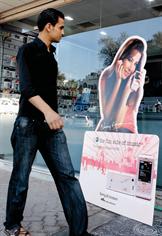
Sony Ericsson is targeting the youth with its Nancy Ajram mobile phone.(MOHAMMED HAKEEM)
At a large mobile phone shop in Abu Dhabi, a woman and her daughter stood staring at the scores of neat handsets. As if she was desperately searching for something missing, the girl suddenly shifted her eyes towards a large pink box and said excitedly: "That's it."
The Syrian girl eagerly picked a Sony Ericsson mobile phone signed by famous Lebanese singer Nancy Ajram. The pretty pack carried a large portrait of a smiling Nancy as she held the handset close to her face. Printed under her green eyes and lipsticked mouth were: "I love the fun side of music."
Nancy is the latest of many popular Arab singers used by major mobile phone makers to push deeper into the UAE and other regional markets. The trend gained momentum after the global financial crisis and concerns that it could reverse years of steady local growth.
Sony Ericsson's archrival, Samsung, has also enlisted popular singers from Lebanon and other Arab countries to expand its market share. LG, another major mobile phone producer, has introduced several new models carrying portraits of singers while Nokia, the world's largest mobile handset maker, has just marketed a phone uploaded with scores of Arab songs with the help of Rotana Music.
The 16-year-old girl at the shop seemed to be in love with Nancy as she kept humming one of her songs. At first, her mother protested when she learned that the handset is nearly Dh400 costlier than the same model not signed by Nancy. But in the end she gave in as it was her daughter's birthday.
"The mobile phone companies are targeting the young generation as they are picking the signers most popular among teenagers," said Imad Hariri, Sales Manager at Al Asala mobile phone shop on Defence Road. "It is a clever move by those companies because the idea is working. The other day I sold eight Nancy Ajram phones in just a few hours. For me this is a record sale of any phone in such a short time."
Sony Ericsson, the largest investor in promotional campaigns in the UAE, has backed up its Nancy phone with a real-life portrait of the singer, distributed to all shops on Defence Road, the main mobile phone shopping centre in the capital. The portrait is placed at the entrance of the shops and is done in a way that Nancy's eyes follow the onlookers wherever they move. Other singers used in promotions include Lebanon's Maya Nasri and Wael Kfouri by LG, and Iraq's Kazem Al Saher and Lebanon's Alissa by Samsung. Sony Ericsson has also used Fadel Shaker, one of the most popular Lebanese singers, but dealers said the Nancy phone was more successful.
"There are several reasons for the success of this phone… it is a good handset, the colour is sensational and appealing, and Nancy Ajram's signature is engraved on its back cover," said Mahmoud Hindawi, Manager of the Golden Crown mobile phone shop. "Another good reason is that the box includes a CD containing Nancy's latest songs."
The Nancy phone, Sony Ericsson W595i, is far more expensive than the same model, which is not promoted by the singer. It retails at about Dh1,250 while the price of the other one is about Dh850.
Dealers said the large price gap is because of the high costs of the promotion drive involving an expensive contract, a bigger, neater and more colourful package, a music CD, and additional accessories.
"These promotional drives involve the most popular signers among teenagers. The latest, the Nancy phone, targets both teenage and adult females," said Abdul Monem Al Hariri, a mobile phone dealer in Abu Dhabi. "The campaigns cover most of the Middle East but the focus is on the UAE. This is because of the high growth in mobile phone users and strong demand for mobiles as this country has one of the highest per capita incomes in the world."
According to Abu Dhabi Department of Planning and Economy (DPE), mobile phone penetration in the emirate stood at about 108.2 per cent at the end of 2006, while figures for PC penetration were also high at nearly 26 per cent, compared to only two per cent in Egypt.
In more recent figures from an Al Mal Capital report, mobile penetration had reached 166.4 per cent by the end of 2007 and etisalat sources expect the ratio to have exceeded 200 per cent at the start of 2009.
While the global financial crisis has started to affect the purchasing appetite of expatriates in the UAE, it has had no impact on nationals.
According to Khaled El Mattrawy, Senior Economist at DPE, the crisis would not impact UAE nationals. "They are not going to stop purchasing the latest phones and small laptops," he said.
 Follow Emirates 24|7 on Google News.