- City Fajr Shuruq Duhr Asr Magrib Isha
- Dubai 04:20 05:42 12:28 15:53 19:08 20:30

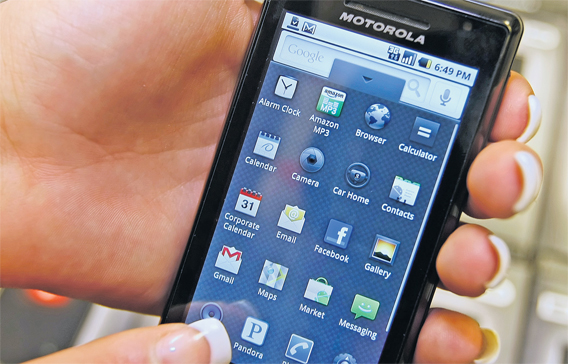
By 2011, more than 85 per cent of handsets shipped globally will include some form of browser. (AFP)
Usage of mobile applications and technologies will increase through 2011 as organisations emerge from the recession and ramp up both business-to-employee (B2E) and business-to-consumer (B2C) mobile spending.
IT research and advisory firm Gartner identified mobile technologies that will evolve significantly through 2011 in ways that will impact short-term mobile strategies and policies.
"We are highlighting these mobile technologies that should be on every organisation's radar screen," said Nick Jones, Vice-President and distinguished analyst at Gartner. "These mobile technologies were selected because they will evolve in ways that affect corporate strategies, significant numbers of customers or employees will adopt or expect them, or they will address particular mobile challenges that organisations will face through 2011."
According to the Gartner, two new Bluetooth versions will emerge by 2011. Bluetooth 3 will introduce 802.11 as a bearer for faster data transmission, and Bluetooth 4 will introduce a new low-energy (LE) mode that will enable communication with external peripherals and sensors.
Both versions will include other technical improvements to improve battery life and security. Gartner believes that Bluetooth 3 will facilitate corporate and consumer functions demanding large bandwidth (eg, downloading images and videos from handsets). Bluetooth LE will enable a range of new sensor-based business models in industries such as fitness, healthcare and environmental control and will be used by handset and PC peripherals to enable new functions, such as PCs that autolock when users move away from them.
By 2011, over 85 per cent of handsets shipped globally will include some form of browser. In mature markets, such as Western Europe and Japan, approximately 60 per cent of handsets shipped will be smartphones with sophisticated browsing capability and the ability to render conventional HTML sites in some manner. The growth in smartphones with relatively large and high-resolution screens will encourage greater numbers of people to access conventional websites on mobile devices, and will make it possible to deliver some B2C applications using conventional Web tools without adaptation. In mature markets, the mobile Web, along with associated Web adaptation tools, will be a leading technology for B2C mobile applications through 2012, and should be part of every organisation's B2C technology portfolio.
Widgets are installable Web applications that use technologies such as JavaScript and HTML. Many handsets support widgets running on their home screens, where they are easily visible and accessible. Despite the lack of standards, widgets provide a convenient way to deliver simple, connected applications, especially those involving real-time data updates (such as weather forecasts, e-mail notifications, marketing, blogs and information feeds). Because widgets exploit well-understood tools and technologies, they have lower entry barriers than complex native applications, and thus can be a good first step to assess the demand for an application on a specific platform.
Mobile platforms will become more diverse through 2012 although consolidation will not have started, and, in some markets, five or more platforms may have a significant presence. Therefore, tools that can reduce the burden of delivering installable applications to several platforms will be very attractive. Platform-independent application development tools cannot deliver a "write once, run anywhere" equivalent to native code. However, they can significantly reduce the cost of delivering and supporting multiplatform applications that provide a more sophisticated experience than the mobile Web and operate outside signal coverage.
 Follow Emirates 24|7 on Google News.