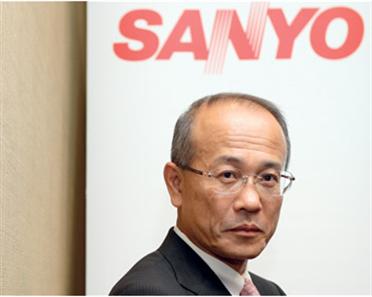
After the Chuetsu earthquake severely damaged Sanyo's semiconductor plant in 2004, the company recorded a huge financial loss for that year. Even in the fiscal year 2005, Sanyo's financial results saw a $2 billion (Dh7.34bn) net loss. Today, the company is back on its feet thanks to its new business strategy, which largely banks on green technologies. As of March 31, 2008, the company has recorded an operating profit of $761m, driven mainly by the increased sale of digital cameras, rechargeable batteries and electronic devices. The world's number one producer of rechargeable batteries aims to increase its operating profit to $1bn by 2010. To attain that, the company will be investing $2bn over the next two years in its clean energy division. The GCC region – which is currently one of Sanyo's smallest markets – is not expected to become a major player for hybrid vehicles or solar panels in the near term, as the government subsidises energy and petrol here. The company, nevertheless, is positive that the momentum in clean technologies in this region would continue to increase, said Takashi Hirao, Chairman of Sanyo Gulf and the Chief Regional Officer of Sanyo Electric, Middle East, Africa and India, in an exclusive interview.
Sanyo has launched a new corporate vision in 2005 as an environmental company, ploughing investment into strong products such as rechargeable batteries, solar photovoltaics, air-conditioning and hybrid car batteries. How is your energy segment now? Are you planning any major capital injection?
The energy segment is very stable and profitable. In this area, we plan to invest $2bn within 2008 to 2010. In the rechargeable battery business, we will increase production capacity of lithium-ion batteries to meet the high demand and invest about $1.3bn on facilities in the said timeframe. We will also establish strategic partnerships in the hybrid electric vehicle business and establish new production bases to further enhance production. In the solar business, Sanyo will promote overseas sales expansion by increasing the production capacity of HIT (Heterojunction with Intrinsic Thin layer) solar cells. We will expand scope of overseas sales to more than $1bn, focusing primarily on Europe and North America for the fiscal year 2010.
Clean energy has indeed become one of the hottest businesses today. The global carbon emissions trading market has more than doubled to $30bn last year. What is your ultimate goal as far as carbon reduction is concerned?
By year 2020, we are aiming at reducing 20 million tonnes of CO2 annually through our HIT solar panels, hybrid electric vehicles and rechargeable batteries portfolios.
How do you plan to apply such a strategy here in this region, which abounds in cheap subsidised electricity and petrol? What are the incentives in using solar panels and hybrid cars in this part of the world?
What we will focus on in this region is to increase the consumer electronics side. We will also enhance our presence here in the consumer air-conditioning business. The solar and hybrid are still new concepts here but the RTA has already launched some projects in this regard. We are also receiving a lot of business enquiries from the UAE Government, like Abu Dhabi's Masdar. Buildings here also need to comply with LEED Building Code Standards. It is surprising how the UAE Government is conscious about energy conservation. This is in line with Sanyo's vision and direction. The greatest demand at the moment is from the US, Europe and Japan. But with oil prices skyrocketing, the demand will eventually get here.
Some energy analysts say solar energy is the way to go in the Gulf where there is plenty of sunlight. Do you expect your solar panels would be able to secure substantial revenues in the region?
Yes. However, currently we are short of silicon, a major component used in manufacturing solar panels. But we're not the only one experiencing this problem. Moreover, most panel manufacturers are developing thin film layer panels, which consumes less silicon, depending on the market and the demand. In the Middle East, for instance, thin film panels should be the way forward.
Industry estimates show that by using gas-powered turbines, the cost of generating one kilowatt hour (KWh) of electricity in Dubai stands at Dh14. By using solar panels, how much would be the cost of electricity per kilowatt hour?
It depends on which country you are in. Here, electricity is very cheap. But in Japan and Germany, electricity costs are so high. Solar power could be cheaper in places such Germany because of government subsidies. In addition, any excess power generated can also be sold to the government.
What are your strategies specific to this region?
By 2010, we intend to continuously expand our market in this region and double our sales to $400 million from last year's $220m. We will focus on five core products, which are projectors, digital movie cameras, biomedical equipment, commercial air-conditioners and HIT solar modules. And the UAE, Saudi Arabia and Turkey will be our main target markets.
Takashi Hirao
Chairman, Sanyo Gulf
He is also the Chief Regional Officer of Sanyo Electric, Middle East, Africa and India. Previously, he was the Vice-President, Sanyo Electric Co Ltd and the General Manager of Overseas Sales and Marketing. Hirao, 53, joined Sanyo in 1977.
He has worked for 13 years in sales in the company's North American subsidiaries. As Manager of the AV Division in the sales department of Sanyo Electric, he led the division until May 2005. In June 2005 he was made the President of Sanyo Fisher Company (USA), a division of Sanyo North America Corporation, following the merger of Sanyo Sales & Marketing with Sanyo Electric. Hirao graduated from the KINKI University in Japan in 1977.
 Follow Emirates 24|7 on Google News.