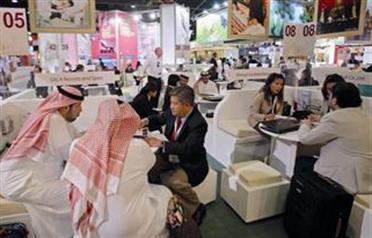
The tourism and hotel industry directly contribute 19 per cent to Dubai's GDP, while their indirect contribution to GDP stands at 32 per cent in 2008. In the last week of February, the average occupancy of five-star beach hotels was 95 per cent with the average room rate for the five-star hotel being Dh1,239. A three-month familiarisation programme – Keep Discovering Dubai – targeting 2,000 tour operators, Mice agents and Media representatives had been launched by DTCM in co-operation with Emirates airlines and other key players of Dubai's tourism industry to provide them a hands-on experience of Dubai. In 2008, Dubai hotels showed an 8.3 per cent increase in the number of hotel guests compared with the previous year, DTCM said. Dubai hotels and hotel apartments played host to 7,531,299 guests as against 6,951,798 in 2007. The guest nights increased by 9.2 per cent in 2008 to touch 22,421,067. The number of hotels and hotel apartments stood at 493, an increase of 11 per cent over the previous year. The average length of stay touched 2.98 compared with 7.3 in 2007. Similarly, the number of hotel establishment rooms increased by 17.9 per cent to reach 50,457 in 2008. Khalid said: "The performance reaffirms that tourism industry in Dubai is healthy and strong. The results confirm excellent growth in almost every segment. The stunning performance also reaffirms the strong co-operation between various organisations in both public and private sectors." He said the department, long before the global financial crisis surfaced with intensity, created a task force with experts and representatives of Dubai tourism industry players, to review the market landscape and take appropriate measures. Based on the inputs provided by the industry players and experts, the department took measures which reflected in hotel occupancies getting a boost even in the first quarter of 2009. The DTCM Director-General said, the department, in co-ordination with the hotels, tour operators and tourism companies, have been working towards boosting hotel occupancies and increasing the number of visitors to the emirate. He said the 2008 performance of Dubai's hospitality industry is a clear reflection of the success of the marketing and promotional initiatives conducted by the DTCM, especially in the markets where it operates a network of 18 overseas offices. The department has participated in several travel and tourism trade exhibitions in addition to holding Dubai Road Shows in 2008. It continues the aggressive agenda in 2009 and the programmes include hosting of workshops and press conferences in the GCC countries, beginning next month, as part of the aim to tap the regional markets potential. The number of hotel guests from the countries where DTCM operates representative offices has been impressive during 2008. There was 24 per cent increase from Americas, while 15 per cent growth was recorded from Australia and New Zealand. The Far East region's growth was 15 per cent, while France reported 27 per cent increase. Germany posted seven per cent increase, while India witnessed 20 per cent growth followed by Italy and Russia/CIS and Baltics regions with 31 per cent and eight per cent, respectively. The Scandinavian region recorded 27 per cent growth with South Africa posting 27 per cent growth. Sustainable tourism The environmental programme which aims to reduce hotel carbon emissions by 20 per cent by 2011 saw a soft launch late last year and has already enrolled a number of prominent five-star properties in Dubai. "By participating in this initiative hotels will not only protect our environment and benefit from lower utility costs, they will be seen as good corporate citizens at home and abroad," said Shaikha Ebrahim Al Mutawa, DTCM's Director of Business Development Department and Director of Environmental Committee CO2 Reduction Programme. "The travel industry is incredibly value-driven at the moment with rates being a major factor of the decision making process. By embracing sustainability initiatives, Dubai hotels can gain a competitive edge, that would undoubtedly have a positive impact on like-minded tour operators," she added. A detailed roadmap, with clear phases, timelines, target dates, and benchmarks aimed at progressing the initiative for sustainable tourism, will be communicated to all of Dubai's hotels and hotel-apartments shortly. Some of the hotels which have signed-up so far include, Emirates Towers, Madinat Jumeirah, Movenpick Hotel and The One & Only Royal Mirage. Dubai hotels generally still lag behind their counterparts in Europe, where the average hotel produces 3,000 tonnes of CO2 emissions per annum. In Dubai that figure is 6,500 tonnes and the size of the carbon footprint produced by all hotels in Dubai, is well over 500 million kilos a year. That is equivalent to 60,000 round-trip flights between Dubai and London. According to Markus Oberlin, General Manager of Farnek Avireal Middle East, some hotel managers w