- City Fajr Shuruq Duhr Asr Magrib Isha
- Dubai 04:20 05:42 12:28 15:53 19:08 20:30

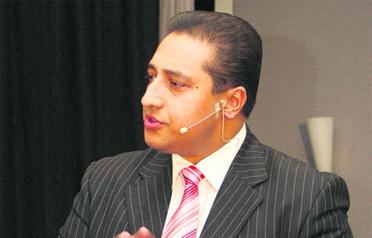
Athwal says companies want results (SUPPLIED)
At a time when many executives are doing all they can to hold on to their jobs, Patricia Tellis has given up hers to go back to school halfway around the world.
The corporate communications professional boards a Dubai-Sydney flight today to study for an 18-month master's programme in strategic marketing. "This global downturn is the best time to broaden my skill set as well as to take a sabbatical," she says, between selling her car and making crucial packing decisions.
"A lot of companies are adopting a wait-and-watch approach in the current scenario and constrained budgets mean a limited scope of work in public relations and marketing. So really this is the best time to get away."
Tellis, 37, is among a slew of mid-career professionals who have either quit their jobs or are using redundancy to return to studying.
Economic downturns have traditionally heralded a surge in applications to top business schools as professionals see a natural opportunity for an on-campus career break or seek to enhance longer-term prospects. According to a report from the Graduate Management Admission Council, the association of leading graduate business schools worldwide, 77 per cent of full-time MBA programmes surveyed said they saw application levels increase in 2008.
Part-time and executive MBA programmes also reported a surge in applications. And here in the UAE applications for MBA programmes for the January intake at Manchester Business School Worldwide, whose Middle East centre is in Dubai, rose 18 per cent compared to its previous intake in July.
"Our MBA students are all experienced middle and senior managers from around the region looking for career development and very often have to use their own initiative to acquire it," says Chris Higgins, Regional Director – Middle East, at MBS Worldwide. His colleague at the school's home campus, Chief Global Officer Nigel Banister, says the trend holds true even in the UK.
Applications for the full-time MBA programme at top Canadian business school Queen's are up 75 per cent, confirms Jillian McCullough, Programme Manager, Gulf Region for its Executive Development Centre in Dubai. And the class size has been expanded to keep pace.
But the trend isn't restricted to MBAs. Applications and inquiries are also up at the prestigious Fletcher School of Law and Diplomacy at Massachusetts' Tufts University, says Senior Associate Dean Deborah Winslow Nutter. The school is seeing increased interest at its full-time, two-year Master of Arts in Law and Diplomacy as well as its flexible one-year Global Master of Arts programme (GMAP) in international affairs, aimed at mid-level to senior professionals.
"Our incoming GMAP class is 10 to 15 per cent larger, while applications for our onsite programmes are up between seven and 10 per cent," says Nutter. With the Gulf states contributing more students than ever, she and her colleagues will be in Dubai and Abu Dhabi from March 23 to 25 to engage in recruitment efforts and meet prospective students.
Other universities targeting the region this month include the University of York and the University of Pennsylvania's Wharton School of Business. And education consultants Intelligent Partners will host a workshop in Dubai from April 10-12 to assist students with admissions to Oxbridge and Ivy league universities.
The downturn is at least partly responsible for the increased number of mid-career professionals opting to go back to the classroom. As salary levels stagnate and promotions are deferred, even those executives who are currently employed are considering whether a return to university may not improve their prospects.
"The opportunity cost to take time out and retrain is much lower in a recession than at any other time," says Raymi van der Spek, Vice-President, Administration at the University of Wollongong in Dubai. "If you take time out you're not missing out."
Manchester Business School's Higgins cites the example of the UAE's massive construction sector, where experience has often been a substitute for education. But as younger people come in armed with MBAs, the first question older executives are asked in job interviews is which university they got their master's from – prompting them to study further simply to advance their careers.
"People are realising that to be more competitive you need something extra," he says. "It's not that people have more time on their hands, just that to simply hold on to their jobs in many cases they need better qualifications."
Human resources expert Amer Zureikat, Regional Manager at recruitment website Bayt.com, says: "Many mid-level to senior executives who are unable to secure positions with their employers of choice, in their field of choice or at the salary level perceived commensurate with their experience and skills are choosing to retrain or upgrade their skills rather than compromise. They aim to increase their competitiveness in the job market and their perceived added value to employers."
At the top-end schools, simply connecting with other students – or alumni – can open the door to new opportunities and contacts. Fletcher's strength, for example, lies in being able to introduce its students to a network of alumni that includes several ambassadors, UN bureaucrats, top executives in Fortune 50 companies and even some UAE royals, says Nutter.
"One recent student wrote to every single alumnus working in the field he wanted to get into – and ended up with 12 job offers, even in the current economic climate," she says, telling of how one engineer was able to transition into a career with the UNDP, while a newswire journalist now works with a soverign wealth fund. Stories such as these seem to be the norm at Fletcher, and are one of its principal attractions for mid-career professionals.
But victims of the recession are also among those retraining – in the hope that they can find work in more robust industries that haven't been as badly affected by the meltdown. When the economy picks up, they hope, they will be better positioned to be rehired at an attractive salary in an attractive position.
Nowshir Engineer, Founder and Executive Director at the Knowledge Village-based EMDI Institute of Media and Communication, says he is busier than ever. An increased demand for advertising, journalism, graphic design and audio engineering staff has prompted him to launch part-time vocational courses catering to UAE residents.
With the banking and construction sectors among the worst hit by the slowdown, he says professionals in those fields are seeking training in fields perceived as offering greater opportunities. And they are attracted to institutes that set up placement interviews, such as his."I'm often asked if I can guarantee a job for a potential student – I can't. We're not a recruitment agency, but we can get you an interview."
This is where individual talent comes in. Human capital expert and author Reg Athwal, often referred to as Mr Unleash Your DNA, says there's no point in learning new skills if you don't have an aptitude or aren't interested in a career that will use those skills. "Everybody must discover their real talent and capitalise on it," he says. "You may retrain and find a new job, but if it isn't a career that drives you, you can end up wasting another 10 years of your life. Besides, companies want results and not skills."
The flexible option
As budgets are slashed and vacancies go unfilled, those lucky enough to be employed have less time on their hands than ever.
Worse, they risk losing out to people who have used the downturn to pad out their CVs and make themselves more attractive to employers.
It is to cater to these harried wage slaves that universities and educational institutions are increasingly taking a flexible approach to education. The all-in-one Global Master of Arts programme at Tufts University's Fletcher School of Law and Diplomacy, for instance, only requires three two-week residencies over the course of the year-long programme with the rest of the course mediated over the internet. That flexibility is invaluable in a downturn.
At the Manchester Business School Worldwide, Chris Higgins, acting director at the school's Middle Eastern campus, says the programme is designed to be portable.
Ergo, if any of the 50-odd nationalities that comprise its student mix should need to return to their home country or be transferred to another area of the world, they will be able to move their course to an administrative base near them and take exams at a local British Council office. (KJF)
 Follow Emirates 24|7 on Google News.