- City Fajr Shuruq Duhr Asr Magrib Isha
- Dubai 04:20 05:42 12:28 15:53 19:08 20:30

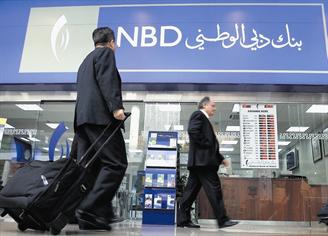
The WEF report lauded the UAE for its highly efficient banking system. (SATISH KUMAR)
The United Arab Emirates has topped the regional rankings in the World Economic Forum's inaugural Financial Development Index, launched yesterday.
The WEF's index, which analyses financial systems, capital markets around the world and benchmarks financial system development to support economic growth in emerging markets, ranks the UAE overall at the 16th spot, out of the 52 countries surveyed for the report.
The UAE achieves the highest ranking of all Middle Eastern countries in the Financial Development Index, displaying a varied performance across the different elements of its financial system. However, its highly efficient banking system (first position) contrasts with poor financial information disclosure (48th). The report highlights that the UAE's business environment is strengthened by a highly favourable, non-distortionary tax regime (first), but is hamstrung by the relatively low quality of training and education underpinning the development of human capital.
The institutional environment benefits from a low burden of government regulation (fifth position), but the country scores low marks for corporate governance dragged down by ineffective corporate boards and a lack of incentive-based compensation, states the report. According to the WEF's report, access to capital is a strong point of the federation's business environment, particularly to traditional forms of financing such as private credit and loans. "The UAE seems to provide strong access to capital for its businesses despite a relatively lower ranking with respect to its depth of financial assets," the report said.
The Financial Development Report 2008, which promotes the full potential of financial systems to drive economic growth in developing countries, provides a ranking of 52 of the world's leading financial systems through which countries can benchmark their performance and evaluate priorities for reform.
"In this time of uncertainty, where the potential to recast many aspects of our financial systems exists, it is important to take a holistic perspective and consider all the different factors that contribute to the development of financial systems and the beneficial impact they can have on the lives of many. It is in the spirit of providing this informed and shared perspective that the World Economic Forum has undertaken the publication of The Financial Development Report 2008," said Klaus Schwab, Executive Chairman of the WEF.
The rankings are based on more than 120 variables spanning institutional and business environments, financial stability, and size and depth of capital markets, among other factors, in assessing the complex financial systems of the 52 countries studied.
Globally, defying the crisis, the United States and the United Kingdom top the WEF's inaugural Financial Development Index.
The US narrowly edged the UK to take the top position in the Financial Development Index.
The US and the UK have close rankings, outstripping the remaining countries in the top 10 – Germany, Japan, Canada, France, Switzerland, Hong Kong, Netherlands and Singapore.
An important and unique measure captured by the index includes the degree to which businesses feel they can easily access capital. The report draws on data taken from a variety of publicly available sources as well as the WEF's Executive Opinion Survey, a comprehensive annual survey conducted by the WEF with its network of partner institutes.
Regionally, the UAE is followed by Kuwait, which manages an overall rank of 26. Like the other Gulf countries, Kuwait offers a highly favourable tax regime that is enhanced by a low cost of doing business. Its equity markets are well developed for a country of its size. However, this factor does not translate to successful non-bank intermediaries, which captured the lowest score on the Financial Development Index. Although its banks are efficient, similar to the UAE, they have low levels of financial disclosure, the WEF report added.
Like the UAE, Saudi Arabia (27th) achieves high marks for the stability of its financial system (third position). The country's favourable tax regime is an asset to its business environment, but this success is offset by the relatively low quality of human capital (42nd) and infrastructure (35th). Saudi Arabia's well-capitalised stock markets are active, but its non-bank financial intermediaries are weak, particularly with respect to M&A activity, securitisation and insurance, the report said. Saudi Arabia's active stock exchange does not appear to translate to a high degree of access to the equity markets for end users of capital, the report added.
Bahrain placed below Saudi Arabia, shows significant advantages in terms of the quality of its institutional environment, including a fully liberalised domestic financial sector (first). Its taxes are low and non-distortionary, but the relatively poor quality of human capital proves a disadvantage .
Egypt scored 37th on the overall Financial Development Index.
 Follow Emirates 24|7 on Google News.