- City Fajr Shuruq Duhr Asr Magrib Isha
- Dubai 04:20 05:42 12:28 15:53 19:08 20:30

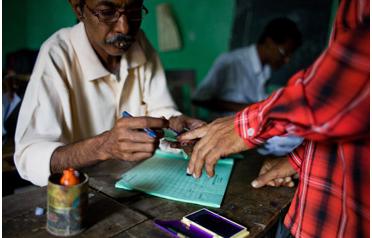
A man has his finger stained with ink, by an election official, as he registers to cast his vote at a polling station in the Muslim dominated town of Mukalmua, near Guwahati, India. (GETTY IMAGES)
Coming only months after Islamist militants killed 166 people in a three-day rampage in Mumbai, the campaign for the general election now being held in stages between April 16 and May 13 could have been overshadowed by communal demagoguery.
Some tensions have flared, but debates have turned out to be focused far more on local issues across this huge country. Moreover, the Hindu nationalist Bharatiya Janata Party (BJP), the main opposition force, has toned down its religious pitch.
The soft-pedalling of religion highlights how the BJP has struggled to find a campaign appealing both to core supporters as well as more moderate middle class supporters unmoved by communal politics, but who back the party's pro-business stance.
"The BJP is not able to exploit religious identity as much as in the past," said Asghar Ali Engineer, a Muslim scholar and champion of interreligious cooperation who heads the Centre for Study of Society and Secularism in Mumbai.
"Local problems have assumed a greater importance," he told Reuters in his office in India's bustling finance and film capital. "The BJP leadership has to exercise caution – if they're seen as extremists, they will not be voted to power."
In Nashik, a major Hindu pilgrimage centre 180 km northeast of Mumbai, religious leaders said interfaith relations at the grass roots level were better than campaign rhetoric suggested.
"There was no 'Mumbai effect' here," said Pradnyasagar, chairman of the local Buddhist temple, referring to a feared backlash against Muslims. "The politicians make problems before every election," Imam Mohammad Ismael said at his mosque. "After the elections, it's calm again."
SHIFTING LOYALTIES
The calm is relative. Tensions remain high after recent anti-Christian riots in Orissa state, while the killing of 2,500 people – mostly Muslims – in Gujarat in 2002 has dogged Hindu nationalist leaders in the state.
Hindus make up 80 per cent of India's 1.1 billion population, followed by Muslims at 13 per cent, Christians at 2.3 per cent, Sikhs at 1.8 per cent and Buddhists at 0.8 per cent.
But faith competes for voters' attention with caste, class and local loyalties. The Hindu vote is split among two national and several regional parties while Muslims are no longer the "vote bank" they once were for the governing Congress Party.
"The Muslim vote is no more a monolithic object to be had by one party," said political scientist SAM Pasha at Jamia Milia Islamia university. "Muslims now vote for whichever party they think will safeguard their interest in that particular region."
Chief Minister Nitish Kumar of Bihar state is a BJP ally but believes economic growth now trumps the old caste loyalties. "Development breaks down all the caste barriers," he says.
In Uttar Pradesh state, Chief Minister Mayawati, a long shot to become India's next prime minister, heads a party that allies her own Dalit (untouchable) caste with top-drawer Brahmins.
Some Hindu nationalists who have played the religion card have seen it backfire. Varun Gandhi, an estranged member of India's powerful Nehru-Gandhi dynasty, was arrested after allegedly threatening to cut off the hands of anyone harming Hindus and comparing a Muslim rival to Osama bin Laden.
The BJP distanced itself from his comments but it was a major embarrassment to the party and its stress on moderate policies.
But while it publicly denounces divisive politics, the BJP remains close to Hindu radical groups such as the Rashtriya Swayamsevak Sangh (National Volunteer Corps - RSS) and Shiv Sena. Communal violence mars some states where it governs.
At least 38 people were killed and scores wounded in Orissa last year in waves of anti-Christian violence. Tens of thousands of Christians fled their homes and India's Supreme Court had to order the state government to assure their security.
This January in Karnataka, Hindu hardliners dubbed "India's Taliban" attacked women in a pub in a self-proclaimed drive to uphold traditional Indian culture against Western influences.
Roman Catholic Archbishop Felix Machado, a former top Vatican official, has met several times with other faith leaders since arriving in Nashik last year.
A picture of him hugging a Hindu swami was prominently displayed in local media, a sign of howmany religious leaders were trying to ensure religious tensions were muted in this election year.
Keep up with the latest business news from the region with the Emirates Business 24|7 daily newsletter. To subscribe to the newsletter, please click here.
 Follow Emirates 24|7 on Google News.