- City Fajr Shuruq Duhr Asr Magrib Isha
- Dubai 04:20 05:42 12:28 15:53 19:08 20:30

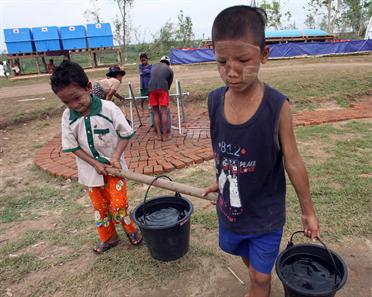
Children carry drinking water at a camp for people displaced from Cyclone Nargis in the Irrawaddy Delta town of Labutta, some 320 kms from Myanmar's largest city of Yangon. (AFP)
The storm left a trail of destruction across the city, ripping off roofs, uprooting century-old trees and tossing them onto cars.
But the destruction here was mild compared to the Irrawaddy Delta, where entire villages were washed away and where most of the 133,000 dead or missing lived.
The United Nations estimates that about one million people in the delta are still without international aid, while the poor around Yangon are receiving at least some support.
Cho Cho still has her job teaching English, but says even her middle-class family is worried about how they will survive the months to come in a country that was already among the poorest in the world.
"My father spent all of his money on repairs," said the 29-year-old, who lives with her parents.
Much of the city's water system was damaged by the storm, and without electricity to power the pumps, there's no way to get water into Cho Cho's building.
They can rent a generator, but this costs nearly $8 an hour. Pumping water into the building takes about five hours, and the $40 it would cost is more than what some families pay in rent each month.
"We'd need to buy fuel on the black market to make the generator work, because fuel is rationed," she told AFP.
Fuel prices more than doubled after the storm, though the price has eased a little as supplies have resumed again.
For families in top-floor apartments, their bigger priority has been shelter, because many of their roofs were blown away by the storm. The price of corrugated metal has doubled, but people have been forced to buy it because of the daily monsoon rains.
"Those who could not afford metal bought tarpaulins. Those who don't have enough money have gone to live somewhere else, and their apartments have been flooded by rain," Cho Cho added.
To add to this new list of worries, Yangon's residents also have to cope with the high price of rice.
Ju Ju, who works for a medical instrument import company, had to give up good quality rice after the price jumped 50 per cent to 45,000 kyats ($40) for a 24-pound bag.
That was unaffordable on her 80,000-kyat salary and her mother's dismal pension of 1,600 kyats, the price of about three packets of cigarettes.
"Even if we have money, here in Yangon, we can't buy the rice that we want. Officials are stockpiling it and waiting to sell it for a higher price," she said.
"Also, we don't know what will happen with the next harvest. Next year rice will be even more expensive," she added.
Crops in the Irrawaddy Delta, Myanmar's most important rice-growing region, were flooded by sea water. Residents there have lost everything and are still waiting for help.
If crops aren't in the ground by the end of June, farmers will have missed the planting season, prompting experts to warn of shortages and even famine.
The delta was also the main source for charcoal used throughout Myanmar for cooking and manufacturing. After the cyclone, the price of charcoal went up 20 percent.
"Even though they aren't considered poor, many people are having huge difficulties," said Cho Cho.
Despite their struggles, many people in Yangon are still using their meagre resources to buy food and clothing to send into the delta, helping people in even more desperate need.
 Follow Emirates 24|7 on Google News.