- City Fajr Shuruq Duhr Asr Magrib Isha
- Dubai 04:20 05:42 12:28 15:53 19:08 20:30

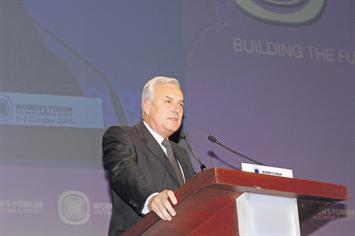
People in the Middle East have a strong sense of optimism and sophistication and appreciate luxury, said Bernard Fornas. (EB FILE)
Luxury jewellery and watch company Cartier is forging ahead with its expansion plans in emerging markets such as the Middle East and China despite the global recession.
"In recent years we have positioned ourselves strongly in new markets," Bernard Fornas, President and CEO of Cartier International, told Emirates Business. "Since 2000 we have developed a great network of Cartier boutiques worldwide. We are the number one luxury brand in China, the Middle East, Russia and the CIS countries.
"With 300 boutiques worldwide, we have a wide presence already. The Middle East has been growing strategically over the last few years and its growth has contributed to Cartier's expansion in Dubai and the Gulf region.
"While we cannot divulge statistics, we can say that the Middle East has been one of the fastest growing regions for Cartier over the past few years."
How does Cartier view the Middle East market?
The Middle East has great potential for the luxury goods industry and is populated by high-net-worth individuals. People in this region have a strong sense of optimism and sophistication and appreciate luxury.
We see great potential for bespoke creations in the Middle East as luxury is all about being unique. This works in our favour as from jewellery to watches, accessories and even fragrance, made-to-measure is one major aspect Cartier has historically focused on.
Which is your biggest market globally?
Today's world is a global one and our customers have adapted to this way of life. They travel a lot and buy wherever they are residing at the time of their purchase.
Do you think the luxury goods market is set to see difficult days with the world economy heading into recession?
The international context is alarming but Cartier has been through many rough times in its history, including world wars and recessions, and has always come out strong. Unlike fashion brands, Cartier's creations are resistant to trends and have proven to be timeless and passed on for generations. Our house is renowned for its creativity and customers are turning to names they know and trust. Cartier has a reputation as the king of jewellers and clients feel reassured by the quality and inventiveness of our products.
Has the downturn hit your sales?
More than ever in a period of economical turmoil, Cartier is appreciated for what it stands for: The search for savoir faire, exception, temporal beauty and heirloom value.
What about expansion, has the crisis forced you to shelve any plans?
With 300 boutiques worldwide we have a wide presence already. However, we will keep on opening in China and plan more than 30 boutiques there next year. We plan to open boutiques in Macau or in other Eastern countries. The pioneering spirit is a founding value of Cartier. That's the reason we have grown in the past and why we are broadening our horizons today and in the future. In recent years we have positioned ourselves strongly in new markets.
Since 2000 we have developed a great network of Cartier boutiques worldwide. We are the number one luxury brand in China, the Middle East, Russia and the CIS countries. We have taken risks but not without careful consideration. Looking back, I can sincerely say that I am glad that we have dared to take on these challenges.
Have you any expansion plans for the region?
The Middle East has been growing strategically over the last few years and its growth has contributed to Cartier's expansion in Dubai and the Gulf region. Cartier is investing in expanding its boutique network in the region. While we cannot divulge statistics, we can say that the Middle East has been one of the fastest growing regions for Cartier over the last few years.
Cartier is investing in beautiful stores in the most prominent areas. For instance, Cartier has just opened its largest boutique in the Middle East to date in the Dubai Mall. We have also just opened a second boutique in Qatar and will open new boutiques soon in Jeddah, Khobar in Saudi Arabia and Bahrain. And we plan to open another boutique in Kuwait.
What is your core growth strategy?
Ten product segments and a sound and stable presence all over the world are behind the success of Cartier. We are like a human being with five arms and 10 legs. This gives us resistance against events in any of those regions and against any slowdown of business in individual segments.
We can balance our business because we are so diversified. Another asset is creativity. In the high-end jewellery and watch industry there are many active brands. The competition is high and everyone tries to reach the top. To me Cartier's creativity makes the difference. But creativity is not our only success factor, it is not just about the development of the right product.
It has to be available at the right time, in the right location and in the right quantities. The supply chain and the whole logistics process are crucial. At Cartier we are one team: The designers, production staff and the development division.
What are the largest selling products here?
Our most sought-after creations are those that have been recognised as icons of the house of Cartier, such as the Santos watch, created in 1904 for the Brazilian aviator Alberto Santos-Dumont, and the more recently launched Ballon Bleu de Cartier watch with its rounded dial and blue crown.
Other examples are the Trinity ring, adopted by French poet Jean Cocteau, which consists of three intertwined bands, in platinum, pink gold and yellow gold, the love bracelet, which has become the timeless piece for love and commitment, and pure signature collections such as Panther.
Last but not least, the Marcello de Cartier handbag tattooed with the famous double C medallion has become a much sought-after fashion accessory. These jewellery, watches and accessory collections have become cult objects and emblems of our times.
Any plans to launch new products in 2009?
We recently created the exclusive Santos 100 watch with the Arabian horse motif on the occasion of the opening of the Cartier boutique in the Dubai Mall. This limited edition of 20 watches specifically caters to the tastes of the region. On an international level, we will be launching a new Trinity collection this spring and a new high-end jewellery creation next fall. Our new high-end watch collection, which we presented at the SIHH fair in Geneva this January, will be on sale from September.
How do you handle the competition?
We continue to ensure awareness of our creations through new launches and the events we organise. Also, we strive to build long-term relationships with our clients. We view them not just as the buyers of our products but as individuals who understand the significance of everything Cartier has to offer.
What is the secret of Cartier's success?
For more than 160 years Cartier has initiated most of the styles that exist today and has always been ahead of its time. Louis Cartier's goal was to establish a new frontier for taste and today Cartier has the same ambition. What we do is give a future to our past, and our past is so rich that our future is going to be even richer.
How was 2008 for Cartier in terms of growth and profits worldwide?
The year started on a very positive note then slowed down, as you would expect. But the results were varied. There were geographical regions that continued to perform very well, such as the Middle East and Asian countries, especially China. On the other hand the US did not fare well and Japan proved to be a difficult market.
PROFILE: Bernard Fornas CEO of Cartier International
Fornas became President and CEO of Cartier International in November 2002. He was previously Chairman and Managing Director of Baume et Mercier. He graduated from the Ecole Supérieure de Commerce in Lyon, France, in 1970 and obtained an MBA from Northwestern University's Kellogg School of Management in the US in 1972.
Fornas began his professional career at Procter & Gamble and from there went on to work for Camay, the International Gold Corporation and Guerlain.
In April 1994 he joined Cartier International as International Marketing Director and in January 2000 he was appointed Corporate Marketing Manager, responsible for the marketing of all Cartier products, including jewellery and luxury jewellery.
He left to join Baume et Mercier in November 2001 before rejoining Cartier in 2002.
 Follow Emirates 24|7 on Google News.