- City Fajr Shuruq Duhr Asr Magrib Isha
- Dubai 04:20 05:42 12:28 15:53 19:08 20:30

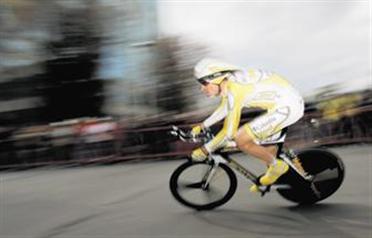
Brands are gaining increased exposure thanks to their involvement in cycling teams such as Columbia-Highroad. (GETTY IMAGES)
New team sponsor logos will mingle with the old as the riders pass over the hard cobbles of Belgium to race this cycling-mad nation's most important one-day classic, the Tour of Flanders, this week.
In early-season races this term, last year's most successful team, Columbia-Highroad, parked their motorhome in the same church square in Ghent as fellow US squad Garmin-Slipstream, just across from the buses of new entrants from Russia and the Netherlands.
Team owners say cycling is a cheap path to pan-European brand awareness and this year sponsors have come to bike racing seeking inexpensive sports marketing deals.
"The last time we did a cross-sport analysis, cycling was about a buck twenty-five," said Columbia-Highroad's owner Bob Stapleton, speaking of the sponsors' return on investment as a ratio of cost per one thousand media impressions, or CPM.
"Formula One teams were about 25-30 euros per CPM... and then football was about 35.
"If we look at our results last year we were down in the 20-30 cents per thousand range," said Stapleton, ahead of the Tour of Flanders, which starts this week.
Columbia-Highroad won 85 races in 2008, including five stages and 20 podium appearances at the illustrious Tour de France.
"For €5m (Dh24m) a year, you can get a lot of exposure in cycling," said Stapleton.
European sports advertising was worth around €5.3 billion in 2008, according to Italian sports marketing group StageUp. As companies slash an expected 11.3 per cent from those budgets in 2009, cycling looks like a bargain deal.
Team Vacansoleil, sponsored by a holiday campsite operator with sites in 15 European countries, is run by accountant Daan Luijkx, who said full naming rights and nine months of televised racing made cycling team sponsorship attractive to businesses.
"In the past, Vacansoleil sponsored a lot of football teams in all their countries, one in England, one in Belgium, one in Holland, one in France. Now they have put their budget together and now they have their own team," said Luijkx.
"Unlike in football, where Ajax will always be Ajax, never the ABN-AMRO team, this team will be called Vacansoleil for at least three years, and probably four to six."
Europe's two most popular spectator sports, Formula One and football, are facing budget contractions as sponsors draw away from expensive deals in search of cheaper ways to advertise.
The English FA's chairman David Triesman said last year that English football was collectively £3bn (15.68bn) in debt, and that he could not rule out a top club collapsing.
Manchester United's record £56.5m jersey sponsorship agreement with American International Group (AIG) will not be renewed when it expires in May next year, after the insurance company's repeated bailouts by the US government. AIG have also been discussing the current deal with the club.
Honda have pulled out of Formula One as a result of the global credit crunch and concern lingers over the commitment of fellow carmakers Toyota and Renault.
Russian cycling team Katyusha, newly formed this year with a €20m, Kremlin-funded budget as a child health education programme, has no commercial goals for its sponsors.
"The oil and gas companies that make up our sponsors, Itera – Gazprom and Rosstechnology – have no need for advertising," said Andrey Tchmil, Katyusha's team manager.
"Our project is global cycling awareness for Russian youth; to get kids involved in sport, away from bad habits."
To compete with Katyusha's non-commercial goals, fill budget gaps and add cash where sometimes sponsorship means discounted equipment and stocks of water bottles, US team Garmin-Slipstream created fan-club sponsorships.
"For us to be competitive with a team funded by a government, we have to have a similar-sized budget in order to recruit athletes of a similar calibre," said Jonathan Vaughters, manager of Garmin-Slipstream.
"It's a way to make up that 10-20 per cent gap between a commercial sponsor, who is able to give X amount of dollars because they can justify it with strict marketing metrics, and a government that can just plunk down a hunk of cash," he said.
 Follow Emirates 24|7 on Google News.