- City Fajr Shuruq Duhr Asr Magrib Isha
- Dubai 04:20 05:42 12:28 15:53 19:08 20:30

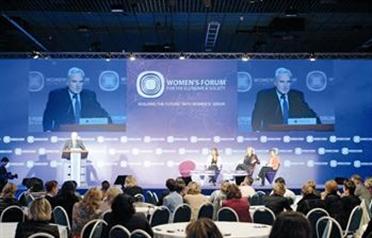
Women from 70 countries participated in the initiative this year. (SUPPLIED)
Businesswomen play a vital role in building a vibrant economy – and no country understands this better than the UAE.
Women here have been encouraged to step out of their traditional roles and progressive leaders and businesswomen such as Sheikha Lubna Al Qasimi, Minister of Foreign Trade, and Raja Al Gurg have emerged.
To celebrate the achievements of female entrepreneurs Cartier has teamed up with the Women's Forum, McKinsey and the Insead management school to set up the Cartier Women's Initiative Awards.
This unique business plan competition for female entrepreneurs was created in 2006 and each year the awards are presented to women who have creative, sustainable and socially responsible business ideas.
Each year five laureates – one from each continent – receive personalised coaching support for 12 months and a grant of $20,000 (Dh73,460) plus follow-up coaching.
Emirates Business spoke to Bernard Fornas, chief executive officer and president of Cartier International, and also to some of the winners of last year's contest to find out more about the awards and how they help budding businesswomen.
—What was the inspiration behind the awards scheme and what is its objective?
—Cartier started supporting the Women's Forum for the Economy and Society, which was founded in 2005, because we shared its belief that women have a key role to play in the 21st century. A year later, wanting to bring the partnership a step further and eager to take action, we joined forces with McKinsey and Insead to create a programme that would have a concrete impact on women's lives. That's how we came up with the idea of the Cartier Women's Initiative Awards, an international business plan competition for budding women entrepreneurs.
The objective of the awards is to identify, to encourage and to accompany women entrepreneurs around the world. Fifteen entrepreneurs, three per continent, are selected in the first round on the basis of their application forms and five winners, one per continent, are nominated in the second round after careful evaluation of their detailed business plans and verbal presentations. Between these two rounds we offer coaching.
After the finals we offer additional coaching for a year as well in addition to the $20,000 grants. I think the distinctiveness of the awards lies in the coaching and the human experience we have to offer our finalists and laureates. This initiative is part of a broader company philosophy that includes both philanthropy and social responsibility. This includes the support of contemporary art through the Foundation Cartier and the promotion of ethical jewellery practices through the Council for Responsible Jewellery Practices.
Our corporate social responsibility is about responsible ways of doing business and our philanthropy projects are additional programmes we believe to be important to promote our vision of the world. In that sense the awards are part of our philanthropy policy, closely linked to our corporate social responsibility.
—How many countries participated in the initiative this year and of these how many participants were from the Middle East?
—This year about 70 countries were represented but we received just a few applications from the Middle East. That's why I take this opportunity to strongly encourage women from the UAE and neighbouring countries to join our competition in 2009 by applying online on cartierwomensinitiat-ive.com. It provides exposure and a experience for start-up entrepreneurs.
—Is there any support from the UAE Government for this initiative?
—We receive strong support from the UAE Government through the active involvement of Sheikha Lubna, who serves as jury president for our Asian selection panel. The insight and knowledge she was able to share with us during last year's jury deliberation meetings were incredibly valuable. She has renewed her commitment this year and we are extremely grateful given her high position and busy schedule.
—What are the main criteria for choosing the finalists and winners?
—The projects received are evaluated on criteria of creativity (is the business original?), sustainability (is it financially viable?) and impact (can it contribute to social development?). During the final selection round the juries evaluate the candidates' detailed business plans and verbal presentations. The question-and-answer session following each verbal presentation is equally important.
—What types of businesses have been supported and established successfully so far?
—This year, among our finalists, we have projects in foodstuffs, services, the internet, leather goods, motorsports apparel and even biotechnology. So it's quite diverse. In 2007 the winners all had very different projects too. Lucia Avoaka, 2007 laureate for Africa, is involved in a community health passport system based on monthly subscription fees enabling to provide healthcare both to low and middle-income patients in the underprivileged region of Abobo, Côte d'Ivoire.
Since winning the Cartier Women's Initiative Awards Lucia has received the Prix d'Excellence Special Award of the Jury by the Order of Medical Doctors in Côte d'Ivoire. Her current objective is to extend her idea to the entire city of Abidjan. She is working with a McKinsey coach.
Nandini Pandhi Narula and Yasmina McCarty, the 2007 laureates for Asia, have created GreenMango, a mobile phone-based virtual marketplace for low-income entrepreneurs and their customers in the city of Hyderabad, India. Since winning they have hired staff, set up offices and launched their pilot website, www.greenmangoindia.com.
The 2007 European laureate, Bettina Götzenberger, is the founder of LomasLEGAL, a low-cost law agency on the high-street providing legal services through a network of franchise stores and over the phone. Since winning Bettina has opened several new shops in Spain and the first master-franchise in Mexico. She has also made her services available over the internet on www.lomaslegal.com with new products that complement the shop business. Antonia Sanin, the 2007 laureate for Latin America, competed with her business The Globe, a day-care centre for children offering innovative educational products and services such as multimedia stories, workshops, manuals and blogs.
Thanks to the awards she was able to move to new premises three times larger than her previous ones and benefited greatly from the media exposure in her country and her collaboration with McKinsey mentors on the marketing aspects. There are many others.
—What type of training and support have these businesses received?
—The Cartier Women's Initiative Awards offer coaching aimed at preparing the winners to approach investors. The follow-up support lasts one year after the awards ceremony so it's a serious commitment. In 2007 coaches helped the European and African laureates in financials and business plan writing, the Asians in their strategy and business model, the North Americans in their public relations and the Latin American in her marketing and implementation schedule.
Additional advantages include the credibility associated with Cartier, McKinsey and Insead's names and the media visibility. Many finalists mention the confidence that their participation has given them. To create one's own business is hard so a push in the right direction gives added impetus.
Last year's winners
Yasmina McCarthy and Nandini Narula, founders of Indian marketing platform GreenMango and Asian laureates in the Cartier Women's Initiative Awards 2007, spoke to Emirates Business.
—How did the idea of setting up your own business come up?
—We founded GreenMango to provide low-income entrepreneurs with the business services they need to reach their full potential. GreenMango is an affordable, accessible marketing platform designed to help small entrepreneurs in developing countries grow their businesses. It gives them access to new sales channels, enables them to market their businesses to new customers and validates their work through the reviews of their past customers. GreenMango centralises credible information and its multiple access points – the internet, in-person and SMS – reach low-income segments in India.
By bringing these small businesses online and giving them the power to market and promote themselves, GreenMango levels the playing field for small entrepreneurs to compete with other local businesses.
—How did you hear about the Cartier Women's Initiative Awards?
—We learned about the awards through a posting on a business school list. Winning the award helped GreenMango gain credibility for other investors and build awareness through public relations.
—Do you feel that the training they provided helped you to become successful businesswomen?
—The mentoring we received through Insead and McKinsey provided highly valuable strategic inputs to make the GreenMango business model stronger. The coaching helped us to develop a really strong business plan that we were able to use throughout the fundraising process.
Since winning in 2007 GreenMango has launched its operations in Hyderabad, India, built a dynamic team of employees and worked with thousands of low-income entrepreneurs. It is now expanding the business throughout Hyderabad. In the coming years we will expand across cities all over India and later into other developing countries.
How to apply
Every woman with an interesting business idea can apply online at www.cartierwomensinitiative.com/register from October 18 by filling in the registration form. The questions asked relate to the business project and the completed form is the equivalent of a short business plan.
The application period for the 2009 awards runs from October 18, 2008, to February 13, 2009.
 Follow Emirates 24|7 on Google News.