- City Fajr Shuruq Duhr Asr Magrib Isha
- Dubai 04:20 05:42 12:28 15:53 19:08 20:30

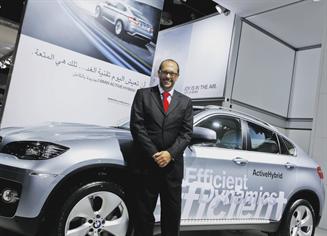
Phil Horton says hybrid technology is the future for BMW. (ASHOK VERMA)
Global launches, regional launches, million dollar cars and spanking customisations always make for an entertaining motor show. And while manufacturers look for trade partners and peddle their wares to rich garages, the focus for many at this year's Dubai Motor Show has been sustainability.
The word "hybrid" is plastered across most stands with companies keen to show off their progress in what is set to be an industry milestone and the starting point for future cars.
This region is still far removed from the global need for environmently friendly cars as oil prices remain subsidised, diesel engine cars almost non-existent and pollution an ignored concern. It also escapes from other issues brought on by large populations.
Yet this year's organisers have scheduled the region's first forum on sustainable mobility, which will be held today. Top bosses of General Motors, Ford, Roads and Transport Authority and Enoc are among the many that will finally bring the challenges, objectives and game plan for reducing CO2 emissions in the region to the fore.
Undoubtedly, this is a big step forward. There has been a lot of advocacy repaid by encouraging words but very little action. This time, there is action. Both from manufacturers and regional stakeholders.
"Sustainable mobility is the future of the motoring industry. Technical advances and innovations don't just comprise basic engine adjustments but manufacturers are protecting and harnessing the environment. We're providing the perfect platform for manufacturers to showcase their work," said James Raffoul, Industry Group Manager, Exhibitions, Dubai World Trade Centre.
"We're not trying to change the world but highlight the important issues to the public. The government is also taking a stand; there are a number of environmental bodies set up recently and a number of manufacturers are taking it very, very seriously. The UAE is leading the region when it comes to green issues so it's fitting to have this as the theme of this year's show."
Well aware that the shift to greener cars has slowly begun in this land of gas guzzlers, manufacturers have brought in more hybrids this year than ever before.
BMW together with local importer, AGMC, is showcasing 12 new models including the BMW Gran Turismo, the X5 10th year anniversary edition and the 760Li Individual Edition. But the highlight, with displays that cannot be missed, are its "ActiveHybrids" – 7 and X6.
Speaking to Emirates Business, Phil Horton, Managing Director of BMW Middle East said: "We've all been used to hybrids particularly after the US success of Toyota Prius. But most manufacturers are focused on small car hybrids. BMW decided its spearhead into hybrid would be with cars with bigger energies, so we've gone in from top of the range."
The X6M is a full hybrid, which means its electric motor is capable of powering the car on its own for speeds up to 60kph. You would use that primarily in an urban environment, so at low speeds the car will run on an electric engine, switching to a combustion engine at high speeds.
The ActiveHybrid7, however, is not a full hybrid. Its electric motor will help start the car and run some of the ancillaries and add extra power to the car if put under hard acceleration, but it will not run on its own.
Interestingly, BMW's hybrid technology adds more power to performance rather than the universal belief that such technologies reduce power. The net result of both cars? The full hybrid reduces CO2 emissions by 20 per cent while the mild hybrid reduces emissions by 15 per cent.
Manufacturers today are moving towards fully electrically powered cars that will hit speed of up to 120kph, Horton said. BMW itself will launch a mega city vehicle – a full electrical car without a combustion engine – in three years.
Then there is Ford Motor Company's new high-volume, affordable engine technology called EcoBoost. Produced for a range of global vehicles of all sizes, the gasoline turbocharged direct-injection technology delivers better driving performance versus larger displacement engines, and also achieves 15 per cent fewer CO2 emissions.
By 2013, more than 90 per cent of Ford's North American line-up will be available with EcoBoost technology, and nearly 80 per cent of Ford's global nameplates will have an available EcoBoost option.
But there are other ways to produce environmentally friendly cars, which Hyundai has demonstrated at the show. With the extensive use of advanced materials, its crossover coupe QarmaQ is 60kg lighter than a comparable vehicle made with traditional materials.
GreenOrder, an environmental strategy firm based in New York audited QarmaQ and estimated that the loss of 60kg means the vehicle will require about 80 fewer litres of fuel per year and will cut annual greenhouse gas emissions by more than 200kg.
Hyundai does a good job up-selling this fact.
"If every new vehicle registered in the European Union in 2006 had reduced fuel consumption by the same amount, the result would have been an annual savings of more than 7.4 million barrels of diesel fuel or enough to sustain the European Union diesel demand for three days. As a result, the greenhouse gas savings would equal approximately 3.1 million metric tons of carbon dioxide," the company said.
One of its many green features other manufacturers could take a leaf from are body panels made of environmentally responsible plastics, Xenoy iQ and Valox iQ. The plastic was developed as part of GEs "ecomagination" initiative to address three critical environmental concerns: conserving energy, lowering greenhouse gas emissions, and up-cycling or re-using materials such as PET plastic bottles. QarmaQ re-uses approximately 900 PET bottles that would otherwise become landfill.
It is also heartening to see other stakeholders playing their part.
Enoc's Groud Brand and Marketing Manager, Khalid Hadi told this newspaper his company is talking to international conservation agencies to update its knowledge and practices.
"We are in the process of evaluating new technologies that might be adopted across our service stations, and help in protecting the environment. We work with an ethos of environmental responsibility that shines through all our operations, products, services and sites. We recognise that as a national institution, Enoc has a responsibility to contribute to the community it serves," said Hadi.
At the show, Enoc Lubricants has displayed its new eco-friendly range of engine oils and is sponsoring the "Take the Green Route" activity for children.
As you walk around the halls of the Dubai World Trade Centre and gawk at tarmac kissing bent metals that most people dream of wheeling, you cannot escape the green rhetoric.
And while it is all very well to raise awareness, manufactures are not kidding themselves when it comes to actual sales.
"In this part of the world, the whole fuel economy, fuel emissions debate which has driven us to hybrid and other fuel saving actions doesn't exist," said BMW's Horton. "This is not a live and current issue for a vast majority of our customers here. We see ourselves selling a relatively small number of cars here. This would be in the corporate market space where people feel they need to make a statement or those who fancy something new or want to stay with the latest technology."
For the moment, the only country in the region that is certain to drive hybrid sales is Jordan. A full customs and tax exemption for hybrid vehicles makes them nearly 50 per cent cheaper than their non-hybrid brethren.
In countries such as the UAE, where there is only five per cent import duty and no tax, similar incentives cannot be offered. The solution? "Drop fuel subsidies, bring the cost of fuel to its commercial rate and just sit back and watch. It will have a rapid and significant effect on people who will focus on trying to save fuel, which will have a quick effect on emissions," said the global head of a European auto major who declined to be named on this issue.
"If you want to be serious about cutting emissions from vehicles it has to be legislated. Over the past 15 years emissions in Europe have dropped significantly only because it was mandated by government," he added.
Keep up with the latest business news from the region with the Emirates Business 24|7 daily newsletter. To subscribe to the newsletter, please click here.
 Follow Emirates 24|7 on Google News.