- City Fajr Shuruq Duhr Asr Magrib Isha
- Dubai 04:20 05:42 12:28 15:53 19:08 20:30

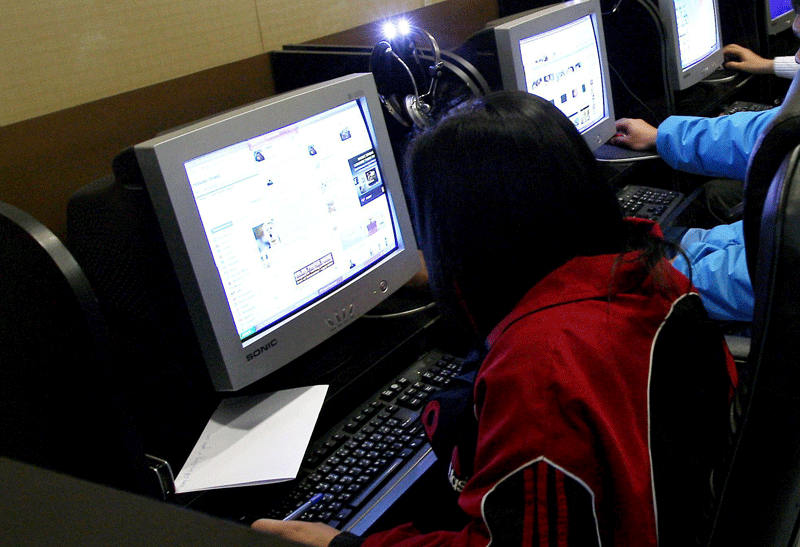
The book says even a brief usage of internet leaves a deep impact on brains. (FILE)
The race of homo sapiens from caves to PC terminals may be just about beginning to go awry, especially going by a new book that argues that internet may actually be re-wiring our brains that has evolved over the millennia.
Titled ‘The Shallows: How the Internet is Changing the Way We Think, Read and Remember,' the book by American author Nicholas Carr could well be taking the first serious look into the negative impact on human brains which are over-exposed to the information explosion on the world wide web.
The book is an extended version of Carr’s article titled ‘Is Google making us stupid?’ published two years ago in the Atlantic magazine and delves into hitherto unknown neurological aspects of the impact excessive browsing leaves on the human brain.
From the “cacophony of stimuli” and “crazy quilt” of information his Atlantic article blamed internet for, Carr quotes a series of scientific studies to claim that internet could be re-wiring human brains through “neuro-plasticity”.
“If, knowing what we know today about the brain’s plasticity, you were to set out to invent a medium that would rewire our mental circuits as quickly and thoroughly as possible, you would probably end up designing something that looks and works a lot like the internet,” he writes.
Although not much of research has gone into the effect of internet on the human brain, Carr’s theory is based on a study carried out in 2008 by a trio of psychiatrists at UCLA. The team was led by Dr Gary Small, who co-authored iBrain: Surviving the technological alternation of the modern mind.
The researchers supervised the scanning of 12 hard-core web users and 12 newcomers as they were Google. The results titled ‘Your Brain on Google’ threw up a vital difference between the two sets in the dorsolateral prefrontal cortex that deals with short-term memory and decision-making.
While the cortexes of the newcomers were hardly active, those of the seasoned users were in full steam. But the surprise was when just six days later – after an hour day each online – their mental activity was identical.
Wish such scientific examples done by well-qualified researchers, Carr attempts to establish that deep thinking becomes difficult since online activity is very superficial.
Path-breaking inventions such as the map, the clock and the typewriter had influenced the mode of thought process, now dominated by internet which calls for multi-tasking which he says “is not an efficient way to do things.”
Carr writes that “we make far more errors (by multi-tasking), and there’s a tendency to do things faster, but sloppier.”
 Follow Emirates 24|7 on Google News.