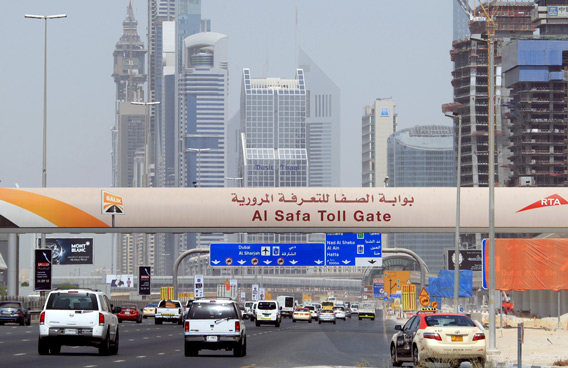
Dubai’s Roads & Transport Authority (RTA) announced today the launch of the third phase of the Salik toll gates system, whereby two new toll gates will be installed. In a media statement issued this morning, RTA said the two gates will come up in Al Mamzar, situated before and after Al Mamzar Bridge, and the toll will be deducted once upon passing under the two gates. The second toll will be located at the Airport Tunnel, situated at the northern entry and exist of the tunnel. Both the new toll gates will be operational from April 15, 2013, the RTA has announced. “The launch of Phase III of the toll gates system was made after conducting exhaustive traffic and field studies of the first and second phases, particularly after the lapse of more than one year since the operation of the Green Line of the Dubai Metro, and more than three years since the operation of the Red Line of the Dubai Metro,” said Mattar Al Tayer, RTA’s Chairman of the Board and Executive Director. “It also comes after the deployment of a sprawling network of public buses network and the opening of Al Khail Road Widening & Improvement Project. The study also included examining the traffic congestions which are still being experienced by key roads in the emirate, and sorting out appropriate solutions and alternatives for them,” he said. Al Tayer noted that the new Salik gates will help divert traffic towards unutilised roads where the RTA has made massive investments. In addition, it will also lead to more people using the public transport system, particularly the Metro and buses, which will help ease congestion on Dubai roads. “About 1,500 vehicles are expected to be diverted from Al Ittihad and Beirut Roads to the Sheikh Mohammed bin Zayed Road and the Bypass Road. People will be more encouraged to use public transport means and accordingly contribute to realizing RTA’s strategic objective of raising the number of trips made by public transport means to 20 per cent by 2020,” Al Tayer said. The RTA chief also noted that Salik has been very successful in easing congestion and slashing journey times on the country’s busiest highway, the Sheikh Zayed Road. “Studies have proven that Salik has succeeded in slashing the trip time on the Sheikh Zayed Road by as much as 44 per cent. For instance the time of the trip northward on the Sheikh Zayed Road in the evening peak time from Dubai Marina to the Trade Centre has dropped from 34 minutes in 2007 before the operation of the initial stage of Salik to 19 minutes now,” he said. “Salik has also succeeded in utilizing the massive capacity of the Business Bay Crossing which was largely idle before the introduction of Salik, thus raising the utilization rate of this vital corridor from just 30 per cent in 2007 to 90 per cent at the moment. Salik has also succeeded in easing bottlenecks in Al Garhoud and Al Maktoum Bridges, thus the time needed to cross these bridges dropped from 20 minutes in 2007 to less than one minute at present,” Al Tayer noted. “Al Ittihad Road is considered one of the busiest roads in Dubai Emirate where the trip time indicator is (9.98) for travelling north during the evening peak time from the intersection of Al Ittihad Road with the Airport Road up to the intersection of Al Ittihad Road with Baghdad Road; which means that the trip time during the evening peak time is ten times the trip time during the free flow period (midnight). “This indicator is considered very high compared to the general indicator of the trip time across the Emirate which is (1.47). There are about 260,000 vehicles using Al Ittihad Road every day, and as the total number of vehicle trips in the emirate is estimated in the order of 3 million trips per day, it follows that the percentage of vehicles using Al Ittihad Road is 9 per cent of the total number of vehicles travelling in the emirate. “The RTA has spent around Dh1 billion in upgrading Al Ittihad Road through constructing a number of flyovers and additional tunnels. However, the service levels remained below the international standards, given the massive demand for this vital corridor; which is one of the key roads in the emirate. The traffic congestion on Al Ittihad Road impacts a wide network of roads in the Emirate, and the bottlenecks of Al Ittihad Road spills over to all other key intersections of this vital corridor such as Abu Hail, Al Nahdah, Airport, Al Maktoum, and Al Muraqqabat Roads. “The traffic studies concluded that the installation of a toll gate system on Al Ittihad Road without installing the system on the Airport Tunnel will result in massive traffic congestions in the Airport Tunnel. “The Airport Tunnel is considered one of the key roads that serve the Dubai International Airport, particularly as the Civil Aviation Authority in Dubai has embarked on a massive expansion of the Dubai International Airport such that it will have the capacity to handle 110 million passengers per annum by 2020, knowing that the number of passen