- City Fajr Shuruq Duhr Asr Magrib Isha
- Dubai 04:20 05:42 12:28 15:53 19:08 20:30

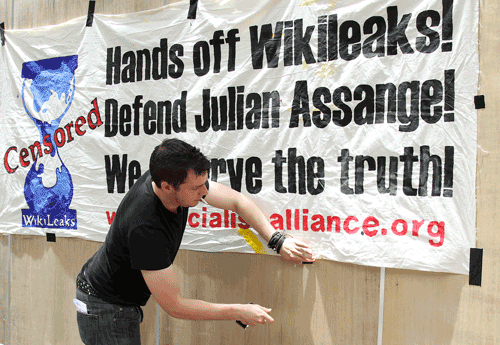
An unidentified protestor tapes a slogan to a wall before hundreds of protestors march through Brisbane's city centre to protest against the detention of WikiLeaks founder, Julian Assange, in Brisbane, Australia, Friday, Dec. 10, 2010. (AP)
Cyber attacks on global companies seen as enemies of WikiLeaks drew the attention of US authorities on Thursday and Dutch police arrested a 16-year-old boy suspected in attacks on credit card sites of Visa and Mastercard.
Internet activists vowed to crash sites that have blocked business with WikiLeaks and PayPal, and others saw sporadic outrages.
US Attorney General Eric Holder said US authorities were looking into cyber attacks on companies like Amazon.com and others. "We are aware of the incidents," he said.
The teenage boy was arrested by a high-tech crime unit in The Hague after admitting to attacks on the websites of two credit card companies, MasterCard and Visa, the prosecution in the Netherlands said on its website.
The suspect, whose details were not disclosed, was believed to be part of a larger group of hackers under investigation that participated in so-called denial of service attacks, the prosecution said. Data and computer equipment were confiscated during his arrest.
The loosely organised campaign to avenge WikiLeaks against those who have obstructed its operations, calling itself Operation Payback, has already temporarily brought down the websites of Visa and MasterCard, and of the Swedish government.
A succession of US institutions has withdrawn services from WikiLeaks after the website published thousands of sometimes embarrassing secret US diplomatic reports that have caused strains between Washington and several allies.
In Moscow, Russian Prime Minister Vladimir Putin said the arrest of WikiLeaks founder Julian Assange showed the West was hypocritical in its criticism of Russia's record on democracy.
When asked about leaked US diplomatic cables that cast him as Russia's "alpha-dog" ruler of a corrupt bureaucracy, Putin questioned whether the US Foreign Service was a "crystal clean source of information."
WikiLeaks activists instructed their followers on Thursday to mount a distributed denial of service attack on a PayPal website that manages the integration of the company's payment processing technology with independent online merchant websites. Paypal is a subsidiary of eBay.
A PayPal spokesman said the company had detected an attack on the site but that it appeared to be operational, although various attempts to access the website by Reuters on Thursday were unsuccessful.
Online retail and web-hosting powerhouse Amazon last week stopped hosting WikiLeaks' website, and on Thursday it briefly became the main target of the pro-WikiLeaks campaigners -- before they admitted it was too big for them, for the moment.
"We cannot attack Amazon, currently. The previous schedule was to do so, but we don't have enough forces," read one message on Twitter.
The activists said they would instead attack PayPal, which has suspended the WikiLeaks account the organization had used to collect donations. MasterCard and Visa had also become targets after stopping processing donations.
Facebook said it had removed the activists' Operation Payback page on Thursday because it was promoting a distributed denial of service attack -- a form of freezing websites by bombarding them with requests that is illegal in many countries.
The campaign also disappeared briefly from Twitter before reappearing in a different guise. Twitter declined to comment.
In an online letter, Anonymous, a loose-knit group, said its activists were neither vigilantes nor terrorists. It added: "The goal is simple: Win the right to keep the internet free of any control from any entity, corporation, or government."
 Follow Emirates 24|7 on Google News.