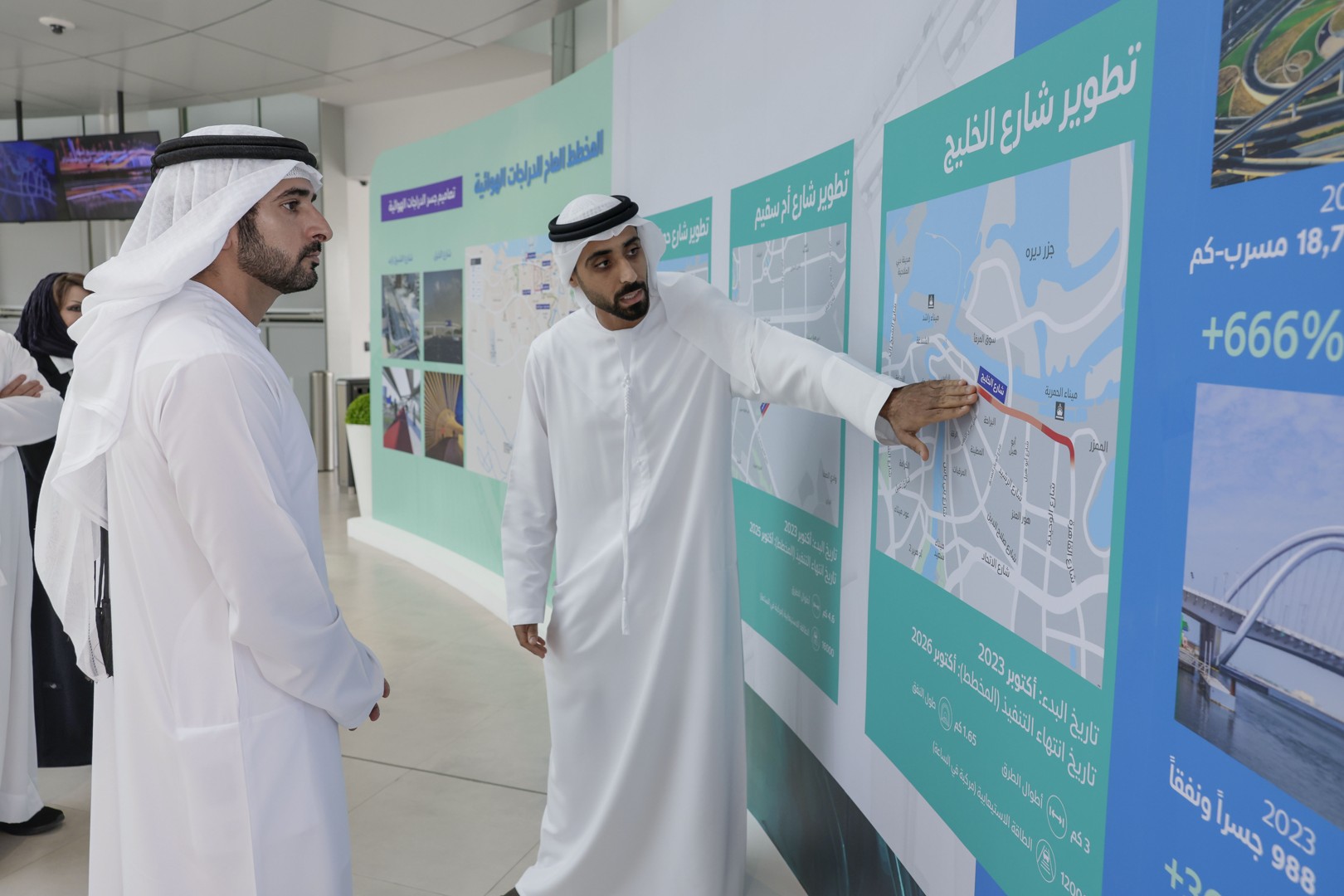
H.H. Sheikh Hamdan bin Mohammed bin Rashid Al Maktoum, Crown Prince of Dubai and Chairman of Dubai Executive Council, reviewed the strategic projects and initiatives undertaken by the Roads and Transport Authority (RTA) to develop infrastructure related to road and transport systems in Dubai. His Highness was also briefed on RTA’s plan to expand the coverage of Intelligent Traffic Systems (ITS), which support the government's drive to transform Dubai into the world's smartest city and promote the use of smart technologies and software to manage traffic and ease mobility around Dubai. The review took place during His Highness’s visit to the Dubai ITS Centre in Al Barsha, a subsidiary of the RTA. One of the largest and most advanced traffic control centres in the world, the centre boosts Dubai’s ability to meet its growing needs emerging from its increasing urbanisation. It also raises its global standing in intelligent traffic systems, ranking it among cities such as Singapore and Seoul. Upon arrival at the Dubai ITS Centre, His Highness was received by Mattar Al Tayer, Director-General and Chairman of the Board of Executive Directors of the Roads and Transport Authority, and several senior RTA officials. At the start of the visit, His Highness received a briefing from Mattar Al Tayer, about the Dubai ITS Centre, which was developed under the directives of His Highness Sheikh Mohammed bin Rashid Al Maktoum, Vice President, Prime Minister and Ruler of Dubai. The centre uses cutting-edge technologies including Artificial Intelligence, Big Data, the Internet of Things (IoT), and advanced communication systems to provide innovative traffic solutions. Equipped with an array of traffic-monitoring and data-gathering devices, as well as a suite of smart services, the centre plays a key role in ensuring that Dubai's intelligent traffic management systems are able to effectively manage the rapid expansion of the city’s current and future road networks. Since its opening in November 2020, the Dubai ITS Centre has significantly enhanced the city's traffic management, leading to a 20 percent reduction in travel time, a 63 percent improvement in incident monitoring and a 30 percent faster response time. “The centre currently monitors 60 percent of the main road network in Dubai, and RTA aims to increase coverage to 100 percent in 2026. Traffic signals and the traffic control system are now 100 percent interlinked. “The centre features an advanced traffic control system (iTraffic) enhanced with Artificial Intelligence as well as big data analysis and decision-making support tools to facilitate the management of traffic movement. Linking all of Dubai, the system ensures a smooth traffic flow, manages incidents, emergencies and events, monitors the efficiency of operational systems and reports malfunctions. The centre is connected to an 820-km-long fibre optic network, and 425 traffic surveillance cameras, including Dubai police cameras. It is also equipped with 235 incident-monitoring and vehicle counting devices, 115 travel time measurement devices, 112 electronic display signs, and 17 road weather information systems,” Al Tayer said. His Highness was briefed on the smart screening system for paid public parking, which currently covers 65,000 slots or 34 percent of all paid parking. These are monitored by nine smart screening vehicles, which are set to double to 18 by the end of the year. The expansion will cover around 140,000 slots or 70 percent of total paid parking. The system has significantly enhanced the operational efficiency and digital transformation of the parking screening process. His Highness was briefed on mega road projects implemented by RTA in the previous phase: the Dubai-Al Ain Road Improvement Project, the Infinity Bridge developed under the Al Shindagha Corridor Improvement Project, and the Sheikh Rashid bin Saeed Corridor Improvement Project. RTA seeks to develop several main roads in the next phase, including a project to develop Hessa Street from its intersection with Sheikh Zayed Road to its intersection with Al Khail Road stretching 4.5 km to augment its capacity to 16,000 vehicles per hour. It also entails the Umm Suqeim Street Improvement Project from its intersection with Al Khail Road to its intersection with Sheikh Mohammed bin Zayed Road extending 4.6 km, increasing its capacity to 16,000 vehicles per hour, and the Al Khaleej Street Improvement Project, stretching 3 km from the Infinity Bridge ramp to Cairo Street. The project encompasses the construction of three underpasses stretching 1.65 km, with an estimated capacity of about 12,000 vehicles per hour. His Highness was also apprised of major indicators of the rapid development of Dubai’s road network infrastructure. The total length of Dubai’s road network has grown from 8,715 lane-km in 2006 to 18,768 lane-km in 2022, marking a 115 percent growth. The number of bridges and underpasses saw a big increase, from 129 to 988 during the sam