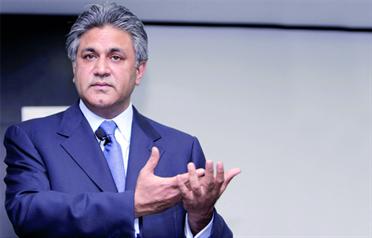
The Middle East, North Africa and South Asia bloc will overtake the US to become the world’s largest economy after China by 2050, said Arif Naqvi, Founder and Group Chief Executive of Abraaj Capital. This economic belt will also be the second-largest growing economy in the next five years, he said. “This growth prediction comes from six or seven different sources and is based on the expected price of oil, announced infrastructure projects and market projections. “The number comes from much smarter people at Economist Intelligence Unit and is a consensus number approved by the Organisation for Economic Co-operation and Development and The Economist,” he said. “Our key driver in the UAE and Mena region is we have already embarked on large scale infrastructure projects which when push comes to shove will be financed by the reserves we created in the past.” Naqvi was the first to identify the potential of this region and coin the acronym Menasa. This was in 2002. Since then, his buyout firm has raised $7 billion (Dh25.71bn) in funds and paid back $3bn to investors. With $6bn currently under management, Naqvi’s vision is invested in substantial stakes in Air Arabia, Jordan Aircraft Maintenance, Gems, Art Marine, Spinneys and Serai among others. In six years, he has built the largest private equity firm outside North America and Europe and in June last year, Private Equity International named the 48-year-old Pakistani one of 50 people who will change the course of private equity. And it all started with him discovering Menasa. “We look at the Menasa as one continuous region because the Middle East and South Asia have links that go back hundreds of years, be it cultural, historical, religious or financial. Significant cultural, political, and economic synergies have led to strong intra-regional trade links, labour mobility and investment opportunities. “It has a combined GDP of $3.2 trillion and is growing at five per cent each year with a population of 1.6 billion. This is one of just two or three regions in the world that will sustain constant growth. As such, we’re in a part of the world which has a tremendous future and enormous opportunities,” he said. The key drivers for this growth are favourable demographics, hydrocarbon based liquidity and government reforms and diversification, Naqvi said. “Things are not so bad in our part of the world. Yes, this crisis will hurt but let’s go back to that most basic of comparatives. The GCC sits on 62 per cent of the world’s energy reserves. Every year we contribute 33 per cent of the global annual oil production. This means we’re under producing by 100 per cent. “It doesn’t matter whether alternate energy is found. The reality is oil will remain the driver of the global economy for some time to come. I recently attended a briefing by the IEA where they pulled out statistics for the next 30 to 40 years. “They took every conceivable current technology like wind and solar, and said that if every technology becomes a reality, at the current cost of converting it to sustainable power generation, the reliance on oil as a source of power for the world will still be 45 per cent, down from 85 per cent. Even with that drop there is growth expected from current demand levels. “So the power and energy requirement is there. Even if oil were to drop to $25 a barrel, we will still continue to experience growth. You must remember, just 10 years ago the region lived through oil at $10 a barrel,” he said. “We have hydrocarbon based liquidity. We have a young population, which is growing and driving consumption. We are faced with the challenge of creating a 100 million new jobs over the next 10 years to continue to sustain growth. More and more private sector roles will be encouraged going forward. There are major gaps in health care, education and low cost carriers. This is where the opportunity lies. If you look at global averages we need to build 39,000 hospitals and 7,000 new schools in this region. We’ve only just started with low cast carriers. There’s just so much driving this region,” he said. Naqvi lambasted the role debt traders had played in degrading Dubai’s debt rating and called for stricter controls on their projections. “When we do something that is focused on gain, there is always a cost to pay. When you take the route of rating debt you immediately put yourself in the hands of traders who trade debt. There is madness when it comes to the perception of the West. “It was madness of them to assume and think that Dubai was less sustainable than Iceland. Our credit-default swap (CDS) spreads were higher than Iceland at a certain pointing January, which is insane. I have a serious issue with that immature behaviour and them being allowed to get away with it. It’s good to get rated, good to get debt, specially when it’s being handled out for free. But the problem is perception management. When that trader says our economies here are more riskier than Iceland it becomes a joke.