The Letters: How Mohammed bin Rashid turns a lifetime of experience into lessons for future generations
In 26 personal letters, Mohammed bin Rashid shares the experiences, values and lessons forged through six decades of public service
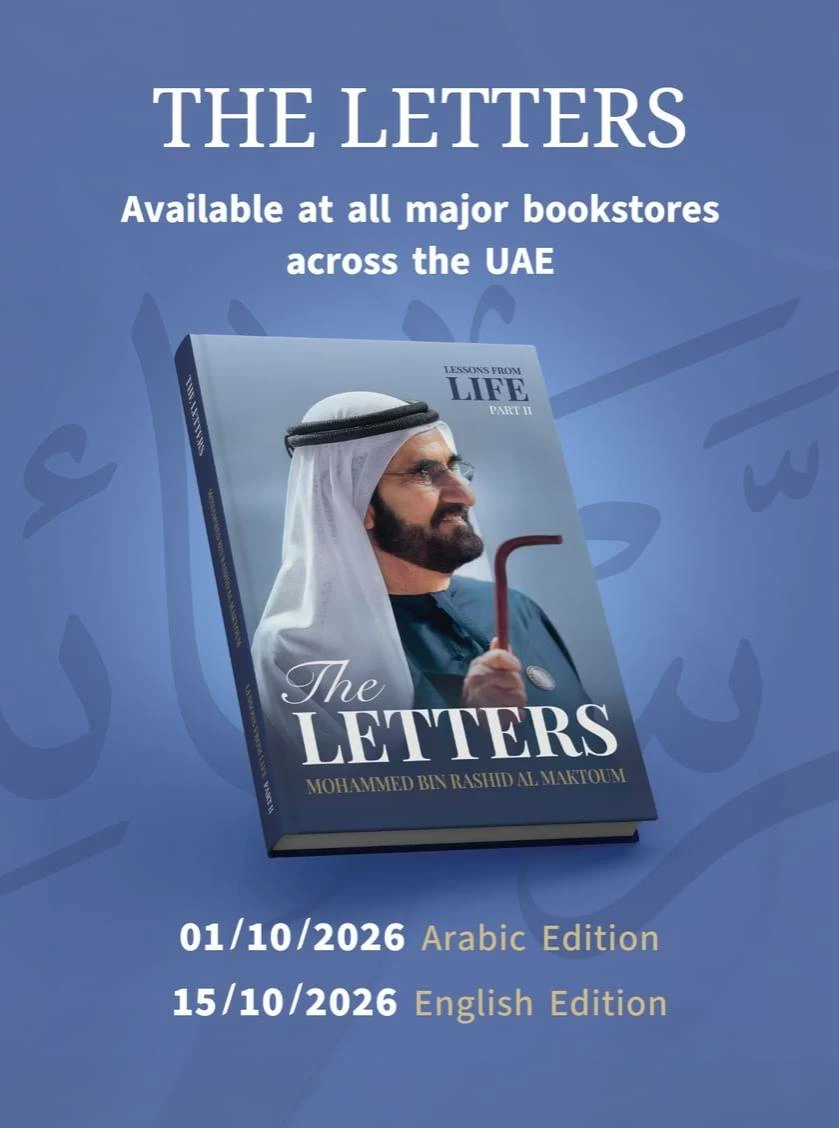
In The Letters, His Highness Sheikh Mohammed bin Rashid Al Maktoum, Vice President and Prime Minister of the UAE and Ruler of Dubai, distils six decades of experience and public service into words addressed to national figures, prominent personalities and different generations. Each of the 26 letters has its own recipient, and each reading offers a perspective that extends beyond the pages of the book.
In this series, The Letters: From Experience to Impact, published weekly, we explore these letters from within, drawing closer to the ideas shaped by experience, what they reveal about our present, and what they may offer for our future.
-----
As experience accumulates, not all days remain equal in memory. Entire years can sometimes be distilled into a single moment. A person may be gone, yet a piece of advice remains with us. A small decision can later reveal itself to have changed the course of an entire journey. Over time, the noise of details fades, leaving behind what truly matters: an idea that reshaped the way we think, a lesson that stayed with us, or a meaning we felt compelled to pass on to others.
It is from this perspective that The Letters by His Highness Sheikh Mohammed bin Rashid Al Maktoum, Vice President and Prime Minister of the UAE and Ruler of Dubai, can be read. Comprising 26 letters, the book comes after nearly six decades of public service. In it, he addresses family members, work teams, young people, teachers, officials and future generations.
In the introduction, His Highness Sheikh Mohammed explains the nature of what he places in the hands of his readers: the outcome of experiences he has lived through, decisions he has made, projects he has completed and lessons learned from many years in public life and personal experience. He writes while reflecting on those who came before him, those who accompanied him along the way and those who will carry responsibility after him, hoping that his experience might shorten part of the journey for them.
The Letters begin with the people who shaped the beginning: the guidance of a father that continued to provide direction, the prayers of a mother that accompanied every morning, and the late Sheikh Zayed bin Sultan Al Nahyan, described as “my teacher, my leader and my inspiration”, ever-present in the memory of a man who sees today’s UAE as an extension of that vision and dream.
As children grow, so too does responsibility. A father’s words become something closer to guidance for continuing the journey. Writing to His Highness Sheikh Hamdan bin Mohammed bin Rashid Al Maktoum, Crown Prince of Dubai, Deputy Prime Minister, Minister of Defence of the UAE, Sheikh Mohammed says: “If people look at you with their eyes, then look at them with your heart, Hamdan.” In the space between how people see and how a leader sees lies an entire philosophy of leadership: to understand people as they live, to remain close to their concerns and to allow compassion to grow with responsibility.
Any successful journey also requires this kind of awareness. Sheikh Mohammed warns that repeated success can create a sense of complacency and excessive confidence in past achievements. A position loses its value when an institution becomes centred on a single individual. True leadership, he argues, is reflected in an institution’s ability to remain strong after its leader has departed.
Teachers today face a generation that can access information faster than any generation before it. Sheikh Mohammed notes that a student can now ask a machine about physics, history or literature and receive an immediate answer. The teacher’s role, therefore, lies in developing the ability to think, choose and distinguish between fact and opinion.
In his letter to media professionals, Sheikh Mohammed recalls the experience of Radio Rwanda as a reminder of what words can do when they become fuel for hatred, particularly in an age where platforms compete relentlessly for attention.
For the official, Sheikh Mohammed sets out two contrasting images: the ‘seeker of status’ and the ‘holder of trust’. The true test lies in what remains after a person leaves office.
The future is present throughout these letters from the opening pages. Sheikh Mohammed writes about artificial intelligence that will transform work and education, cities that will compete for talent and ideas, and leadership that requires faster learning and decision-making. Here, the future is both an extension of experience and a test of it: what remains valid when tools and circumstances change?
As the audience for the letters expands, the letters themselves begin to transcend their intended recipients. At its core, a letter is an act of selection. The writer chooses from their experiences what they wish to say to a particular person and what they believe deserves to endure.
Perhaps this is why Sheikh Mohammed chose the format of a letter. It begins as a personal communication addressed to a specific individual, yet its meaning widens whenever a reader finds within it something that resonates with their own experience. A letter can live many lives. Its words may speak to us in one way today, only for us to return years later and discover a deeper meaning shaped by the experiences life has added along the way.
By the final page, The Letters emerges as another chapter in a long journey. After decades in which Sheikh Mohammed’s name became associated with building cities, strengthening institutions and creating opportunities, he now places before readers something drawn directly from that journey: knowledge forged through experience, tested by time and ultimately transformed into words.
And when that experience finds its way to those who never lived it themselves, a lifetime becomes a letter.
----
Naoufer Ramoul is a senior TV presenter and producer at Dubai Media Incorporated, and the host of the award-winning political show Qabel lil Niqash on Dubai TV. She has worked as a presenter at Al Jazeera, Al Arabiya and Alhurra.