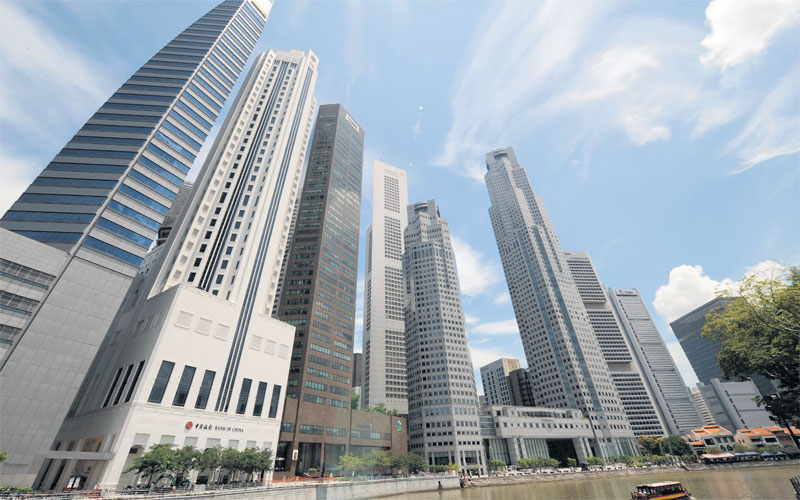
Residential markets in Beijing, Shanghai and other Chinese cities are currently overvalued, said a recent report. The latest Deutsche Bank Research report said after the bursting of price bubbles in many Organisation for Economic Co-operation and Development (OECD) countries, investors are keeping a close eye on price developments in asset markets. "House prices in Beijing, Shanghai and many other Chinese cities have risen rapidly in the course of the past few quarters, and our set of valuation indicators suggests that these markets are currently overvalued. This also holds for Hong Kong and Singapore," said the report. Overvaluation in housing and, to a much lesser extent, also in office markets is not an Asia-wide phenomenon, but is only concentrated in a few countries. No downside risks are being displayed in Indonesian and South Korean property markets or in Malaysian office markets. "While the risk of a downward adjustment has obviously increased on some residential markets, we do not expect that this can trigger severe macro-economic distortions, as regulatory bodies have acted prudently so far, there is no sub-prime segment in the analysed markets and debt-financing plays a much smaller role than in many OECD countries. Finally, medium- to long-term drivers such as urbanisation and population growth are still intact," said the report. The question that now arises is whether this upward trend has gone too far. Housing overview The Asian housing markets has seen a strong upward price trend since 2003. Only in a few cases was this trend briefly interrupted in the course of the global recession. In fact, over the last year house prices in major Asian conurbations have increased even faster than in the pre-crisis years. This upsurge evokes memories of the Asian financial crisis of 1997/1998, especially so in Hong Kong and Singapore, which were hit hardest by the price deterioration. In Singapore, property prices have increased by 34 per cent compared to January 2007, while in China they rose by no less than 67 per cent until March 2010. Within China, the price boom was not only confined to cities such as Beijing or Shanghai, but also took place in other cities such as Tianjin and Chongqing where prices have rallied in the past few years. Despite some putative downward pressure over the past few weeks in some Chinese metro areas, the overall upward trend is still uninterrupted. Singapore's central area faced a sharp decline in prices for residential property at the beginning of 2009 after increasing constantly since 2002. However, the price drop was quickly followed by a sharp increase over the past five months. Key valuation measures for residential property suggest some overheating. Prices have risen significantly faster than rents over the past few quarters, while in China this has been the case for the past three years. This clearly signals that prices have decoupled from rental demand. However, this does not hold for South Korea and Indonesia. From a consumer's perspective, buying residential property has become less affordable as households are having to spend an increasing share of their disposable income on housing. Especially in China's top five cities and in Hong Kong prices rose much faster than incomes. In Beijing, an average household now needs to spend 17 years of income to afford buying a 100 square metre apartment. "A notable exception is Indonesia, where our affordability index fell since January 2007 by roughly 20 per cent," said the report. Office market Meanwhile, office demand is picking up strongly; rents are starting to rise after falling heavily in many cities. Still, caution is also advised particularly for Chinese office markets, as cap rates have fallen significantly over the last few quarters. Prices for prime offices have evidently been rising much faster than rents, indicating that investors are betting on a strong upswing. While office rents (in local currencies) rose by roughly 20 per cent in Beijing and Seoul during the upswing that ended in 2008, office rents in Shanghai increased by more than 170 per cent, in Singapore by more than 380 per cent and in Hong Kong by no less than 550 per cent from the lowest level to the last peak. Three things are important here: first, the upswing was followed by a sharp downswing after 2008, and especially those markets that had shown strong rental growth were cooling markedly: office rents in Shanghai and Hong Kong dropped by 40 per cent from peak to trough, in Singapore by no less than 60 per cent. Secondly, the cyclical markets are also those markets with highest trend growth in office rents, that is risk seems to be closely related to the associated [rental] returns. Thirdly, all rental markets but Singapore's have touched bottom; since the beginning of 2010 office rents have started to pick up. While residential units account for the larger part of an economy's overall property stock, there are three important reasons for also l