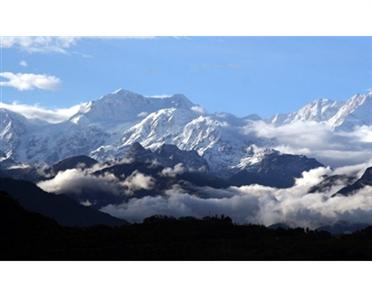
Somewhere, amidst the vast expanse of a country that is India, there is a region so unlike the rest of it that you begin to wonder if your geography teacher had got it all wrong. Nestled in the foothills of the great Himalayas and connected by just 20km of land to the mainland, India's north-eastern region – about the size of the United Kingdom – is as un-Indian as it gets. And it's easy to see why. Religiously, culturally and geographically, there is very little India in this land of bamboo trees where people obsess about football, not cricket, where rock music trumps Indian-pop and South Korean DVDs disappear faster from the shelves than the latest Bollywood blockbusters. Even Hindi, the national language, is barely spoken. But this is still India. Bordering Bhutan, China, Myanmar and Bangladesh, the eight states that make up the region are as diverse as the rest of the country. Its dense hills and breathtaking landscapes are also home to more than 166 tribal groups, each with its own distinct history and culture. Socially and genetically closer to East Asia, yet politically attached to Indian legislation, the people of this remarkable land have historically straddled varying influences and disparate injunctions from the mainland – yet managed to preserve cultural elements uniquely theirs. And therein lies some of its unceasing problems. In their attempt to preserve their heritage, the ethnic groups have for many years struggled against the Indian Government. In recent times, some of those campaigns have turned violent, in-turn leading to the rise of insurgency. Today, ethno-political conflicts have become synonymous with the region, forcing the Indian Government to term it a "sensitive zone". But that has not stopped resolute travellers making a beeline for the region – what with it's unrepeated natural beauty, varied people and rare wild-life, the region is a haven for adventure junkies. Ideal for trekking, whitewater rafting, mountaineering and wildlife explorations, north-east India, thanks to its cultural mix, is also home to some of the country's most respected dance forms. Well connected by air and road, you can experience a bit of tribal culture in Nagaland and Mizoram, taste some of the world's finest teas in Assam, explore martial arts in Manipur, visit monasteries in Sikkim, experience India's first sunrise in Arunachal Pradesh and breathe in fresh air amidst the hills of Meghalaya, or take in great temples-scapes in Tripura. How to get there Almost all visitors to India require a visa from a local consular office. The helpline for the office of the Consulate General of India (cgidubai.com) is 04 397 1222. The closest international airport from north-east India is Kolkata in West Bengal, which is effectively connected by air, rail and road to all the states. Emirates (emirates.com) has daily direct flights to Kolkata. Travellers' Tips Due to its strategic geographical location and political situation, tourists travelling to the states of Arunachal Pradesh, Manipur, Mizoram and Nagaland need to acquire a Restricted Area Permit from the consular office. Since much of the region is a "sensitive zone" due to its various problems make sure you are updated with the current news before travelling.