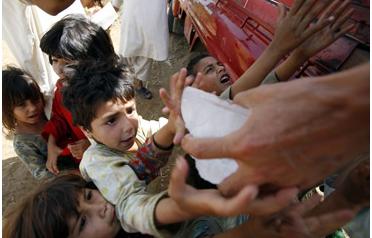
Poor countries, already hard hit by the global economic downturn, are now facing cutbacks in foreign assistance from traditional donors saddled with rapidly expanding deficits. The worldwide recession has driven 50 million people into extreme poverty, according to the World Bank and the International Monetary Fund, which have exhorted rich countries to live up to promises to boost development aid. "There's a risk that these promises will not be kept if the crisis deepens," warned Jose Gijon, head of the Africa-Middle East department at the Organisation for Economic Co-operation and Development. Added Shanta Devarajan, chief economist for Africa at the World Bank: "The fiscal pressure that developed countries are facing, especially to address the problems of their citizens, is so high that it will be hard to get political support to maintain the level of foreign aid." He said a 2005 pledge from the Group of Eight industrialised powers to double aid to Africa, made when the world economy was flourishing, had already fallen about $20 million (Dh73.4 million) short of the target before the latest crisis erupted in late 2008. "If during the boom period they were unable to meet these commitments, I'm wondering what is going to happen now that we're in a deep recession." Emmanuel Frot of the Institute of Transition Economics in Stockholm described development aid as an "easy target" for governments anxious to trim spending. He said his research had shown that six countries that had suffered an economic slowdown in the 1990s, including Japan and the United States, had in one year cut their overseas assistance by 13 per cent. Aid volumes came to a record last year but have now begun to slide. Italy has reduced its overseas development budget by 56 per cent and Ireland by 10 per cent while Latvia has abandoned such initiatives altogether, according to the European Network on Debt and Development. Oliver Buston of the non-governmental organisation ONE has noted that in addition to a fall in aid amounts, there has been a worrisome shift "toward more loans and less and less grants," which could trigger a "debt crisis." While the United States is planning an 8 per cent hike in development aid next year, there are concerns about France, currently the fourth largest aid giver by volume. "We fear a setback in France and nothing is clear," said Sebastien Fourmy of Oxfam-France Agir. The 2009 French budget foresees development assistance equivalent 0.47 per cent of gross national product, declining to 0.41 per cent in 2010 and 0.42 per cent in 2011. But Eric Chevallier, spokesman for the French foreign ministry, stressed that such figures are estimates that are still being analysed. He added that France remained committed to increasing assistance to 0.7 per cent of gross national product in 2015, consistent with the United Nations Millennium Goals. Keep up with the latest business news from the region with the Emirates Business 24|7 daily newsletter. To subscribe to the newsletter, please click here .