Orbitworks launches first commercial satellite built in UAE
Altair-1 marks the launch of the Altair constellation: ten satellites forming the UAE's first commercial, AI-enabled Earth observation network
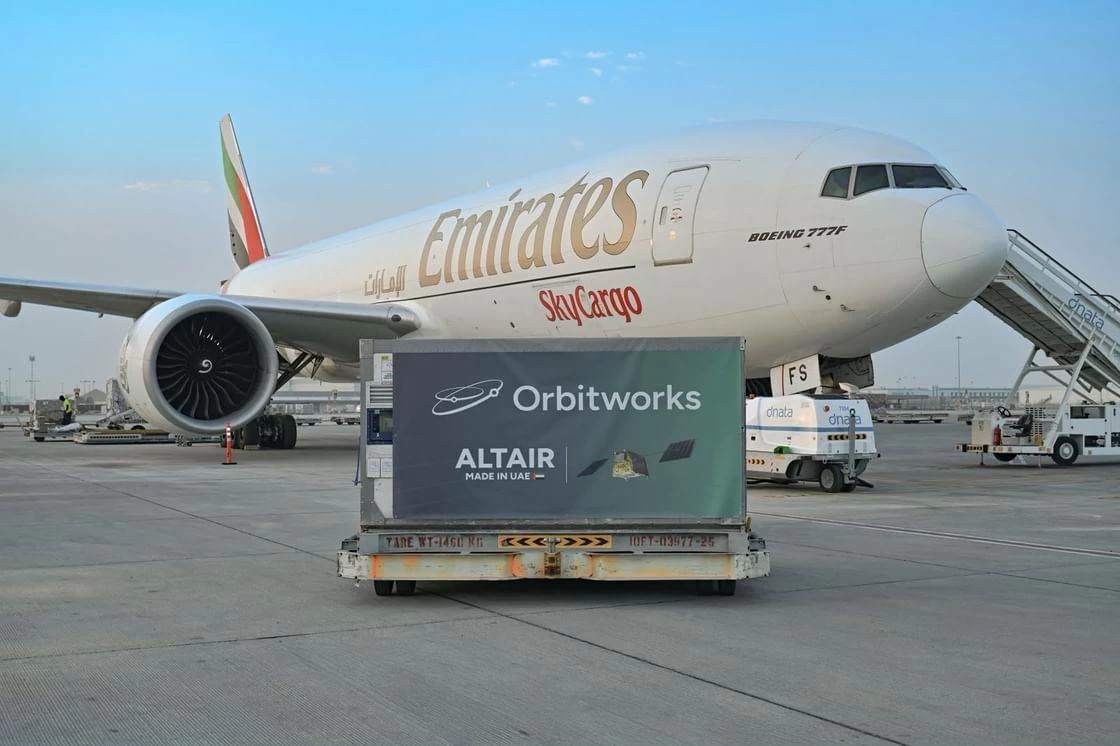
Abu Dhabi: Altair-1, the first commercial satellite built in the UAE and integrated by Loft Orbital, was launched aboard the Transporter-18 rideshare mission with SpaceX at 11:32 a.m., PT / GST from Vandenberg Space Force Base, California. Altair-1 successfully deployed and acquired a signal, the satellite is nominal is now in commissioning
Altair-1 marks the launch of the Altair constellation: ten satellites forming the UAE's first commercial, AI-enabled Earth observation network. It was designed, assembled, integrated and tested at Orbitworks’ facility in Abu Dhabi and flown to California in August. The other nine satellites will follow through 2027.
Dr. Ahmad Belhoul Al Falasi, Minister of Sports and Chairman of the UAE Space Agency, congratulated the Orbitworks team on this milestone, highlighting the private sector’s role in building advanced, scalable national space industries.
He said, "The launch of Altair-1 reflects the strength of the UAE’s national space ecosystem and its growing capacity to develop and manufacture advanced space technologies. Guided by the National Space Strategy 2031, we are bringing together research, industry and investment to enable national companies to innovate, grow and contribute to economic diversification.”
He added, "Altair-1 also demonstrates how capabilities developed in the UAE can deliver solutions with commercial value beyond our borders. By opening new markets and international partnerships for UAE companies, the launch will strengthen the country’s contribution to the global space sector and advance our ambition to become one of the world’s ten leading space economies by 2031.”
Each Altair satellite carries five integrated sensors: optical, shortwave infrared, thermal, hyperspectral and radio frequency. Onboard NVIDIA GPUs turn that data into analysis-ready intelligence within minutes, not the hours that ground-based processing typically takes. At full strength in 2027, the constellation is designed to revisit any point on Earth roughly every four hours. Operating in real time and autonomously, the satellites process data at the edge and act on what they detect, fast enough to catch a wildfire at its first heat signature or locate a vessel operating clandestinely. It will support disaster response, maritime awareness, environmental monitoring, food security, infrastructure surveillance, and national security applications.
Altair takes its name from the Arabic al-ṭā’ir (الطائر), "the flying one”, a star used for centuries to navigate by. It is also a reference to the Altair 8800, the 1975 computer for which Microsoft wrote its first BASIC interpreter.
"Two years ago, Orbitworks was an idea. Today, a satellite built in Abu Dhabi is in orbit,” said Dr Hamdullah Mohib, Chief Executive Officer of Orbitworks and Chief Executive Officer of Marlan Space. "The UAE is no longer only a buyer of space capability; it is a builder of it. Altair-1 is the first of ten, and the start of a future in which customers see, decide and act on their own terms, with intelligence created in orbit.”
Altair-1 was built at Orbitworks’ 50,000-square-foot facility in Khalifa Economic Zones Abu Dhabi (KEZAD), inaugurated in November 2025 as the first of its kind in the Middle East dedicated to commercial satellite production. The site includes a 15,000-square-foot ISO-class cleanroom, electromagnetic interference (EMI) chambers, thermal vacuum systems and shaker tables, with capacity to produce up to 50 satellites a year at full scale, roughly one a week.
Orbitworks is a joint venture between Marlan Space, a UAE-based space company and subsidiary of IHC, and Loft Orbital.
"We are proud to have been a small contributor to this landmark achievement in Abu Dhabi,” said Pierre-Damien Vaujour, CEO of Loft Orbital. "The UAE space ecosystem has been growing steadily on solid foundations for decades, and it is now ready for liftoff. The launch of the first satellite produced at Orbitworks’ KEZAD's Abu Dhabi facility paves the way for 10 more over the next 12 months and 50 more over the next few years. This moment shows the world what the UAE has quietly built, and that it is ready to lead globally in AI powered satellite constellation production and operations"
Customers can own an Altair satellite and the data it produces, or access the same capability as a service, tasking and licensing Altair’s intelligence directly. Altair has a number of anchor customers and end users in Europe and the Middle East namely, the multiple entities of the French government, the Abu Dhabi Maritime Academy and the Abu Dhabi Fund for Development. Orbitworks is in discussions with prospective customers across North America, Africa and Asia for access to the remaining capacity.
Altair-1 is the first step in a much larger programme. On 9 September, Marlan Space and Loft Orbital announced a US$1 billion consortium with Mistral, BlackSky and MaiaSpace to build an AI satellite infrastructure whose initial phase comprises fifty satellites. Together, the programmes support the UAE’s ambition to rank among the world’s ten largest space economies by 2031, alongside national initiatives including Operation 300bn and Make it in the Emirates.