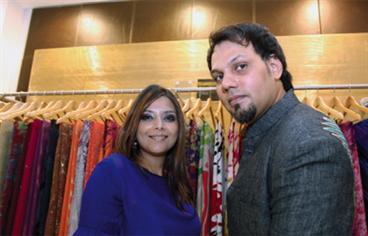
Falguni and Shane Peacock, whose garments are as opulent as their name, are among India's hottest fashion properties right now, retailing from more than a dozen countries, including the UAE. The husband-and-wife designers were in Dubai this month to support their Fall-Winter line, which retails out of Samsaara at Souk Al Bahar. The pair, who unhesitatingly refer to themselves as commercially minded, are criss-crossing the globe in a sort of pop-star tour to promote their new collection across the 20-odd cities they retail from. But to take the brand forward, they are now looking for a large injection of capital. You retail in more than a dozen markets. How has the downturn and the dip in consumer spending affected business? Shane: We've been very focused in knowing how and when to change our focus to target different markets. That's the good thing about operating in so many countries. While the United Kingdom has been badly hit with many stores slashing their budgets, certain parts of India have barely been impacted at all. Falguni: People may have become more cautious, but they're still spending. Gone are the days when designer pieces were heirlooms. Now women only wear a garment three times before buying something else – society women are photographed so much, they can't afford to repeat their outfits. But are buyers coming back then, with this new optimism everywhere? Shane: Yes, there's a lot of interest for Spring-Summer 2010. Among the people at our London Fashion Week Show this month are Selfridges, Harvey Nichols and others. So do you tailor your lines for different markets, then? How different is your UAE line from your India product? Falguni: Yes and no. Overall, our clothes are aimed at the international buyer who understands designer wear and wants to dress on trend, without going over the top. What's available at our stores in India is different from what we retail anywhere else – we need to keep them distinct. Shane: Our range for the UAE is more toned down than our India line, and similar to our lines for Miami, Spain and Greece. You've got a signature label, Falguni and Shane Peacock, and a more Gothic line, Spendthrift. I believe you will now be launching another? Shane: Yes, a Japanese line, which will be oriental in colour and styling, so it is more about cut and drape rather than prints or embellishments. But why do you need so many labels? Shane: You can't change your signature from one season to the next, doing a Gothic line and then a Japanese line – your clients will get confused. Commercially, separate labels works very well, too: A multi-designer store can reach different demographics by ordering from each collection separately. Was it similar reasons that prompted a kidswear line, Baby Peacock? Shane: We couldn't find anything suitable for our daughter. I don't want to put her in a pink Barbie dress, which is all that seems to be available. But I'm a designer, so I should be able to make her new clothes. Falguni: Once our clients saw what we'd done, they wanted the same for their children. It's a good move: a mother will spend more on her children than on herself. How do you work together? Don't you fight? And who does what? Falguni: (laughs) We only fight. But in terms of what we do, both of us design. I tend to meet with clients and buyers and deal with stores, while Shane looks after the publicity and marketing side. The two of you met over a design collaboration and decided to join forces once you were married. What was your start-up investment? Shane: Practically nothing; we could only afford one machine, one pattern cutter and so on. Falguni: Rs20,000 [Dh1,533], we bought fabric, one machine and made an initial collection of 40 pieces. Yours is pretty much a new-century success story, going from that Rs20,000 in 2002 to a production of nearly 10,000 garments a year? Shane: From the beginning we wanted to go with big-name stores. We were very lucky that at our very first show for India Fashion Week in 2005, a buyer from Harrod's was in the audience – ours was the only Indian label they bought at the event. Since then, we haven't wanted to deal with anything that isn't on the same level. Falguni: Ever since that first collection, every penny that comes in – and more – goes back into the business. Eventually, you end up putting in much more than you take out, but you need to do that if you want to maintain a hold on the company. What about expansion? I believe you have several new stores in the pipeline? Shane: We now have four standalone stores in India and we want to open six more around the country. At least three should be open in the next six months. And over the longer term, how do you move forward? Shane: Right now, we're doing everything ourselves, from designing to chasing payments, so the aim is to get an injection of funding and corporatise the brand. Roberto Cavalli spends $1 million [Dh3.6m] on one show, that's my income in a year. Falguni: We're creative mastermi