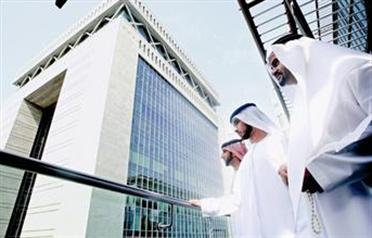
The world is tired of hearing about the financial crisis and has started to move away from its depressing frame of mind, said Dr Omar bin Sulaiman, Governor of Dubai International Financial Centre. "Hopefully, to a certain degree, even if it is a small percentage, some of us have moved on from the crisis mind set," he said in a far-reaching interview on where the UAE is positioned today. Sulaiman, a member of the Supreme Fiscal Committee, also serves as the Vice Chairman of the Central Bank, a responsibility he hoped to achieve in a few decades. "I wear two hats. One of them is a federal hat as the vice-chairman of the Central Bank and you can imagine the Central Bank has been deeply involved in mitigating this crisis. "I don't know if it's my good luck or bad luck, but I got involved with the Central Bank one month before the crisis. I always thought that would be my retirement job, but it was not my luck, I guess. So it has been quite an experience." What is your perception of what has transpired over the past few months? In the past few months, or the year some might argue, the world has changed. The first instance was a shock for all of us. You're running at 400kph and all of a sudden somebody stops you. Mentally and physically you cannot balance yourself. So it took us a few months to adjust psychologically to the fact that things would not be the same any more. The hits globally were so strong, that people mentally did not want to move on. There were people who lost money and people that had money but didn't want to spend any more. People wanted to wait and adjust and that affected everything, including the banking system. A lot of the UAE banks had the money but they didn't want to spend it. They wanted to hold and see what happens. The mental side was worse. The confidence issue was the biggest issue in the global crisis. If you look at asset classes anywhere in the world, there are good assets and bad assets. But everything was now being labelled as bad assets. And that did much more damage than the real damage that took place. How crucial has the Central Bank's role been? I give a lot of credit to the Central Bank of the UAE. I'm one of the people who opposed the governor of the Central Bank [Sultan bin Nasser Al Suwaidi]. Because all of us have been running very fast for a long time. And he's been walking. But during the crisis when a lot of us stopped, he continued walking. And that is a very credible thing to do and shows wisdom. The fact that the Central Bank was conservative – something we kept complaining about – actually saved a lot of the banking and financial systems in the UAE. Whether we like it or not, that's the truth today. We're fortunate that they've been conservative because it saved a lot of us. What was the biggest impact of the recent $10 billion bond issue? Confidence. The bond issuance even though it is a liquidity solution that will go into the economy, brought back confidence. I'll share a personal example: We were constantly meeting with global bankers and financial institutions for a few months to discuss each other's plans and possibilities for growth. Global banks said they didn't know whether they'd exist. But when the bond was announced, the first call I got was 20 minutes after the news broke. It was from the chairman of one of the global banks that I was with just a few days before. He called me and asked, 'How can we participate in the second tranche?'. Now he is someone I know very well. So I said, 'You were with me two days ago and you said you didn't have money and were worried about your existence.' And he said, 'No, we can manage.' You see, they actually thought Dubai was going to collapse. A lot of people thought that. So the confidence side is what will make the difference. The bond gave people confidence. You can feel it already. Look at real estate. I know investors from the region and globally, even from sovereign wealth funds in the region, are looking at Dubai resale properties. This is a fact. Now they feel that the prices are right and they see the opportunity. They wouldn't be here if they thought Dubai would collapse. Now they know we're going to survive so they want to jump in quickly before prices rise again. What lessons have we learnt from the crisis? Will we look at regulating areas such as land supply like Hong Kong or Singapore have done? With all the regulations and parceling and control in these foreign markets real estate still collapsed. The learning there is that that doesn't work. When Dubai was growing we looked at all the models. We learnt from Hong Kong, Singapore, London and the US. Did we know everything? Definitely not. Did we make mistakes? Definitely yes. But mistakes are part of the experience everyone goes through. When the real estate industry collapsed, let's not forget that it was a global crisis caused in some other region that impacted the world. Now I could argue that we're lucky that this happened today. If it didn't h