US and German scientists win 2026 Nobel Prize in Medicine for pioneering optogenetics
Breakthrough discoveries using light to control nerve cells have transformed brain research and opened new possibilities for restoring vision and hearing
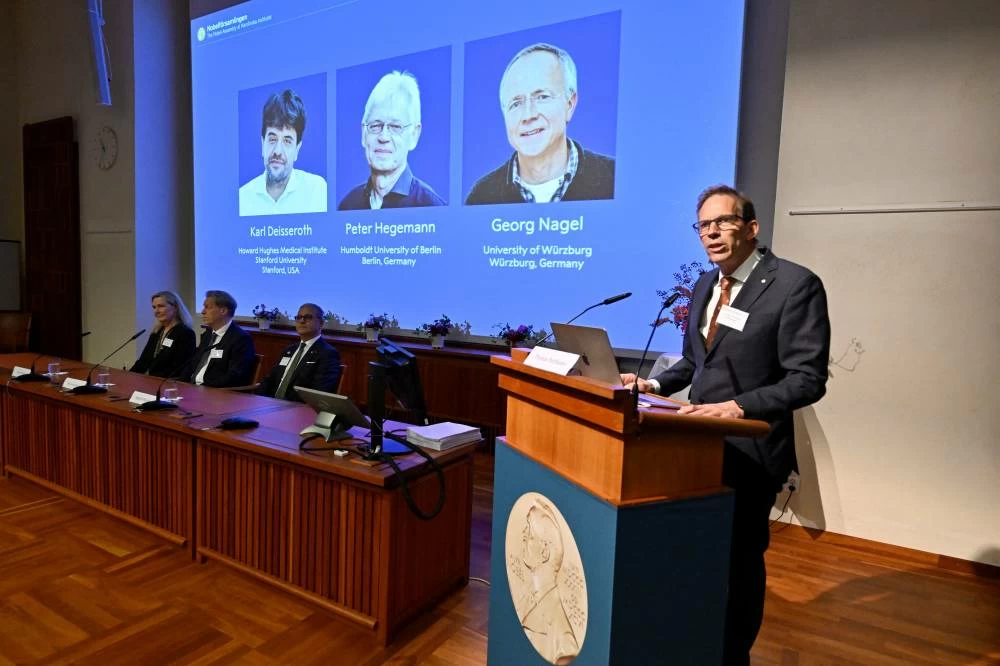
Stockholm: American scientist Karl Deisseroth and German researchers Peter Hegemann and Georg Nagel have been awarded the 2026 Nobel Prize in Physiology or Medicine for discoveries that laid the foundations of optogenetics, a technology that allows scientists to control nerve cells using light.
The Nobel Assembly at Sweden’s Karolinska Institute said the trio were honoured for their “discoveries concerning light-gated ion channels and optogenetics”.
Thomas Perlmann, Secretary-General of the Nobel Assembly, said the breakthrough has enabled researchers to switch individual nerve cells on or off inside a living brain.
“This method is now being used in laboratories around the world to reveal the brain’s mysteries,” Perlmann said.
Optogenetics has become one of the most important tools in modern neuroscience, allowing researchers to study how specific groups of neurons contribute to behaviour, memory, movement and disease.
The technology is already being explored in clinical research. Scientists are working on restoring vision in people affected by retinitis pigmentosa, an inherited eye disease that causes blindness, by inserting light-sensitive proteins into the retina. Researchers also believe the technique could improve cochlear implants by enabling more precise stimulation of the auditory nerve.
How the discovery was made
The prize-winning work began in the early 1990s, when Hegemann investigated how the alga Chlamydomonas responds to light within milliseconds. He proposed that a single protein both detected light and functioned as an ion channel.
Nagel later tested the theory by introducing Chlamydomonas genes into frog eggs, leading to the discovery of channelrhodopsin-2, an ion channel that opens when exposed to light.
In 2003, Hegemann and Nagel demonstrated that the protein could be inserted into human and hamster cells to trigger electrical signals using light.
Two years later, Deisseroth, working at Stanford University, successfully applied the technique to rat nerve cells. The approach was subsequently named optogenetics, launching a new era in neuroscience research.
Shared honour
The three laureates will share the 12 million Swedish kronor prize, worth approximately $1.2 million.
Perlmann said all three scientists were “surprised and delighted” when informed of their award.
“All three said the same thing, that they thought it was absolutely wonderful to receive the prize with the other two and they call them my friends,” he said.
Nobel season begins
The medicine prize traditionally opens the annual Nobel Prize announcements, with awards in physics, chemistry, literature, peace and economics set to follow over the coming days.
The Nobel Prizes were established under the will of Swedish inventor and industrialist Alfred Nobel and have been awarded since 1901, with only limited interruptions during the two World Wars.
The awards ceremony will take place on December 10, the anniversary of Nobel’s death, when recipients will receive their prizes in ceremonies held in Stockholm, while the Nobel Peace Prize will be presented in Oslo.