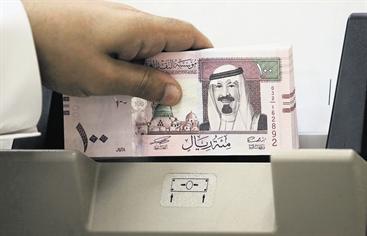
Saudi Arabia's banks have kept a tight lid on their credit taps in defiance of monetary easing measures taken by its central bank seeking to unlock massive resources to feed the crisis-hit economy, a Saudi bank said yesterday. Despite a series of rate cuts and reduction of the banks' mandatory reserves with the Saudi Arabian Monetary Authority (Sama), the banks' lending has remained at one of its lowest levels after peaking through 2008, the National Commercial Bank (NCB) said in a report sent to Emirates Business. "Last year, as the global economy tumbled and financial markets became dysfunctional, Sama was able to navigate the banking system away from the illiquidity that governed money markets, proving to be a pragmatic crisis manager not hostage to policy bias," said NCB, the kingdom's largest bank. "At the peak of these liquidity concerns, Saudi banks had extended credit at a double digit annual growth rate of 27.9 per cent by the end of 2008. However, the growth of private credit had dwindled ever since to a relatively meagre 3.8 per cent in July this year. Will monetary policy play any role at this juncture? And who is the main player going forward?" The report noted that the Saudi monetary policy is at present "extremely" accommodative, with the benchmark lending rate and three-month Sibor rate dipping to historical lows of two and 0.298 per cent respectively, implying that this strategic orientation pertains to domestic banks and their perception of credit risk. "Saudi banks continue to keep huge excess reserves, which reached 62 per cent out of the total deposits held at Sama at nearly SR79.9 billion (Dh78.2bn) in July compared to only 4.38 per cent in October 2008," it said. "Hovering around 60 per cent since the beginning of the year, excess reserves could either reflect reluctance, lack of opportunities or, in the Saudi case, banks that are recalibrating their portfolio mix to reflect the realities of a moderate business cycle and ,in turn, credit cycle." To offset a sharp fall in credit growth, Saudi banks have largely boosted investment abroad, mainly in high-yielding US treasury bills. Sama's figures showed the combined foreign assets of the kingdom's 12 banks climbed to one of their highest levels at the end of July and a large part of the increase was in their investments abroad. From around SR153bn at the end of 2008, their foreign assets soared to SR185.1bn at the end of July. The increase was mainly in their investments abroad, which leaped from around SR63.1bn to SR92.2bn. The increase allied with a decline in foreign liabilities to sharply widen the banks' net foreign assets from SR41.5bn to SR95.1bn. Net foreign assets plunged to lowest level of only SR45 million in September after a sharp fall in foreign assets. "The banks are continuing to build foreign assets as domestic lending stagnates… as we anticipated, Sama's cut to its reverse repo rate has not stimulated commercial bank lending to the private sector in the way the central bank might have hoped," said the Saudi American Bank said. It noted that Sama, the central bank, made the repo cut in the hope that banks would be less content to park liquidity with the central bank and more inclined to lend to the private sector. "So far, this has not occurred. Banks have been attracted by the high yields on US debt… rather than channelling additional liquidity towards the private sector, banks have chosen to buy higher yielding foreign assets." After rocketing by around 28 per cent to SR734bn at the end of 2008 over the previous year, Saudi banks' claims on the private sector receded to nearly SR728.8bn at the end of July. Bankers cited several factors for the slow credit activity in the world's largest oil exporter, including slackening domestic demand, weak investor's confidence, and a more selective and cautious lending policy adopted by the banks. Despite meagre lending operations, Saudi banks' net profits increased to around SR6.47bn in the Q2 2009 from SR6.28bn in Q1. But the income was lower than the profits of SR6.82bn achieved in the second quarter of 2008. First half net earnings also fell by around 5.2 per cent to SR12.76bn this year from SR13.23bn in the first half of 2008. Keep up with the latest business news from the region with the Emirates Business 24|7 daily newsletter. To subscribe to the newsletter, please click here .