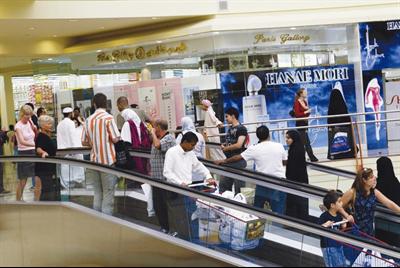
The UAE needs to tighten rules on personal bank loans to curb soaring consumer spending which has drained the domestic economy and turned the country into one of the biggest importers, a government report said yesterday. "Consumer spending by families has jumped by 122 per cent since 2002 to account for nearly half the gross domestic product last year and turn the UAE into the largest spender in the Arab world, with its average per capita consumption standing at seven-fold the average spending in the region," said the report by the Abu Dhabi Department of Planning and Economy (DPE). The surge in consumer spending has allied with soaring inflation to mar the recent upsurge in the domestic economy, obstruct production and investment and upset the country's trade balance, the report said. It blamed a rush by the country's banks to provide personal loans, soaring inflation rates, high population growth, expanding promotional campaigns in the market, and growing media publicity and advertisements. "The heavy consumption trend in the UAE is sustained by many factors. One of these factors is high inflation rate, which reached 10.9 per cent last year. Growth in the population rate which continues to be fuelled by massive development projects is another key reason," the report said said. "However, there are other factors that have combined with the above factors to propel consumption rate to unprecedented levels. They include the incentives offered by commercial companies for consumers, media publicity and advertising which tend to push consumers to buy goods which they do not really need. Above all, this consumption trend is fed and reinforced by banks." Banks The report found that banks are the main cause for such a problem as they vie to attract more clients for higher profits. Its figures showed that the net profits of the country's 52 banks have sharply grown over the past few years, standing at around Dh7.5 billion in the first quarter of 2008. They accounted for as high as 30.5 per cent of their 2007 net profits of Dh24.45bn. It also cited Central Bank statistics showing personal loans had risen during the first quarter of this year to Dh48.4bn compared to Dh43.5bn at the end of last year, recording 11 per cent rise increase during the first quarter. "Although there are varying opinions about the phenomenon of personal loans, there is unanimity about who is to blame on the rise of personal loans: banks. These banks have embarked on massive campaigns to entice clients to borrow more and more loans and thereby maximize their interests," it said. "The bank-client relationship has been more than unfair. While banks have been steadily maximising their profits, customers have been sinking deeper and deeper in personal debts. "On the other hand, these huge profits by the banks have never been matched by similar benefits on the part of clients." Adverse effects According to the report, the adverse effects of personal loans are not only limited to the individuals or their families but the entire society. "As a result of the spending spree, there has been a surge in goods imported for foreign countries Thus, the country's trade balance is titled in favour of those foreign countries as cash moves away from local to international markets. Local economic institutions would cease to produce, preferring rather to import. "The cure to this woe is to introduce a set of stringent measures to limit the ceiling of these personal loans. It has been noted that some banks provide loans that are 50 times the salary of a person. This needs to be reviewed." Spending surge The report showed that consumer spending in the UAE has jumped by around 122 per cent between 2002 and 2007, an average annual growth of 18 per cent. In value, it leaped from around Dh144bn in 2002 to Dh320bn last year, recording higher increases than economic growth during that period. As consumer spending is one of the main indices of economy, natural and balanced increase in this index impacts positively on production and the overall economic performance, whereas excessive rise would have a negative impact. For instance, a considerable chunk of liquidity would be drained at the expense of production and investment, the report said. "Indeed, some of the woes that have beset the UAE's economy have to do with the pervasive culture of consumer spending. Semi-official statistics indicate that per capita consumption in the UAE is seven-fold higher compared to the average spending in the rest of Arab countries. It is estimated at around $27 while average daily consumer spending in the rest of Arab states is $3.5 per day." The report cited a recent survey conducted by DPE on family spending in Abu Dhabi that consumption spending drained nearly 60 per cent of the family income. It said the survey covered most of last year and the first quarter of 2008, adding that the rate was found to be even higher among families whose monthly income was less than Dh10,000. This huge ga