China's rise to create a truly global auto market
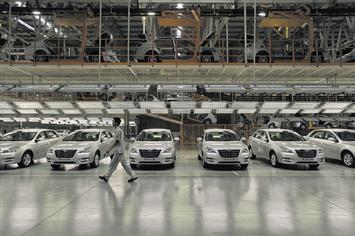
In the century since Henry Ford rolled out his first Model T – the world's first mass-produced, affordable car – in 1908, America has been the world's number one auto market. But nothing lasts forever.
Some day in the not-too-distant future the rise of China's middle class and its growing hunger for cars will push aside the US auto market and grab that top spot.
That in and of itself makes sense given China's 1.3 billion-plus population – a fifth of the world's total – and robust economy, which is not growing by double-digits anymore but is still healthy.
"The Chinese auto market is going to explode exponentially over the next five to 10 years," said Mirko Mikelic, an analyst at Fifth Third Bank. "They have an untapped consumer base that is constantly growing, so I don't think it would surprise most people that China is expected to surpass the US in the next 10 years."
But China's rise to the top in numerical terms has some broader implications for the global auto sector.
As ever more people in the country seek to buy their first car, the expectation is that small, low-cost and rugged cars – rugged because China's roads are still a work in progress, not unlike American roads of Ford Model T days – will dominate. The US automakers have not focused on building small cars over the years, which means more vehicles will be developed in Europe and Asia, continuing a long-term shift away from Detroit as a research and development centre.
America's automakers, however, should benefit from their strong image in developing markets such as China. And more than ever before, China's sales will mean car makers must reach out to far-flung world markets.
"China's rise emphasises the fact that the auto companies that are going to do well are the ones that are truly global," said Aaron Bragman, analyst at IHS Global Insight. "If you don't have a global presence, you're going to miss out."
Unlike most other auto markets, China's has continued to post impressive growth this year.
On July 9, the China Association of Automobile Manufacturers said the country's passenger car sales jumped 47.7 per cent in June to 872,900, lifted in part by government stimulus measures including a halving of the sales tax on small cars and subsidies for buyers in rural areas.
The association said total vehicle sales for 2009 would exceed 11 million units. That growth dwarfs the US, where auto sales fell 27.7 per cent in June to 859,847 vehicles and analysts now forecast 2009 sales of about 10 million units.
Although at face value the numbers suggest China has already surpassed America as the world's number one auto market, this is not an apples-to-apples comparison because the Chinese numbers include heavy trucks while the US data does not.
According to Michael Robinet, Vice-President of global vehicle forecasting at CSM Worldwide, heavy trucks account for about a third of Chinese sales – so a comparable number for 2009 would be about eight million units.
But while US auto sales are expected to recover with the economy – to about 14 million units annually – the market is largely saturated, with more cars than registered drivers. China, however, has a long way yet to go.
In a July 6 note, Credit Suisse analyst Hung Bin Toh wrote that by 2020 "we expect car ownership to reach 148 cars per 1,000 residents", five times current levels.
According to JP Morgan, China is on the threshold of a fresh car sale bonanza driven by rising incomes in third-tier cities that could last a few years.
"We believe this is the start of a third auto boom in China," Frank Gong, JP Morgan Managing Director and China Economist, told reporters at a July 8 briefing.
Unlike America, China has a vast pool of "virgin demand" for vehicles as more workers attain middle-class status, said Robinet.
For automakers, China represents the best opportunity to expand sales rapidly without having to battle for market share as manufacturers do in Europe and the US.
General Motors, for instance, has seen Buick sales in China outstrip US sales two years running.
"China is a good opportunity for General Motors," said Bragman. "In countries such as China, India and South America its brands are not damaged the way they are in the US."
But while US automakers can gain from the boom, most product development will be done in Europe and Asia – for instance, Ford Motor's new small cars will be based on European platforms. And Chrysler Group, owned by a union-aligned trust, the US and Canadian governments, and Italian automaker Fiat, will not develop its own small cars.
"Chrysler's cars will be developed in [Fiat's headquarters in] Turin, not [Chrysler's headquarters in] Auburn Hills," said CSM's Robinet.
As China's market grows, Jeremy Anwyl, Chief Executive of Edmonds.com, said that the key to success for global automakers lies in "leveraging common platforms and tailoring them to local tastes".
He said that Volkswagen provides a "textbook example" of an auto company that uses a few common platforms to produce a number of different – and different-looking – vehicles.
"If you're not selling five million units a year, you're not going to be competitive," said Anwyl. "The focus will be on efficiency, but if you are not smart about how you leverage your platforms it won't work."
Keep up with the latest business news from the region with the daily Emirates Business 24|7 newsletter. To subscribe to the newsletter, please click here.