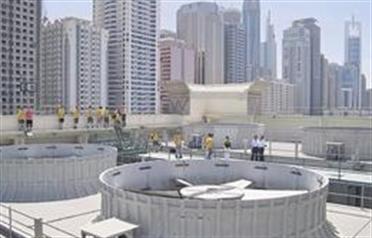
A new, less capital-intensive tariff model when it comes to financing is being considered by the district cooling industry, according to a senior industry expert. The current tariff model followed by most companies dictates expensive or heavy capital investment upfront. Shafiq Khoori, Managing Director, Palm District Cooling, yesterday told Emirates Business that companies are in the process of developing a new tariff model that could make investments more convenient. "The current economic situation has definitely had an impact on district cooling companies. There are projects that have gone on hold or are cancelled. However, as district cooling provides a more cost-effective solution, companies that are going ahead with their projects are preferring the option of district cooling," said Khoori. However, with banks facing a liquidity crunch and securing project financing becoming a herculean task, things are getting a bit more difficult. "The current tariff model that is followed by most companies dictates expensive or heavy capital investment upfront. With lack of liquidity and financing in the market, it has a direct impact on expansion and growth of district cooling plants," he said, adding companies are coming up with alternative solutions. "However, alternative tariff structures and models are being considered by district cooling companies, which makes financing projects more friendly. Palm Utilities is one of those companies that is thinking of implementing the new mechanisms. It is less capital intensive as far as financing is concerned." However, with many projects still unoccupied, companies are also struggling to get returns on massive investments. Khoori said, "Complete capacity can happen only when the development is fully occupied. We do face such a situation, but not to a large extent." "We were working on a particular growth plan and suddenly things changed. The growth plan just died, forcing us to rethink our strategy and slow down our construction. In the process, obviously there are some investments that we made that cannot be reversed," said Khoori. "The idle capacity we are hoping will be utilised in the coming year. We are expecting some signs of recovery starting from the second half of this year," he added. According to him, the company has meanwhile been working closely with Dewa and Dubai Municipality. "Once that scheme is finalised and details are cleared, it will further reduce the cost of production. The cost benefit can be passed on to the end users. "We are working with DM towards the supply of treated sewerage effluent for our water requirement. Things are progressing well on that front and we are planning to convert the supply of water from portable to treated sewerage effluent for current and future use," he said. Meanwhile, the National Central Cooling Company (Tabreed) recently released its first quarter consolidated financial results. The company witnessed a 29 per cent increase in consolidated net income compared to the same period last year. The Abu-Dhabi based utility firm said the increase reflected a strong rise in gross revenues particularly within Tabreed's manufacturing unit, in part offset by higher costs associated with higher sales volumes. The company is working on 16 district cooling plants under construction and announced four new district cooling contracts that will supply a combined total of 9,905 tonnes of new cooling capacity per year. The UAE continues to remain the largest market for district cooling facilities with about $2.6 billion worth of ongoing projects. Industry sources, however, feel that Saudi could soon emerge as the leading player with massive ongoing and planned construction projects. Saudi Arabia currently has about $598 million worth of ongoing district cooling projects. According to statistics released by research institute Proleads, the UAE, Saudi Arabia, Bahrain and Oman put together alone currently have district cooling projects worth over $3.6bn. While Bahrain has ongoing district cooling projects worth $400m, Oman has a comparatively small number at $39m. Keep up with the latest business news from the region with the Emirates Business 24|7 daily newsletter. To subscribe to the newsletter, please click here .