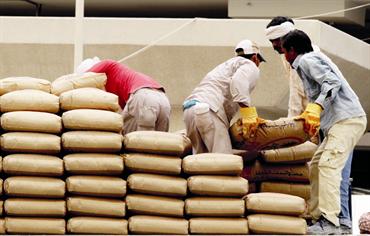
Cement production in the GCC will exceed demand by almost 15 per cent in 2009 with largest additions scheduled in Saudi Arabia and the UAE, according to a research report on the GCC cement sector by Credit Suisse. The researchers estimate that the construction markets in Saudi Arabia, Qatar and Abu Dhabi would remain strong, giving an impetus to demand for consumption material, whereas Dubai and Kuwait represent less attractive markets. "We expect a wave of excess supply across the region, with the largest additions in Saudi Arabia and the UAE. We expect demand to slow as a result of projects put on hold or cancelled, thus exacerbating the oversupply situation. Regional pockets of cement manufacture might be able to withstand some of the resulting pressure on prices and lower operating rates," said the report. Supply of cement is expected to grow by about 20 per cent in 2009 whereas demand growth would be limited to just five per cent. Given these circumstances, the report says environment, location and cost structure are key to demand. "Geographically, from a cement industry perspective, we prefer Saudi Arabia (Riyadh region), Qatar and Oman to have the most advantageous cost structure," it said. The cement capacity evolution, the report said, points to Saudi Arabia with an additional capacity of 39 per cent from 2008 to end-2010, the UAE with an addition of 27 per cent and Qatar with an addition of 114 per cent undergoing major capacity expansion in the next two years. "We believe the outlook for cement demand is still relatively good in some countries, albeit with slower growth than in recent years. If all planned projects in Saudi Arabia go ahead, this country could see continued growth in demand – and the same can be said for Qatar. "However, the scenario for Kuwait does not include the substantial demand we expect from the development of Silk City and hence we expect demand growth in this country to be the slowest among the six GCC countries. We expect the strongest demand growth in Qatar and Saudi Arabia, based on the outlook for GDP growth and infrastructure spend." According to the researchers, at 2009 installed capacity levels, this demand scenario would generate internal stresses. They expect 24 million tonnes of excess capacity across the GCC in 2009 and even 31 million tonnes in 2010. "We believe, therefore, that the outlook for 2009/ 2010 for the cement industry in the GCC is weak, with the single most important factor being a company's cost structure in response to domestic and regional peers. In this scenario, we expect operating rates to fall by 10-15 per cent across the board, which would translate into lower selling prices. We thus have a negative top-down view of the sector," it said. The report also estimates that 14 per cent of Saudi excess capacity could have a serious negative impact in all other GCC markets except the UAE, especially under the scenario of a free GCC cement market with no import or export barriers, rather than one where domestic demand is catered to purely with domestic supply. Calculating the relative competitiveness among the GCC countries, taking 2008 prices as a base the report estimates that 2008 realised prices by producers in various GCC countries would be $69 (Dh253) per tonne in Saudi Arabia, $85 in Oman, $69 in Qatar, $88 in the UAE and $95 in Kuwait. "As a result, we expect pressure on prices across the GCC, particularly in the UAE and Kuwait where prices are at the high end of the GCC average. For the UAE, we estimate an average year-on-year decline of 22 per cent for 2009 and a further 10 per cent in 2010. For 2009, we are forecasting an average price of $79 per tonne for the UAE. For Kuwait we estimate an average drop in cement prices of 10 per cent in 2009 and five per cent in 2010, to reach an average price of $81 per tonne," said the report. Commenting on the situation in the UAE, the report estimates an installed cement capacity of 28.5 mtpa in 2008, increasing to 36 mtpa by end-2010. "While domestic installed capacity has been unable to meet demand in the past, an impending change in sentiment could tip the balance to an unfavourable excess supply scenario," it added. The report said realised prices in the UAE last year were among the highest in the region at $90 per tonne. For 2009, the report anticipates a substantial slowing in demand growth in the UAE from an average of 17 per cent per annum in the past three years to five per cent in 2009 and 2010. "In our estimates, demand increases from 22 million tonnes in 2008 to 25 million tonnes in 2010," it said. The report said that "even under this positive demand scenario, we expect operating rates to drop, as we expect capacity additions of 20 per cent in 2009 and six per cent in 2010". Most of the cement produced is consumed domestically, except in Oman, where exports used to be a key component of sales. In addition, exports from Egypt, Iran, India and Pakistan find their way into the region. The