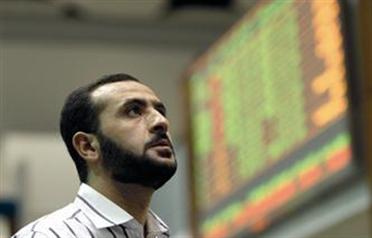
Gulf stock markets are expected to remain low relative to regional economies in the near future but the decline in their valuations has made them more attractive for investors, a key Kuwait bank said yesterday. After large gains during the first half of 2008, the bourses in the GCC dipped by at least $500 billion till the end of April, sharply reducing their ratio to the gross domestic product in member states, the National Bank of Kuwait said in an eight-page report on GCC markets. Instead of using the traditional price to earnings, price to book and other known ratios to assess share valuations in the GCC stock exchanges, NBK opted for market capitalisation to GDP (Mcap/GDP) ratio, which it said reflected the real market performance in the GCC over the past few years. Its figures showed plunging stock prices over the past year because of the global financial distress had dramatically depressed that ratio. "There is no fixed level to which the Mcap/GDP ratio should return, but share valuations for most GCC countries clearly look a lot more attractive now than at most points over the past seven years," NBK said. "In today's more subdued growth environment, equity prices may move more closely in line with growth of non-oil GDP. If so, market capitalisation/GDP ratios could stay below historical levels for some time." The report showed that after standing at 48 per cent in 2002, the combined GCC Mcap/GDP ratio climbed dramatically to 182 per cent by the end of 2005 – just about the peak of the regional bull market. In other words, the combined value of regional stock markets was equivalent to 1.8 times the value of economic output, it said. But it added that this turned out to be unsustainable, as stock prices crashed at around the end of the year, sending the ratio back down to 94 per cent. "Interestingly, at the peak of the following market cycle in June 2008, the ratio only made it slightly higher to 101 per cent. But by the end of the year, it had halved to 50 per cent, a proportionate fall more severe than the one seen after the crash of 2005-2006. By April 2009, it stood at 67 per cent – around one third of its 2005 level," the study said. A breakdown for 2002-2008 showed Kuwait has had the highest ratio of Mcap/GDP, standing at 126 per cent, compared to a GCC average of 99 per cent. This partly reflects the fact that the Kuwaiti market saw a relatively modest correction in 2005/2006, according to NBK. By contrast, Bahrain and Saudi Arabia have seen averages of around 100 per cent while Oman has had by far the lowest ratio, of 30 per cent. The report said this reflects the small size of the Omani stock market and the relatively under-developed status of the country's financial sector. "Also of note, despite the impression of the UAE being home to some of the region's more speculative behaviour, its ratio has been one of the lowest, at 80 per cent. This probably reflects the relative diversity in the UAE's economy, as well as the number of non-listed foreign firms operating in the UAE, which add to GDP but not to the value of the stock market." NBK also used another ratio to better evaluate GCC market performance by excluding the oil sector, the largest component of the GCC in most GCC countries. Another ratio excluded both the oil and the public sectors. "Excluding oil sector output provides us with a better grasp of how regional stock markets are positioned relative to the companies upon which its performance depends. This showed that the absolute levels of the ratios are clearly much higher, reflecting the exclusion of the region's huge hydrocarbon output from the denominator of the calculation," the bank said. For the GCC as a whole, the study put that ratio at as high as 361 per cent in 2005 and around 271 per cent in 2007. The study said the other ratio, which excludes the public sector, represented an even smaller share of the total economy than non-oil GDP. It estimated the current average contribution of the private sector to non-oil GDP to be less than 65 per cent in the three countries-- Kuwait, Saudi Arabia, and the UAE. It noted that a share price should typically reflect the present value of future cash flows accruing to shareholders. The bank said the total market capitalisation is more closely tied to the stream of cash flows generated by resources contributed by the private sector. "Therefore, some may view the ratio of Mcap/private sector GDP as a more appropriate indicator of equity market valuation and, naturally, to be significantly higher than the Mcap/non-oil GDP ratio." Its figures showed that after their peaks last year, the Mcap/non-oil GDP ratios for most GCC countries were stretched well beyond their medium-term averages. These averages themselves may have been over-optimistic benchmarks, since they capture mostly boom years, the report said. NBK said a swift return to decent growth rates could cause a pick-up in equity prices, but a return to the elevated levels seen in rece