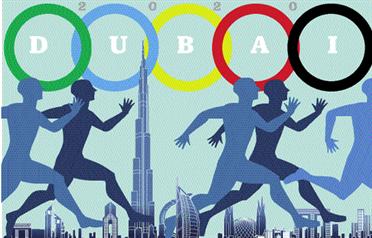
There is not one Arab flag on the list of countries that hold the honour of having hosted the Olympics. That means the Flame of the Olympics, which was first lit in Athens in the eighth century BC, and then re-emerged in the Greek capital in 1896, may have travelled far and wide to almost every country in Europe or to North America and, more recently, Asia, but it has skipped the land very close to its origin. Two Arab contenders have now emerged to contest for the 2020 Olympics – Dubai and Doha. Doha seriously vied for hosting the 2016 Olympic Games and was not considered when the International Olympic Committee (IOC) held its first round of meetings in June last year. Immediately afterwards, Qatar announced it will bid for the 2020 Olympics. The other cities that have already lined up to bid up for the 2020 Olympics include Durban, Cape Town, Busan, New Delhi, Toronto and Kuala Lumpur. Dubai has now set up a committee to study the city's potential to host the Olympic and Paralympic Games in 2020. Even though the emirate may be relatively young compared to the growing list of ambitious cities lining up for the 2020 bid, there are certain aspects that give it an edge over the other contenders. The most important of all, people with knowledge of the matter say, is its potential for constructing townships, buildings and infrastructure at a pace that is arguably one of the fastest in the world. "Dubai's record in construction will come to its aid. The Metro and the transport system will also add to the emirate's strength while bidding," Dr Eckart Woertz, Programme Manager (Economics) at Gulf Research Center, told Emirates Business . But how does the IOC decide which city will host the Olympic Games? This is a decision that involves dozens of members of an elite club who consider everything from the candidate city's financial situation to its traditions of "Olympism and culture". According to reports, the IOC evaluates 18 themes, which vary from the logistical, such as transportation and security, to the subjective plans for an Olympic Village, for example. Dubai, by all accounts scores well on these issues. Malcolm Thorpe, Marketing Director (Sports Business) at Dubai Sports City, said the evaluations are so elaborate that the IOC goes on to look at even the post-games usage of the edifices and structures that the country creates. "London, which is hosting the 2012 Olympics, is in fact creating several temporary structures for the Games. The British capital can rationally claim that the permanent structures will be part of its legacy and will be used to its potential later." A city's labour relations record is another issue that plays a role in determining its potential for the Games. When Beijing was considered the front-runner among candidates Toronto, Paris, Osaka in Japan and Istanbul, Turkey, this cropped up as one of the issues. China has long been criticised for its practices, which were said to be one of the reasons it lost the 2000 Summer Games to Sydney. It finally won the 2008 Games. Another aspect is the infrastructure. The IOC, says Thorpe, needs to be assured that a city will be able to have its infrastructure ready at least a year in advance. And that gives Dubai a lot of time – probably more than it needs. "There are still three to four years before bids will be made. And then 2020 is almost a decade away. Dubai has part of the infrastructure ready. Furthermore, it has a lot of time to ready what it does not have," he said. How will the Olympics help Dubai? Such is the magnitude of business that the Olympics generate that they are supposed to have played a major role in extricating London from its post the Second World War doldrums in 1948. The Olympics have transformed cities such as Sydney and Beijing. "Every city hosts the Olympics for a different reason. It puts the city on a world map," said Jason Prior, President of Edaco Aecom, the company that prepared London's master plan when it was bidding for the 2012 Olympics. "What's more important for Dubai is the business that the Olympics would bring after the games are over." Business potential attached to Olympics is huge. In fact it can be understood from the fact that China was stockpiling low-sulphur diesel for the Olympics, which played a key role in driving up the oil prices to historic highs in July 2008. Olympics bring and drive global business. And Dubai is no exception. Will being an Arab host help Dubai? It should, people with knowledge of the matter say. In fact, Qatar is known to play this card very strongly. Olympics have never been held in this part of the world. There is an increasing emphasis among most international organisations devoted to the development to involve the Arab youth into constructive spheres. Emboldened after being awarded the 2012 Olympics, a senior British politician on a visit to Doha asserted that the UK will "whole-heartedly" support Qatar's bid for the 2016 Olympics on this ground. "We believe that Olym