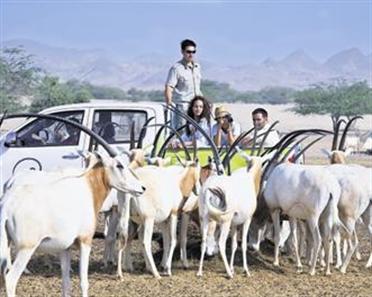
Ecotourism is set to be a big draw for tourists in the UAE as the industry focuses on ways visitors can give something back to the Emirates via a holiday in the sun. Home to high-rises, five-star hotels and tourists looking for a beach break, the UAE is not an obvious destination for those waiting for an eco-holiday. But as a number of new destinations begin to combine first-class service and accommodation with sustainability projects, maybe it should be. Desert Islands, a major development being built off the coast of Abu Dhabi, will become the country's first purpose-built ecotourism destination when it opens to the public in October, heralding a new era for travel in the region. The eight land masses, which include Sir Bani Yas and Dalma islands, are sites of historical and natural beauty and will be used to educate visitors. The scheme – being overseen by the Tourism Development and Investment Company (TDIC) part of the Abu Dhabi Tourism Authority – is the first of its kind in the UAE. Lee Tabler, TDIC CEO, says the first phase will open in October on Sir Bani Yas Island with further sections opening yearly until the project is complete in 2017. "Visitors will learn a lot about the geography, history, culture and indigenous wildlife of Abu Dhabi while the tourism and international development industries will have a case study in sustainability, proving that sometimes it is not so much what you develop, but how you develop it that equals success," he says. "Sustainability and environmental stewardship are values at the very core of the company's corporate philosophy." The Desert Islands destination was conceptualised in 2002 when the Abu Dhabi Government began formulating its tourism strategy for the future. "The government realised the immense potential of Sir Bani Yas Island, the former royal eco-reserve, and the emirate's largely untapped Western Region," explains Tabler. TDIC has now commissioned a long-term environment impact report for the destination examining conditions both above and below sea level. The report is expected to take a year to complete. "We are determined to implement and adhere to its recommendations," says Tabler. Initially visitors will be restricted to limited tours and those staying overnight at the 64-room, five-star Desert Islands Resort and Spa or in a tented Arabian beach side camp. Tabler says: "As a flagship project, Desert Islands will serve as a paradigm of how developments can be successfully and sustainably tailored to a destination's tourism strategy. We are also upgrading and expanding the bird sanctuary to ensure the island remains the migratory home of hundreds of species." According to TDIC the region's first wind turbine is now up and running on Sir Bani Yas and they are working with the Abu Dhabi future energy initiative Masdar to ensure that Desert Islands utilises as much renewable energy as possible. "In terms of socio-economic impact Desert Islands will be something of a showpiece. This will become one of the world's largest sustainable tourism destinations. It will demonstrate the socio-economic benefit of considered development as it opens up Abu Dhabi's western region to international tourism and promotes the countries great outdoors to a wider audience." John Kester, the chief of tourism trend and competitiveness at the World Tourism Organisation (UNWTO), says it is difficult to assess whether ecotourism is growing across the GCC as no recent research has been done. In 2002 UNWTO published a report on ecotourism that suggested it had become the fastest-growing segment in the industry and was increasing 20 per cent annually compared to seven per cent for tourism overall. "It depends how you define ecotourism and where you draw the line. What is eco and what is not." says Kester. "But what we do see is tourism becoming fragmented with many more different types of holidays now available and ecotourism is definitely one of these areas. "However, sometimes companies use ecotourism as a marketing tool and there is no way of telling if they are following the real meaning of ecotourism. At present it is hard to monitor the sector." In the case of Dalma Island – the second largest of the Desert Island's components – TDIC says it is retaining the island culture and showcasing it while ensuring the support of the local population. Dalma Island will also offer an education centre with vocational training to residents. and contribute significantly to the progression of Abu Dhabi's Western Region by generating an expected 6,500 jobs when the destination is fully operational. Plans are also underway to convert a 350 million square metre area of Dubailand into an eco-zone. The three developments are Heritage Vision, the biggest of the three projects that will tell the history of Dubai and the UAE through light and sound shows, Western City, another leisure development that will depict the lifestyle of pre-gold rush times and feature a zoo, farms, villas and a rodeo s