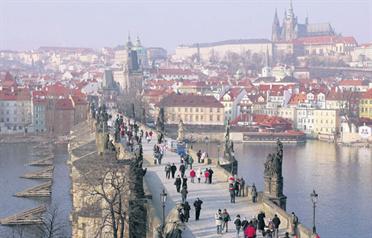
Busy Wenceslas Square is now a far cry from January 1969, when Czech student Jan Palach set himself alight to protest the Soviet-led invasion and subsequent occupation of Czechoslovakia the previous year. "There are all sorts of weird emotions running through me," says Dubai resident Hink Huisman. The Dutch national remembers watching the entire scene from the balcony of his hotel room. "Then, this square was full of tanks and tanks and tanks. Now, it's cars and cars and people." A bronze cross in the pavement marks forever the spot where Palach fell, in front of the National Museum, and a few metres away, a plaque commemorates Palach and another student, Jan Zajíc, who also committed suicide by self-immolation the following month. Twenty years later, in 1989, the square was a focal point for the Velvet Revolution, when the Czechs peacefully overthrew the Communists. Like many other former Soviet Bloc capitals, it's this connection with the recent past, this sense of living history animates this 1,100-year-old city – although the vibrant nightlife doesn't hurt, either. Prague was settled in Paleolithic times, but the modern city was founded in the 10th century. The exotic capital of gleaming spires, arched bridges and witty, contemporary sculpture (bad boy David Černý's babies crawling up the TV tower are a delight) is now a bustling centre for business, particularly into Eastern Europe, as well as a top conference hotspot. In recent years, this conurbation on the banks of the Vltava has also emerged as a hot new luxury destination, with several top-end hotels opening their doors in what is already an extremely crowded market. As far back as 2007, the city had more hotels (320) than streets (280); today there are almost 500 hotels in Prague's city centre. "Compared to 10 years ago, Prague has much more to offer the luxury traveller," says Henning Matthieson, General Manager of the new Rocco Forte-run The Augustine hotel, which opened last month. It joins three other new entrants in the five-star sector: a Sheraton (inaugurated in March), the first Buddha Bar Hotel (January) and a new Kempinski (October). Located in a functioning 13th-century monastery, the hotel is a complex of seven old and new buildings. Many of designer Olga Polizzi's interiors are inspired by this history as well as the country's cubist era (Prague is the only place where the art movement was applied to architecture and interior design, resulting in some rather witty living statements). But with hospitality consultancy The Bench putting Prague 13th in a recent survey of four and five-star hotels in European cities, measured by revenue per available room, competition is also hotting up at the budget-conscious end, with new openings such as The Yasmin and 987 Prague, with its furniture by Corbusier and Philippe Starck. Either way, interest in Prague here in the Gulf is tremendous, says Matthieson, who led a roadshow across the region last month. "Prague has now emerged on the Middle East map," he says. And of course, there's 10 centuries of history in this home of Kafka and Kundera. "In Paris, you need to go to a museum, the whole city of Prague is a museum," he says. Prague suffered relatively little damage during World War II, as compared to nearby Dresden or Nuremberg, for example, and consequently has one of the world's most well-preserved collections of architecture, from Art Nouveau to Baroque, Renaissance, Cubist, Gothic, Neo-Classical and ultra-modern, says Marek Holub, an architectural fanatic and tour guide with the Four Seasons Travel agency. It regularly books hotels in Central Europe for Middle Eastern residents and General Manager Anwar El Ahmed says it can provide Arabic speaking guides as well as handling transfers, tours and even private jets. What you can do in the city depends on how much time you have. From Bohemian palaces and splendiferous Cubist architecture to film trails that revisit the locations for blockbusters such as Casino Royale, The Bourne Identity, Amadeus and the Narnia series, there's so much to do, you're definitely not going to be able to pack it into a few days – or even a week. Short-trippers will definitely want to take in Prague's famous fairytale castle, the tops of whose buildings can be seen from almost anywhere in the city. Founded by the Czech Přemysl princes in the 9th century, the complex is the largest in the world, bigger than seven football fields and is still the official presidential residence. Arrive at midday for the changing of the guard by the castle gates, and stay to visit the Toy Museum, with its entire floor of Barbie dolls; the massive St Vitus Cathedral, built over an astonishing seven centuries from 1344 to 1929; and the 16th-century Golden Lane, which housed royal tradespeople and later, artists and writers, including one Franz Kafka at number 22. Bare minutes away is the iconic Charles Bridge, constructed during Bohemia's Golden Age in the fifteenth century. Thirty statue