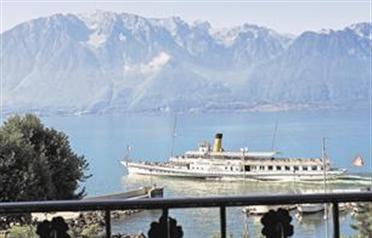
It's a nation of boring bankers, a tax-dodger's paradise in the heart of Europe, where scores of dull-suited diplomats form queues at airport check-in desks, their bags stuffed with chocolate and cheese. Or is it? Switzerland, one of the richest nations on Earth, has long lived with the reputation as the grey man of Europe, a place of seven-plus million people, labouring under four official languages but lacking a single identity. Words such as discreet, stable, neutral and "conservative" (i.e. boring) are usually – and lazily – brandished to describe what is actually a country of stunning natural beauty and a rich cultural heritage. It's neutrality for one – it has not been to war since 1815, unusual for Europe – has ensured much of its stunning architecture remained unscathed through two world wars. But the country has ruffled a few international feathers recently, most notably with its neighbour Germany, in its outright reluctance to reveal who is stashing their cash there, and how much. Switzerland is a favourite among the well-heeled and high-net worth crowd. And visitors from the Middle East are a familiar sight, especially around the shores of Lake Geneva, where multi-million dollar homes look out over the expansive waters. In Vevey, a small but vibrant market town in the French-speaking canton of Vaud on the north shore of Lake Geneva, they are especially proud of their history. This is the home of Nestlé and solid chocolate, it gave shelter to Charlie Chaplin when he was expelled from the United States during the Communist witchhunts, and the Hotel du Lac – where Emirates Business stayed – accommodated British author Anita Brookner while she wrote her award-winning novel of the same name. The Grand Hotel du Lac, as it is now named, recently underwent a radical transformation, which lifted it from four-star splendour to five-star boutique luxury, the interior remodelled under the ever-watchful eye of world-renowned designer Pierre-Yves Rochon. It now has the deliberate look and feel of a neo-Edwardian private house, rather than a hotel, in the belle époque style, its interior filled with objet d'art; its walls lined with beautiful pieces of art; the reception desk is not the first thing to greet guests. And how many hotels can boast their own herb garden? There are only 50 rooms, each different and many of which have beautiful views to France over the lake. And the lake is the centre of life in Vevey and neighbouring Montreux – at any time of day or night, there are walkers, runners, in-line skaters, painters, anglers, families with children, young couples, sunbathers – all enjoying the fresh, fresh air. The beautiful hotel has all the amenities befitting its recently acquired five-star status. At dinner on the hotel's front terrace, general-manager Christopher Rudolph admitted the Swiss have something of an image problem. "To other people, we are seen as being very conservative, and that there is nothing to see or do here," he said. "But the reality is very different. There is obviously skiing in the winter, but in the summer, there is hiking, mountain biking, paragliding… Anything other Alpine nations offer, we offer too and in abundance. "We are a discreet nation," he said. "That is why so many high-net worth individuals come here. They know they can relax, take in the fine food and wine and hospitality, without, say, the paparazzi intruding on their every move." As befits such a choice location, Vevey offers in abundance the finer things in life. The town itself is surrounded by vineyards planted on steep terraces built hundreds of years ago by the region's indigenous monks. Such is its importance, it was made a world heritage site by Unesco. The terraces are now in the hands of independent winemakers, who have worked the land proudly and, in some cases, for generations. The quality of the produce is such that none is exported; all is consumed locally. Back in Vevey, and the town's passion for chocolate is demonstrated by, among others, famous chocolatier Confiserie Poyet, a family-run business where their love for the dark gold is second to none. A tour of its kitchen, while not exactly Willy Wonka in its psychedelic excitement, is fascinating. And tasty. As for good places to eat away from the Hotel du Lac, it is worth tracking down Restaurant Denis Martin, a two-Michelin star winner and once at the leading molecular gastronomy kitchens in the world. Emirates Business was lucky enough to be welcomed into the "experimental" area of his kitchen where he demonstrated the principles of this fascinating way of cooking. Ten-second ice cream, using liquid nitrogen, was a high point. The taster menu, running to sardine sorbet by way of snail "earth" and rien – a seemingly empty dish – will set a diner back about CHF310, (Dh1,070), but is worth the experience, which the chef insists is serious food with a sense of humour. Ultimately, Vevey is probably not a place for younger people to visit, and nor d