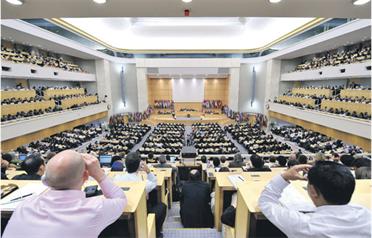
As the world grapples with the worst economic meltdown it has ever witnessed, and the specter of increased unemployment looms large, the International Labour Organisation (ILO) is holding a Global Jobs Crisis Summit in Geneva. The three-day summit, which begins today, will be attended by heads of states, vice-presidents, labour ministers and leaders from employers' and workers' organisations. This summit, will provide a first-of-its-kind opportunity to discuss policies that are being implemented at the national and international levels to address the global jobs crisis. The summit will include four high-level panels on the following topics: global and regional co-ordination, development co-operation, fundamental principles and rights at work, and industry enterprise-level strategies. The French President Nicolas Sarkozy, President of Poland Lech Kaczyski, President of Finland Tarja Halonen, President of Mozambique Armando Guebuza, President of Brazil Luiz Inácio Lula da Silva, and President of Argentina Cristina Fernández de Kirchner are some of the keynote speakers at the summit. Recently, Juan Somavia, the ILO Director-General, called for swift and bold action to prevent a lingering jobs crisis from plaguing the world and called for a global employment pact to address the problem. Somavia said: "We are seeing an unprecedented increase in unemployment and the number of workers at risk of falling into poverty around the world this year. To avoid a global social recession we need a global jobs pact to address this crisis." According to the ILO, the pact would be a cohesive strategy to deal with labour-market issues globally, putting job creation and protection at the heart of economic stimulus packages. If this was not done, the recovery of the job market could lag behind an economic rebound by four or five years. Emirates Business spoke to some industry executives to find out what they think of the idea, if it is feasible and what they think should the pact include. Reacting to the idea of a global jobs pact Bharti Jatti, General Manager, Careertunity, a job portal, said: "The implementation of the global jobs pact would surely be a step in the right direction to help improve the employment situations and define social protection measures that in turn would help create opportunities." Mona Al Munajjed, former ILO special advisor for women workers and gender questions, said: "I think that the job pact, whenever it happens, is an excellent idea and if the world succeeds, then it will mitigate the sufferings of millions of men and women worldwide." Balakumar, Director, Dulsco HR Solutions, said: "There is no denying the growing impact of the economic and financial crisis on the job market around the world. It is a good idea that the ILO has called on its 183 members to attend a summit in Geneva. This will give influential people such as heads of states senior government officials and ministers and labour union leaders an opportunity to discuss ways and means to protect workers and enterprises from the effects of the crisis." Going into how effective the pact might be, Balakumar said: "Since so many decision makers are going to find solutions together, I think the global job pact should be quite effective, but it will also depend on a very large extent on what the terms of the pact are and how they are put to use globally." Jatti added: "In the recent months the global markets have seen a lot of fluctuations and the unemployment rates have risen significantly. The pact, which will be agreed upon by global leaders, with an objective to tackle the crisis through investment and by putting well planned and agreed strategies in place, should definitely indicate a positive direction to help the employment situation at a global level." However, Mona Al Munajjed added a word of caution: "Even though it will be a very positive development, the governments will have to keep in mind the cultural, economic and social differences. These differences are important and they cannot be ignored. For example, something that might be suitable in the United States might not be suitable in the Arab World or in Asia Pacific. However, if they can form the pact keeping all these differences in mind, it will be very beneficial. And I really hope they succed." Balakumar said: "The unemployment problem around the world is a very serious one. The ILO has said that the average global unemployment rate could reach 6.8 to 7.4 per cent by the end of this year. Implementing a global job pact will hopefully mitigate the impact of the crisis on working families and help generate a 'sustainable' recovery that would encourage decent working conditions. "The fact that high-level panels involving ministers, senior policy-makers, representatives of business and labour, representatives of international and regional organisations and other global opinion leaders are talking at the summit on the ways to do that is very encouraging. "They will also be dis