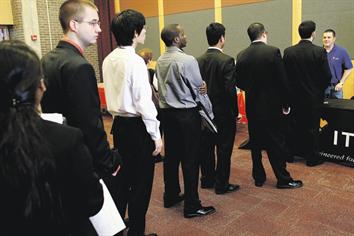
Even as millions of people worldwide struggle to find jobs, the International Labour Organisation (ILO) is busy looking for ways to limit the fallout from the global economic crisis on the world's labour market. The gravity of the situation can be gauged from the fact that this year's International Labour Conference in Geneva, which started on June 3 and runs until June 19, is discussing ways to limit the fallout of the recession on the market. In fact, just recently, Juan Somavia, the ILO Director-General, called for swift and bold action to prevent a lingering jobs crisis from plaguing the world. Presenting new data in Geneva, Somavia said: "We are seeing an unprecedented rise in unemployment and the number of workers at risk of falling into poverty around the world this year. This is a cause for grave concern. To avoid a global social recession we need a global jobs pact to address this crisis, and mitigate its effects on people." According to the ILO, the pact would be a cohesive strategy to deal with labour-market issues globally, putting job creation and protection at the heart of economic stimulus packages. If this was not done, the recovery of the job market could lag behind an economic rebound by four or five years. The ILO has also predicted that the Middle East will be hit hard by job losses this year, with unemployment rising by up to 25 per cent compared with 2007, according to the ILO report in 2008 the unemployment report in the Middle East was 9.4 per cent. The UAE Minister of Labour Saqr Ghobash Saeed Ghobash is also attending the conference along with a high-level delegation of 20 representatives from the UAE, including Humaid bin Deemas, the acting director general at the ministry, and Obaid Salem Al Zaabi, the UAE's permanent representative at the UN's European headquarters. The ILO's predictions regarding rise in unemployment numbers were confirmed by recruitment and human resource consultancies Emirates Business spoke to. Bharti Jatti, General Manger, Careertunity, a job portal, told this paper: "Due to the recession, the number of résume we have received has grown. Since January, there has been a huge increase in the number of job seekers asking to be registered. We have received applications from candidates from the UAE, Qatar, Bahrain, Saudi Arabia, Kuwait. From November 2008 until April 2009, we have seen an increase of around 37 per cent in the number of registrations. The maximum number of applications we have received have been from the construction sector, retail, hospitality, technical, sales and marketing and finance and banking." Anandorup Ghose, Manager, Consulting, Hewitt Associates, a human resource consultancy, told this paper: "The number of people applying for jobs has gone up significantly since the recession. The number of applicants seeking jobs in the Middle East from the West, such as North America and Europe, has been more than it used to be. We saw this rise starting from September and October. "The number of applicants from the Middle East started going up after December as the impact of the recession was felt here later." Patrick Luby, General Manager, Manpower, Middle East, said: "There has been an increase in the number of people seeking jobs, especially in the past few months. Earlier we used to get around 2,000 candidates registering with us, but since October-November the numbers have been going up." Experts said that despite there being so much talent in the market, firms are not hiring and there has been a definite shift from retaining talent at all costs to rightsizing. Ghose said: "Less companies are hiring in the Middle East. Earlier in the Middle East, as in the rest of the world, there was a talent shortage and the focus of the companies here at that time was finding the right talent and then retaining it, even at high costs. "Now that focus has shifted. In the past couple of months, the number of companies hiring has gone down and talent is easy to find now. So now the focus of the companies has shifted from tailoring human resource policies around retaining talent and providing them better incentives to putting stronger performance management systems in place so that if they have to rightsize, they do not lose their top talent and can also weed out the deadwood." In its Global Employment Trends Update, the ILO has also revised its predictions for global unemployment rates in 2009. In the worst-case scenario it sees a global unemployment rate as high as 7.4 per cent, with 239 million people unemployed – an increase of 59 million people on 2007 levels. However, the experts said the recession is not the only reason for this unemployment. To a very large extent the restrictive immigration and labour policies followed by governments around the world and the increased expectations of the employers are also to blame. Luby said: "Immigration and employment rules of many countries are also to be blamed as they do not allow the workforce to move freely. Wh