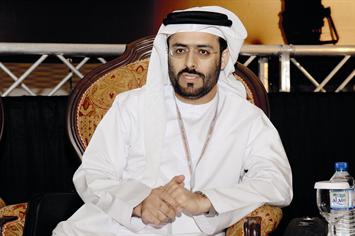
Burooj Properties will go ahead with its Initial Public Offering (IPO) in 2011, by which time the company expects market conditions to improve sufficiently, a senior official told Emirates Business. In an interview, Adel Ahmed Al Zarouni, Managing Director, Burooj Properties – an Abu Dhabi-based subsidiary of Abu Dhabi Islamic Bank – said the company has no intention of reversing its decision on the IPO and is only waiting for the opportune time. He expects the moment to arrive in two years' time. He said while sale of units at its Dh18 billion Sharjah Marina project has been temporarily suspended, the company is going ahead with the project's final designs and infrastructure. Burooj Properties has enjoyed success since its inception in 2005, but analysts of Abu Dhabi's real estate market say the company is facing problems due to recession. Is this true? I think Burooj is a force to reckon with among developers in Abu Dhabi. The company does not suffer from problems that other companies have, especially in financing projects. The company – fully owned by Abu Dhabi Islamic Bank (Adib) –was established in 2005 with a capital of Dh500 million. At present our capital stands at Dh1bn. We are involved in the development of residential and commercial projects in the UAE, the Middle East and North Africa. We have plans for projects in Egypt, Algeria and Syria. Our current portfolio in the UAE is worth Dh10bn. We planned to announce the IPO in 2010, but due to the global crisis, we have postponed it to 2011 or later, when conditions become suitable. We will never cancel the launch. Is liquidity shortage in the market the reason behind suspending the sale of Sharjah Marina units? Burooj Properties does not suffer from shortage of liquidity as our projects have the financial support of Adib. We unveiled the Dh18bn Sharjah Marina project in December 2007. The project contains luxury residential units and a trade centre. But after the beginning of the crisis, we found the Sharjah real estate market no longer ready for the project. Therefore, we have halted the sale of its units. But we are continuing with its final design, getting the necessary licences and preparing the infrastructure. This means the project is going ahead. Property developers across the UAE are complaining that banks are refusing to finance their projects though the market situation has improved and the Central Bank has announced there is now greater liquidity in banks. Your comments? I think the global crisis shocked the financial and real estate sectors in the country. The banks adopted stricter measures for real estate loans. This position of the banks could be understood at the beginning of the crisis, but it has been more than two months now that liquidity in the banking system has improved. I'm not saying the current liquidity situation is like it was before the crisis, but it is certainly better than it was at the beginning of the crisis. The next few days will see more improvement in the availability of real estate finance. All signs indicate the UAE is gradually recovering. Most projects in Abu Dhabi have not stopped, which shows the crisis did not have a big impact on the emirate. What is the reason behind that? This is true. Majority of developments in Abu Dhabi are going ahead through funding by the emirate's top banks and have not faced financial problems. I think the impact of the crisis on Abu Dhabi is limited. The reason is that Abu Dhabi represents one of the region's strongest economies due to its oil revenues, successful economic diversification and its success in attracting foreign investments. Abu Dhabi's position as a regional hub for culture, tourism and business is becoming stronger by the day. The Abu Dhabi Government took steps to improve the capital through the construction of the best infrastructure and industrial zones. Is Abu Dhabi realty market attractive for investors from within the country and abroad. And what do you say to those who think the capital's market will go into a recession in some years due to over-supply? I don't think there will be a recession any time soon in Abu Dhabi's real estate market. In fact, it may not come at all. The Abu Dhabi market offers perfect opportunities for foreign investors and realty developers, including Burooj, because of the imbalance between supply and demand. There is a very big demand for residential units, which exceeds supply. According to the Abu Dhabi Chamber of Commerce and Industry, the capital needs between 20,000 and 25,000 residential units this year compared to 7,000 units last year. Abu Dhabi's realty market is expected to balance out in 2012 when many projects now under development are completed. However, some might see delays. Burooj Properties believes prices in Abu Dhabi's realty for freehold ownership are good, taking into consideration the cost of land, the building cycle and the return that investors obtain from their investment as well as the current rents.